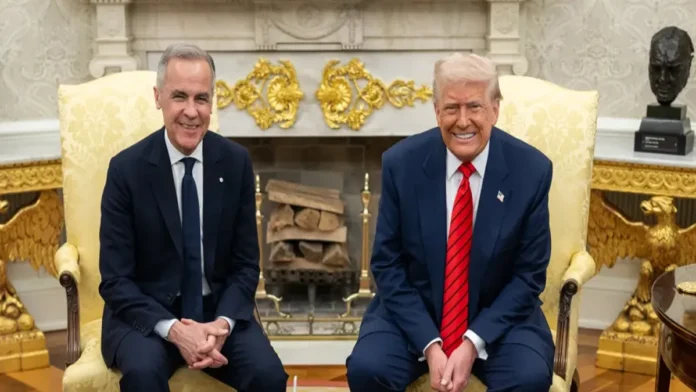
TORONTO, Canada | October 1, 2026 — Mark Carney Nobel Peace Prize speculation has turned the Canadian prime minister’s confrontation with President Donald Trump into a debate about global leadership. Traders briefly pushed Carney to the top of one prediction market, while prominent admirers have backed him for TIME’s Person of the Year. For readers following the headlines, one distinction matters: growing international attention can explain the enthusiasm, but it cannot reveal who will win. The Nobel announcement arrives October 9, and Carney’s place on the committee’s confidential shortlist remains unverified.
INVC NEWS | BEYOND THE HEADLINE
What happened. Why it matters. What comes next.
THE 60-SECOND BRIEF
- Carney briefly led Kalshi’s 2026 Nobel Peace Prize market on Monday, September 28, with an implied probability of 14%, according to the Associated Press.
- His odds subsequently fell. That figure represents a historical market snapshot.
- No public evidence establishes that Carney appears on the Nobel Committee’s confidential shortlist.
- TIME included him in its 2026 TIME100 list. That recognition differs from Person of the Year.
- The Nobel Peace Prize announcement takes place October 9 in Oslo.
What the 14% Figure Actually Tells Readers
Carney’s brief lead on Kalshi generated an attention-grabbing number. However, its meaning requires context.
Kalshi explains that contract prices reflect market participants’ expectations. Buyers and sellers trade on possible outcomes, and their transactions move the displayed probabilities.
Consequently, a 14% implied probability describes what that market priced at a particular moment. It offers no evidence of the Nobel Committee’s preferences, deliberations or votes.
A contender can also lead a market with numerous possible winners while holding a relatively low probability. First place in that setting does not mean traders consider victory close to certain.
The subsequent decline in Carney’s odds reinforces another practical point: readers should check the date attached to any prediction-market figure before treating it as current.
Why Carney’s Message Has Reached Beyond Canada
Carney’s political argument addresses a concern that extends well beyond his country: how can nations protect their independence when larger powers use economic pressure to advance their interests?
In his January 20 address at the World Economic Forum in Davos, Carney argued that countries such as Canada need to strengthen their domestic capabilities and cooperate more closely with partners.
According to the transcript published by the Canadian prime minister’s office, he described tariffs, financial infrastructure and supply chains as potential instruments of coercion. He urged middle powers to build practical coalitions around shared interests.
That argument gives readers a reason to follow the story beyond the awards speculation. Decisions about trade relationships, energy security and international cooperation can shape how governments respond to pressure.
Carney’s approach proposes greater resilience through both domestic strength and partnerships. Whether it delivers lasting results remains a question for policy outcomes, rather than prediction-market rankings.
What Nobel Secrecy Means for the Speculation
The Norwegian Nobel Institute keeps nomination and selection information confidential under rules that generally protect those records for 50 years.
The institute also declines to confirm or deny whether a particular person has received a nomination.
Therefore, the absence of public confirmation cannot establish whether Carney has entered the formal process. Equally, market enthusiasm cannot establish that the committee has shortlisted him.
Nomination, shortlist consideration and selection represent different stages. Headlines that merge them risk giving readers more certainty than the available evidence supports.
For now, the defensible description is straightforward: Carney has attracted Nobel speculation, while his position in the confidential selection process remains unknown.
TIME Recognition Adds Interest, but No Guarantee
TIME has already included Carney among its 100 most influential people of 2026.
In his TIME100 profile, European Central Bank President Christine Lagarde expressed confidence in his ability to help rebuild international cooperation.
That provides documented recognition of Carney’s influence. Nevertheless, TIME100 inclusion does not establish who will receive the magazine’s separate Person of the Year designation.
The Associated Press reported that New York University professor Scott Galloway strongly supported Carney for that distinction. His view represents an admirer’s assessment, rather than an announcement from TIME.
Readers should apply the same distinction to both honors: endorsements explain why someone attracts attention; the awarding institution determines the result.
What Happens Next
The Norwegian Nobel Committee will announce the 2026 Nobel Peace Prize on Friday, October 9, at 11 a.m. CEST in Oslo. That corresponds to 2:30 p.m. IST.
Until then, the clearest way to follow Carney’s prospects is to separate three things: his international influence, traders’ changing expectations and official award decisions.
His growing profile makes the discussion newsworthy. Whether that profile translates into either honor will require an announcement from the institution responsible.