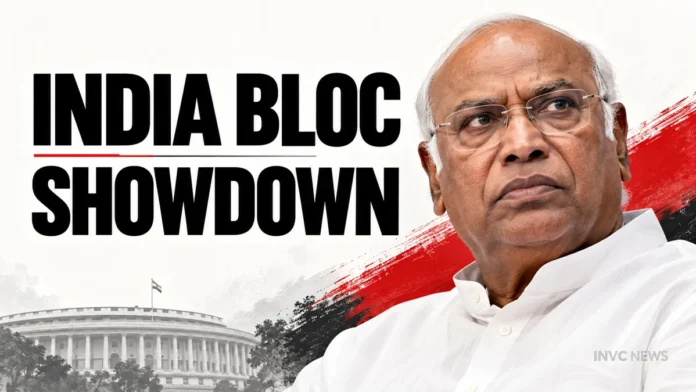
The opposition plans to discuss joint protests and a fresh parliamentary move against CEC Gyanesh Kumar. At stake is how voter-list changes are explained, challenged and scrutinized.
NEW DELHI, India , September 30, 2026 — A political confrontation over India’s election watchdog is heading into a crucial opposition meeting. The INDIA bloc is scheduled to meet in New Delhi today to discuss its next steps over disputed voter-list revisions—one day after Congress President Mallikarjun Kharge demanded Prime Minister Narendra Modi’s resignation and the removal of Chief Election Commissioner Gyanesh Kumar.
For voters, the issue extends beyond who holds office. The controversy raises a practical question: when a name is removed from an electoral roll, how clearly is the decision explained—and what opportunity does the affected person have to challenge it?
Today’s meeting could determine whether opposition parties turn their separate attacks into a coordinated campaign.
What Kharge alleged—and whose resignation he demanded
Addressing the Congress Working Committee on September 29, Kharge alleged that Kumar had acted under pressure from the prime minister. He demanded the CEC’s removal and said Modi should resign on moral grounds.
These are allegations made by the Congress president. They do not establish that the prime minister directed the Election Commission’s decisions or that electoral misconduct has been proven.
The Congress Working Committee also demanded Home Minister Amit Shah’s resignation, widening the party’s confrontation with the government beyond the election watchdog.
What the INDIA bloc plans to discuss
Opposition leaders are expected to consider a joint agitation over alleged irregularities in the Special Intensive Revision, or SIR, of electoral rolls.
A proposed parliamentary notice seeking Kumar’s removal is also expected to come up for discussion. The distinction matters: considering a notice, approving it within the alliance and formally pursuing it in Parliament are separate developments.
The meeting is therefore a test of coordination. A shared demand for resignation would signal political agreement; a common protest schedule and parliamentary strategy would show how the parties intend to pursue it.
At the time of this report, the meeting’s decisions had not been announced.
Why the voter-list dispute matters to readers
Electoral rolls determine who is registered to vote. Their accuracy matters both when eligible voters are omitted and when entries require correction.
The disagreement centers on whether the revision process provides enough transparency and safeguards. Congress has called for accessible electoral data, disclosure of major changes and meaningful opportunities for people to challenge the removal of their names. Kharge has also sought an independent, time-bound inquiry wherever evidence of serious discrepancies emerges.
For a reader, those demands translate into three questions: Was a change explained? Can it be checked? Is there a clear route to contest it?
Those questions offer a more useful measure of the dispute than political accusations alone.
What the Election Commission and BJP have said
The Election Commission has maintained that differences of opinion are a normal part of institutional deliberations. It has also asserted that its orders have legal backing and follow established statutory procedures.
The BJP has pushed back against Congress’s campaign. Party leader Smriti Irani accused Congress of undermining constitutional institutions and questioned its position on removing deceased or duplicate voters from electoral rolls.
That response sets out the competing arguments: Congress alleges that eligible voters face exclusion and demands greater scrutiny; the BJP challenges the opposition’s motives and defends the need for accurate rolls. Neither argument, by itself, resolves an individual disputed entry.
The developments to watch next
The strongest indicator emerging from today’s meeting will be the specificity of its decisions.
Readers should watch for whether the alliance approves a parliamentary notice, announces coordinated protests or identifies particular electoral procedures it wants changed. Any subsequent response from the government or Election Commission will also be important.
Kharge’s resignation demand has raised the political stakes. The next question is whether the INDIA bloc produces a concrete plan—and whether that plan brings greater clarity to the voter-list concerns at the center of the controversy.