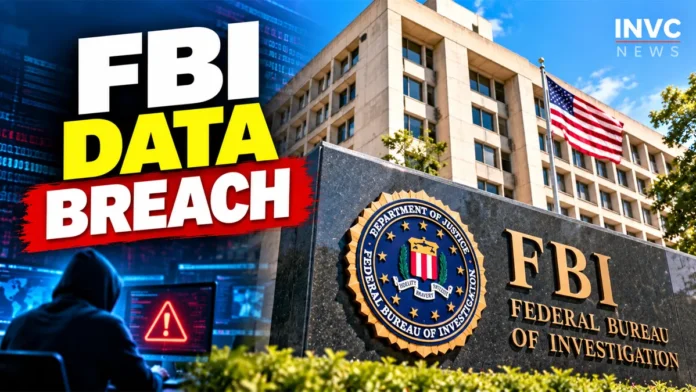
WASHINGTON, United States | September 30, 2026 — The FBI employee data breach has raised concerns that sensitive personal records could expose agents and their families to threats extending far beyond identity theft. Hackers claim they obtained information on thousands of current and former employees through the bureau’s recruitment infrastructure. Reports describe records containing home addresses, family contacts, and sensitive work assignments. However, one crucial correction matters: available evidence identifies Shiny Hunters as the group claiming responsibility and does not establish that Iran carried out this attack.
INVC NEWS | BEYOND THE HEADLINE
What happened. Why it matters. What comes next.
THE 60-SECOND BRIEF
- The FBI is investigating claims involving its FBIJobs.gov recruitment portal.
- The bureau has not publicly established the precise entry point.
- Reported exposure includes personal identifiers and sensitive employment information.
- The full number of affected people remains uncertain.
- An Iranian role has not been established in the evidence reviewed for this report.
What Happened
ShinyHunters claimed responsibility for accessing FBI personnel information. The group’s allegations prompted an investigation involving the bureau and outside providers supporting its recruitment portal.
In its September 23 public statement, the FBI acknowledged the claims but said investigators had not determined whether the breach originated within its own enterprise or a third-party system.
That distinction matters. A recruitment website can depend on several connected services. Identifying which component failed is essential to understanding both the intrusion and its reach.
What Information Appears in the Records?
Reporting on a sample containing approximately 5,000 rows described names, addresses, telephone numbers, birth dates, Social Security numbers, and emergency contacts. The records also included assignments involving intelligence and surveillance work.
Some details underwent independent verification, but the entire dataset and the accuracy of every assignment remain unconfirmed.
Separately, reporting described medical and psychological evaluation documents. Some files underwent partial authentication; the FBI declined to comment on those records.
Therefore, readers should distinguish evidence found in reviewed samples from broader claims about everything the hackers possess.
How Did Hackers Get In?
The precise answer remains unresolved.
The FBI’s public statement did not identify a confirmed vulnerability or establish which organization’s system provided the initial access. Consequently, describing a specific exploit as the proven cause would go beyond the bureau’s findings.
There is relevant technical context. In a September 25 report, Mandiant and Google Threat Intelligence Group documented a broader ShinyHunters campaign targeting a vulnerability in Oracle PeopleSoft, software that organizations use for business administration.
Researchers found that attackers adapted their approach to bypass certain web application firewall rules. They stressed that filtering traffic did not replace installing the security patch.
However, that research does not establish that the same vulnerability caused the FBI incident. The broader campaign and the bureau’s specific investigation must remain separate until evidence connects them.
Why It Matters: A Home Address Can Become a Security Risk
An exposed address carries particular consequences for personnel handling sensitive investigations.
Reports describe concerns among agents that publishing their home locations could endanger family members, especially while the agents travel. Information connecting named employees to sensitive units can also erode the relative anonymity their work requires.
The potential consequences extend beyond fraudulent financial activity. As a risk assessment, combining personal identifiers, family details, and professional responsibilities could help an adversary construct convincing impersonation attempts or identify pressure points.
That possibility does not mean such exploitation has already occurred. It explains why the sensitivity of the records matters as much as their volume.
What Each Side Says
The FBI says it is investigating aggressively and coordinating with supporting providers to reduce risk.
Meanwhile, ShinyHunters demanded changes to an earlier FBI advisory about the group. It subsequently said it had no intention of publishing the stolen information.
On September 29, FBI Cyber Division leader Brett Leatherman publicly urged the hackers to contact authorities, citing a Dutch arrest connected to the wider ShinyHunters investigation.
Neither the group’s assurances nor an arrest establishes that investigators have recovered every copy of the data.
Numbers That Matter
| Figure or date | What it means |
| Approximately 5,000 rows | Size of a reported sample, not a confirmed victim total |
| September 23 | Date of the FBI’s public statement acknowledging the claims |
| September 25 | Date of the separate PeopleSoft campaign report |
| September 29 | Date of the FBI official’s public appeal to the hackers |
These figures describe different parts of the developing story. They should not be combined into a definitive measure of the breach.
The Bigger Picture
The incident highlights a difficult security problem: administrative systems can hold information with operational consequences.
A personnel record may look routine in isolation. When it links an employee’s identity, relatives, and responsibilities, its value to a hostile actor can increase substantially.
The editorial implication is clear: protecting recruitment and personnel infrastructure deserves attention alongside protecting investigative systems.
What Happens Next
Investigators still need to establish the entry point, the complete scope, and which records remain accurate. Those answers will determine how the bureau assesses individual risks and strengthens the affected systems.
INVC NEWS Bottom Line
The central concern is whether exposed records can help criminals or hostile actors identify, impersonate, or pressure FBI personnel and their families. The reported information warrants serious scrutiny. Attribution also requires evidence: Iran’s involvement remains unestablished in this case.