NEW DELHI, India | September 26, 2026 —
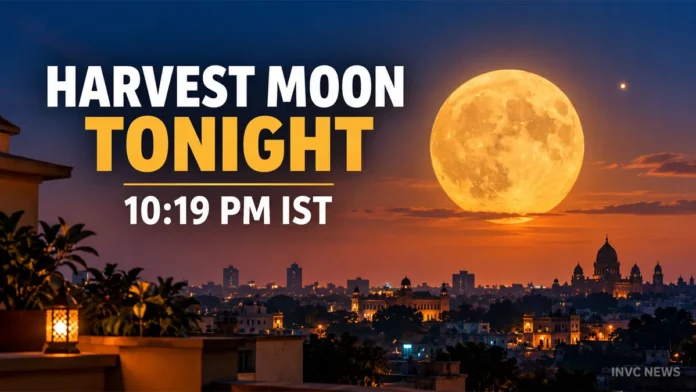
The Harvest Moon 2026 will light up the sky across India tonight, with the September Full Moon reaching its exact astronomical peak at 10:19 PM IST on Saturday.
The Moon will rise around sunset in many Indian cities, giving skywatchers several hours to enjoy one of the most visually striking full moons of the year.
No telescope or special equipment is required.
For most people, the best viewing experience will begin shortly after moonrise, when the Moon appears low on the eastern horizon and can take on a warm yellow, orange or reddish tint because its light passes through more of Earth’s atmosphere.
THE 60-SECOND BRIEF
Event: September Harvest Moon 2026
Date: September 26, 2026
Peak Full Moon: 10:19 PM IST
Delhi moonrise: About 5:53 PM
Mumbai moonrise: About 6:14 PM
Kolkata moonrise: About 5:09 PM
Best direction to look: East shortly after sunset
Equipment needed: None
Special feature: Saturn will also be visible near the Moon in the night sky.
Why Is It Called the Harvest Moon?
The Harvest Moon is the Full Moon that occurs closest to the September equinox.
This year, the September equinox occurred only a few days before tonight’s Full Moon.
That makes the September 26 Full Moon the Harvest Moon of 2026.
The name comes from farming traditions in the Northern Hemisphere.
Around the Harvest Moon, the Moon rises relatively close to sunset on successive evenings.
Historically, that provided farmers with additional natural light after sunset during the harvest season.
What Time Is the Harvest Moon Tonight?
The Moon reaches its exact Full Moon phase at:
10:19 PM IST on September 26, 2026
This timing refers to the precise astronomical moment when the Moon is positioned opposite the Sun as seen from Earth.
It does not mean you must wait until 10:19 PM to see it.
The Moon will already be visible for several hours before the exact peak in most parts of India.
Moonrise Time in Major Indian Cities
Moonrise varies from city to city.
Here are approximate timings for September 26:
New Delhi: 5:53 PM
Mumbai: 6:14 PM
Kolkata: 5:09 PM
Actual visibility can vary depending on clouds, buildings, hills, pollution and the observer’s exact location.
For the most dramatic view, look toward an open eastern horizon shortly after local moonrise.
When Is the Best Time to See It?
There are two good viewing windows.
The first is immediately after moonrise.
At this time, the Moon sits low on the horizon and may appear larger and more colorful.
The second is around 10:19 PM IST, when it reaches the exact Full Moon phase.
Visually, however, the Moon will look almost completely full for much of the night.
So viewers do not need to worry if clouds block the sky at the precise peak time.
Why Can the Moon Look Orange or Red?
A Full Moon near the horizon often appears yellow, orange or reddish.
This is caused by Earth’s atmosphere.
When the Moon is low in the sky, its light travels through a longer path of air than when it is overhead.
Shorter blue wavelengths are scattered more strongly, allowing more yellow and red light to reach the observer.
This is the same basic reason sunsets can appear orange or red.
The color does not mean the Moon itself has changed.
Is This a Lunar Eclipse?
No.
Tonight’s Harvest Moon is not a lunar eclipse.
A lunar eclipse happens when Earth moves directly between the Sun and the Moon and Earth’s shadow falls on the lunar surface.
Tonight’s event is a normal Full Moon.
That means there are no special safety precautions required for viewing.
Unlike a solar eclipse, it is completely safe to look directly at the Full Moon.
Saturn Adds Another Reason to Look Up
Saturn will also be visible near the Moon tonight.
That makes September 26 especially interesting for casual skywatchers.
The bright Full Moon will be easy to identify.
Saturn should appear as a bright, steady point of light nearby.
Unlike stars, planets generally twinkle less because they appear as small disks rather than point-like sources of light.
Binoculars may improve the view, although they are not necessary.
Why the Moon May Look Bigger Near the Horizon
Many people feel that the Moon looks unusually large when it first rises.
This is known as the Moon illusion.
The Moon is not actually much larger at the horizon.
Our brains compare it with familiar objects such as buildings, trees and mountains, making it appear larger than when it is high in an empty sky.
That effect can make moonrise especially impressive for photography.
Best Way to Photograph the Harvest Moon
A smartphone can capture a good image if conditions are clear.
Try these simple steps:
Use the phone’s telephoto lens if available.
Tap the Moon on the screen and reduce exposure.
Avoid excessive digital zoom.
Include a building, tree or skyline for scale.
Keep the phone steady or use a tripod.
Moonrise often produces better photographs than later in the night because the sky still contains some twilight color.
Is the Harvest Moon Rare?
A Harvest Moon happens every year.
What changes is the month and exact timing.
Most Harvest Moons occur in September, although occasionally the Full Moon closest to the equinox falls in October.
The 2026 event is particularly easy to follow in India because the Full Moon reaches peak illumination during the evening.
Harvest Moon and Purnima Are Not Exactly the Same Thing
There is an important distinction between the astronomical Full Moon and the Hindu lunar-calendar concept of Purnima.
The astronomical Full Moon is a precise instant determined by the position of the Sun, Earth and Moon.
Purnima is a lunar tithi calculated according to the Hindu calendar.
Its beginning and ending times can therefore differ from the exact astronomical Full Moon timing.
The two are closely related, but they are not technically identical.
Does the Harvest Moon Have an Astrological Meaning?
Astrological traditions often associate Full Moons with completion, reflection and emotional intensity.
Some astrology systems interpret tonight’s Full Moon as a period for closing unfinished matters and reassessing relationships or personal goals.
These interpretations belong to astrology rather than astronomy.
From a scientific perspective, tonight’s event is a predictable phase of the Moon caused by the geometry of the Sun, Earth and Moon.
How to Watch From India
You do not need to travel anywhere special.
A rooftop, terrace, balcony, park or open area with a clear eastern view should be enough.
Try to move away from bright streetlights if possible.
Although the Full Moon itself is bright enough to see from cities, darker surroundings can make the overall night sky more impressive.
Cloud cover will be the biggest factor affecting visibility.
THE BIGGER PICTURE
The Harvest Moon is a useful reminder that many traditional sky names come from practical observations made over centuries.
The event is not scientifically different from other Full Moons.
What makes it special is its timing near the equinox and its historical connection with the harvest season.
Tonight, that old tradition meets modern skywatching.
Millions of people across India will be able to see the same lunar event without any equipment at all.
WHAT HAPPENS NEXT
The Moon will remain nearly full through the following night.
After tonight, it will gradually move into its waning phase.
The next major lunar phase will be the Third Quarter on October 3.
The next New Moon will occur on October 10.
For tonight, however, the focus is entirely on the eastern sky.
INVC NEWS Bottom Line
The Harvest Moon 2026 peaks tonight at 10:19 PM IST.
You do not need a telescope.
You do not need special glasses.
Simply find a place with a clear view of the eastern horizon after sunset.
For the most dramatic view, watch the Moon soon after it rises.
For the exact astronomical Full Moon moment, look up at 10:19 PM IST.
And if the sky stays clear, look nearby for Saturn too.
What happened. Why it matters. What comes next.