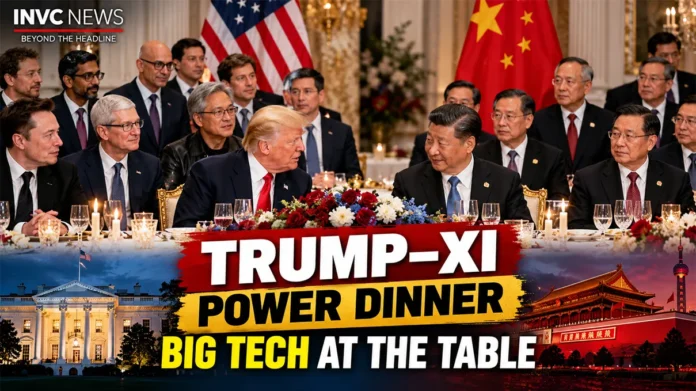
WASHINGTON, United States | September 25, 2026 — Donald Trump and Xi Jinping may have been the two most powerful figures at the White House state dinner, but the guest list told another story entirely.
America arrived with corporate firepower.
Artificial intelligence, semiconductors, digital platforms, banking, aerospace, defence, energy and pharmaceuticals were represented by some of the biggest names in US business.
China’s side looked very different.
Beijing was represented primarily by senior Communist Party and government officials rather than an equivalent parade of corporate executives.
That contrast turned a ceremonial evening into a revealing snapshot of how the world’s two largest economies organise influence — and how deeply technology, business and national strategy now shape US-China relations.
INVC NEWS | BEYOND THE HEADLINE
Who was there. Why it matters. What the guest list reveals.
THE 60-SECOND BRIEF
US President Donald Trump hosted Chinese President Xi Jinping at a White House state dinner following their high-level meeting.
The American guest list included some of the most powerful figures in technology, artificial intelligence, semiconductors, banking, aerospace, defence, energy and consumer industries.
Among them were Elon Musk, Jensen Huang, Mark Zuckerberg, Sam Altman, Satya Nadella, Sundar Pichai, Tim Cook, Jeff Bezos, Lisa Su, Jamie Dimon, Larry Fink and Jane Fraser.
Senior figures from Boeing, Lockheed Martin, GE Aerospace, ExxonMobil and other major companies were also present.
China’s delegation, by contrast, was led largely by senior state and Communist Party officials including Cai Qi, Wang Yi, Vice Premier He Lifeng and Commerce Minister Wang Wentao.
The difference in the two delegations gave the dinner a strong economic and strategic dimension.
Silicon Valley Was Everywhere
Few sectors matter more to the US-China relationship than technology.
That reality was visible throughout the room.
Nvidia CEO Jensen Huang attended.
Meta chief Mark Zuckerberg was there.
Microsoft CEO Satya Nadella, Google CEO Sundar Pichai, OpenAI CEO Sam Altman, AMD chief Lisa Su and Qualcomm CEO Cristiano Amon also joined the gathering.
Apple CEO Tim Cook and Dell Technologies founder Michael Dell were among the guests.
Elon Musk attended, while Amazon founder Jeff Bezos was also on the guest list.
Together, these executives represent companies sitting at the centre of the global race for artificial intelligence, advanced chips, cloud computing, smartphones, digital platforms and next-generation technology infrastructure.
China matters to many of them as a market, manufacturing base, competitor, supplier or regulator.
That made their presence far more than ceremonial.
Semiconductor Chiefs Had a Powerful Presence
The semiconductor sector stood out immediately.
Nvidia’s Jensen Huang, AMD’s Lisa Su, Micron’s Sanjay Mehrotra and Qualcomm’s Cristiano Amon were among the prominent names.
Their presence mattered because chips sit at the centre of one of the most sensitive disputes between Washington and Beijing.
Advanced semiconductors power artificial intelligence, military systems, data centres, smartphones and industrial technologies.
Washington increasingly treats high-end chips as a national-security issue.
Beijing, meanwhile, has made technological self-reliance a strategic priority.
That means the executives most exposed to semiconductor restrictions, export controls and China-related policy decisions were sitting within the diplomatic orbit of both presidents.
AI Leaders Move Closer to Geopolitical Power
The dinner also highlighted how quickly artificial intelligence has moved from Silicon Valley into the heart of international politics.
OpenAI’s Sam Altman joined leaders from Microsoft, Google, Meta and Nvidia.
These companies are no longer merely competing for customers.
They are competing over computing power, advanced processors, data infrastructure and the development of increasingly capable AI systems.
Governments now see those same technologies through the lens of economic competitiveness and national security.
That changes the significance of a state dinner.
When presidents sit in the same room as the executives controlling crucial AI infrastructure, the boundary between business diplomacy and strategic diplomacy becomes increasingly difficult to see.
Wall Street Was Also at the Table
Technology executives were only one part of the American business presence.
Wall Street had substantial representation.
JPMorgan Chase CEO Jamie Dimon attended.
Citigroup CEO Jane Fraser was present.
BlackRock CEO Larry Fink and Blackstone co-founder Stephen Schwarzman also joined the gathering.
Goldman Sachs was represented by senior leadership, while the New York Stock Exchange and major payment companies also had executives at the dinner.
Their presence reflected another major dimension of the US-China relationship.
Trade tensions do not stop at tariffs.
They affect capital markets, investment flows, currency expectations, multinational earnings and long-term business confidence.
A shift in Washington-Beijing relations can therefore ripple rapidly through global finance.
Aerospace, Defence and Energy Chiefs Add Another Layer
The guest list extended well beyond technology and banking.
Boeing CEO Kelly Ortberg attended.
Lockheed Martin CEO Jim Taiclet was also present.
GE Aerospace chief Larry Culp joined them.
ExxonMobil CEO Darren Woods represented one of America’s biggest energy companies.
General Motors CEO Mary Barra was also among the major corporate figures.
These sectors connect directly with some of the most strategic issues in US-China relations.
Aerospace intersects with supply chains and aviation.
Defence links directly to national security.
Energy touches global trade and industrial competitiveness.
Automotive companies increasingly compete over electric vehicles, batteries and manufacturing technology.
The dinner therefore brought together many of the industries most exposed to changes in US-China policy.
China Brought Officials, Not a Rival CEO Parade
The Chinese side looked noticeably different.
President Xi Jinping was accompanied primarily by senior government and Communist Party officials rather than a comparable group of major Chinese corporate leaders.
Cai Qi, one of China’s most powerful Communist Party officials, was among the prominent attendees.
Foreign Minister Wang Yi also joined the delegation.
Vice Premier He Lifeng, a central figure in China’s economic policymaking, was present.
Commerce Minister Wang Wentao and Finance Minister Lan Fo’an were among other senior officials.
China’s ambassador to the United States, Xie Feng, also attended.
The contrast with the US side was hard to miss.
America brought many of its most influential corporate leaders into the room.
China relied much more heavily on officials representing the party and the state.
Why the Contrast Matters
The difference does not mean that one country values business more than the other.
It reflects different systems of economic power.
The United States relies heavily on privately controlled companies that can become global economic forces in their own right.
China’s economic model places a stronger role on state planning, party leadership and government coordination.
Major Chinese corporations remain enormously important.
However, strategic economic policy ultimately operates within a political structure in which the Communist Party maintains substantial influence.
The dinner therefore offered a visual representation of two different models.
On one side stood corporate executives beside government leaders.
On the other stood senior officials representing a tightly coordinated political and administrative system.
The CEOs Have Plenty at Stake in China
For many American companies represented at the dinner, China is impossible to ignore.
Apple continues to depend heavily on Asian manufacturing networks and the Chinese consumer market.
Tesla operates major production capacity in Shanghai.
Nvidia and other semiconductor companies remain affected by restrictions surrounding advanced chips.
US financial institutions continue to watch opportunities and regulatory developments in China.
Aerospace companies remain exposed to shifts in trade and procurement.
Industrial firms depend on supply chains that stretch across the Pacific.
These executives were therefore not simply prestigious dinner guests.
Many run companies whose revenues, manufacturing networks and future strategies can change dramatically depending on decisions made in Washington and Beijing.
Business and National Security Are Now Intertwined
The Trump-Xi dinner also underlined a broader shift in the global economy.
Technologies once treated as ordinary commercial products increasingly carry national-security significance.
Advanced chips are one example.
Artificial intelligence is another.
Cloud infrastructure, communications networks, aerospace technology and energy systems are also moving into the same category.
Governments are increasingly asking not only which company makes the best technology, but also who controls it, where it is manufactured and which countries should be allowed access.
That has transformed major corporations into important players in geopolitical competition.
What the Dinner Says About US-China Relations
The state dinner followed a high-stakes Trump-Xi meeting involving a relationship still shaped by disagreements over trade, technology and security.
Ceremonial diplomacy, however, serves its own purpose.
State dinners allow leaders to demonstrate prestige, build informal relationships and place government officials beside powerful figures from business and society.
This dinner did something more.
It placed much of America’s technological and financial leadership inside the same diplomatic setting as China’s political leadership.
That made the event a reflection of where US-China competition is heading.
The rivalry is no longer simply about tariffs or trade deficits.
It increasingly involves AI, chips, financial power, industrial capacity, supply chains and access to strategic technologies.
One Room, Two Different Models of Power
The most revealing part of the evening may have been the composition of the room itself.
The American side showcased executives controlling companies that shape global technology, finance, aerospace and energy.
The Chinese side showcased officials who help shape policy across one of the world’s most powerful state systems.
That contrast does not automatically tell us which approach is stronger.
It does show how differently influence is organised.
The US model placed private enterprise visibly alongside political power.
China presented a delegation in which state and party leadership remained dominant.
The Bigger Picture
US-China competition has entered a phase in which economics and geopolitics can no longer be separated easily.
An AI company can become central to national-security policy.
A chipmaker can become part of a trade dispute.
An energy company can matter during a geopolitical crisis.
A technology platform can face questions about data, regulation and strategic influence.
An industrial company can find its entire supply chain affected by government decisions.
That is why the Trump-Xi state dinner mattered beyond ceremony.
The guest list itself showed where global power is increasingly concentrated.
What Happens Next
Attention will now shift from ceremony to implementation.
Businesses will watch closely for developments involving tariffs, export controls, semiconductor restrictions, investment rules and market access.
Technology companies will focus particularly on policies affecting advanced chips and artificial intelligence.
Financial institutions will monitor investment flows and broader economic relations.
Meanwhile, Beijing will continue pushing technological self-reliance while attempting to protect access to global markets and supply chains.
The dinner may have been formal.
The economic competition surrounding it is anything but.
INVC NEWS Bottom Line
The Trump-Xi state dinner brought together much more than two presidents.
Elon Musk, Jensen Huang, Sam Altman, Mark Zuckerberg, Satya Nadella, Sundar Pichai, Tim Cook, Jeff Bezos, Jamie Dimon, Larry Fink and other corporate leaders placed a remarkable concentration of American technological and financial power inside one room.
China answered with senior Communist Party and government officials rather than an equivalent CEO delegation.
The contrast offered a revealing picture of the next phase of US-China relations.
AI, chips, finance, energy, industry and political power are no longer separate conversations. They are already sitting at the same table.