UNITED NATIONS, United States | September 24, 2026 —
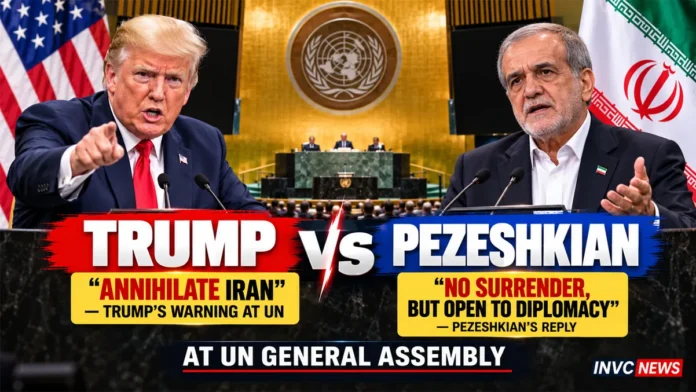
The United Nations General Assembly has become the stage for a sharp confrontation between the United States and Iran, with President Donald Trump threatening that he could “annihilate” the Islamic Republic if negotiations fail and Iranian President Masoud Pezeshkian responding that Tehran will not surrender under pressure.
Yet beneath the escalating rhetoric, both sides are still leaving a narrow door open for diplomacy.
Trump delivered his warning during his September 22 address to the 81st United Nations General Assembly, while Pezeshkian responded from the same podium on September 23.
The exchange captures the central contradiction in the current US-Iran crisis: both governments are publicly projecting strength while negotiations continue through intermediaries.
Trump Tells UN He Faces a ‘Big Decision’ on Iran
Trump used his UN address to defend his administration’s military and economic pressure on Tehran.
He said the United States had prevented Iran from obtaining a nuclear weapon and argued that international pressure should continue until Tehran agrees to a settlement.
Trump then presented Iran with two starkly different possibilities.
He said a deal could allow Iran to rebuild and become more prosperous.
But if negotiations fail, Trump warned that he could “annihilate the Islamic Republic” and do so quickly.
The language represented one of Trump’s strongest public threats against Tehran during the current conflict.
At the same time, Trump predicted that Washington could eventually reach a peace agreement with Iran after the November 3 US midterm elections.
That combination — an explicit military threat alongside an expectation of negotiations — set the tone for the diplomatic confrontation that followed.
Pezeshkian Fires Back: Iran Will Not Bow
One day later, Iranian President Masoud Pezeshkian stood before the General Assembly and directly rejected Trump’s message.
Pezeshkian accused the US president of displaying what he called a “bullying mentality.”
He said pressure and threats would strengthen Iran’s determination rather than force the country to surrender.
His central message was clear: Iran is willing to negotiate, but it will not accept surrender as the price of negotiations.
Pezeshkian repeated several times that Tehran remained prepared to pursue a diplomatic settlement with Washington.
However, he argued that negotiations could not succeed if one side entered the process while threatening the other with destruction.
US Delegation Walks Out
The diplomatic tension was visible inside the UN chamber.
The United States delegation walked out at the beginning of Pezeshkian’s speech, according to Reuters.
The US mission to the United Nations did not immediately provide an explanation for the walkout.
The move added another symbolic layer to an already confrontational exchange.
Pezeshkian continued his address after the American delegation left.
Iran Says It Does Not Want Nuclear Weapons
Iran’s nuclear programme remained at the heart of Pezeshkian’s speech.
The Iranian president said Tehran does not intend to build nuclear weapons.
At the same time, he insisted Iran would not surrender what it describes as its right to peaceful nuclear technology.
That distinction has remained central to Iran’s position throughout its dispute with the United States and Western governments.
Washington has repeatedly argued that Iran must provide stronger guarantees that its nuclear activities cannot be used to develop weapons.
Tehran says its programme is intended for peaceful purposes.
The two sides therefore remain divided not only over uranium enrichment, but over verification, sanctions and what restrictions Iran would accept under any future agreement.
Talks Continue — But the Two Sides Remain Far Apart
Despite the speeches, diplomacy has not stopped.
Trump said US envoys Steve Witkoff and Jared Kushner had held what he initially described as a productive meeting connected to Iran.
He later clarified that they had met mediators representing Iran rather than Iranian officials directly.
A senior Iranian official subsequently told Reuters that Tehran and Washington remained far apart over the terms required to end the conflict, but said diplomatic efforts needed to continue.
That means neither side has closed negotiations completely.
But neither has shown signs of accepting the other side’s core demands.
Strait of Hormuz Becomes Another Pressure Point
Pezeshkian also raised the Strait of Hormuz, one of the world’s most important energy shipping routes.
He argued that Iran could not accept a situation in which other countries continued to benefit from the strategic waterway while Iranian shipping faced restrictions.
He also warned that expanding the war and permanently deploying hostile military forces in the region would not produce peace.
The Strait of Hormuz carries roughly one-fifth of global oil and liquefied natural gas flows.
That makes any disruption in the area capable of affecting energy prices far beyond the Middle East.
Oil Markets React to the Confrontation
Energy markets have already responded to the latest developments.
Brent crude settled $3.83 higher at $103.08 a barrel on September 23, a gain of about 3.9%.
US West Texas Intermediate crude gained $1.64 to settle at $92.16.
Reuters reported that traders were weighing Pezeshkian’s refusal to surrender and Trump’s earlier threat against Iran while monitoring prospects for diplomacy.
For India, the oil-price reaction matters immediately.
India imports most of the crude oil it consumes, meaning sustained prices above $100 can increase pressure on inflation, the rupee, transport costs and government finances.
Trump Wants Other Countries to Isolate Iran
Trump also used his UN address to urge other countries to join Washington’s economic pressure campaign.
He called for greater international isolation of Tehran in an effort to push Iranian leaders toward negotiations.
The United States has already expanded sanctions across Iran’s financial, energy and aviation networks.
Iran argues that such pressure amounts to economic coercion and says meaningful negotiations cannot take place while Washington simultaneously increases sanctions.
That disagreement remains one of the biggest barriers to a settlement.
Pezeshkian’s Message: Diplomacy Without Surrender
Pezeshkian attempted to draw a distinction between compromise and capitulation.
His speech did not reject negotiations.
Instead, he presented Tehran as willing to discuss an end to the conflict while refusing demands it considers equivalent to surrender.
For Washington, however, any agreement would likely require strong restrictions and verification mechanisms around Iran’s nuclear programme.
That means the two governments can agree that diplomacy should continue while remaining deeply divided over what a final agreement would actually contain.
The UN Showdown Reveals Two Messages at Once
The speeches from Trump and Pezeshkian contained two competing messages.
The first was confrontation.
Trump warned that Iran could face destruction if negotiations fail.
Pezeshkian responded that threats would not force Iran to bow.
But the second message was diplomacy.
Trump said he still believes a deal can be reached.
Pezeshkian repeatedly said Iran remains open to negotiations.
That makes the next stage particularly important.
The world will now watch whether the rhetoric coming from the UN podium is followed by another round of threats — or whether mediators can turn the narrow diplomatic opening into negotiations capable of reducing the risk of a wider Middle East conflict.