TEHRAN, Iran | September 24, 2026 —
Iran has issued one of its sharpest warnings yet to neighbouring countries as sweeping U.S. sanctions begin disrupting Iranian international flights.
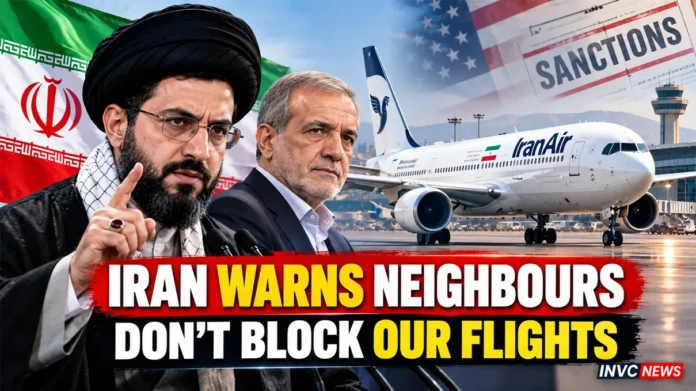
Mohsen Rezaei, secretary of Iran’s Supreme National Security Council, warned regional governments against helping Washington restrict Iranian airlines, saying Tehran would not simply watch if neighbouring states joined the U.S. pressure campaign.
“If you stand alongside the United States, we will not stand by and watch,” Rezaei said in remarks carried by Iranian state television.
He further warned that if regional countries help stop Iranian flights, their own airports could also be rendered unable to operate.
The comments mark a significant escalation in the aviation dispute between Tehran and Washington.
US Sanctions Begin Hitting Iranian Flights
The latest confrontation follows a major expansion of U.S. sanctions against Iran’s aviation sector.
The U.S. Treasury Department sanctioned 27 Iranian airlines earlier this month and targeted additional companies and intermediaries accused of supporting Iran’s aviation network.
Washington says Iran has used commercial aviation networks to transport weapons, military personnel and sensitive equipment.
The U.S. has also warned foreign companies that providing fuel, ground handling, ticket sales or other services to sanctioned Iranian carriers could expose them to secondary sanctions.
For airlines, airports and service providers outside Iran, that creates a difficult choice: continue serving Iranian carriers and risk U.S. financial penalties, or cut commercial ties with them.
Flights to Several Regional Destinations Disrupted
The effect is already being felt.
Flights connecting Iran with several regional destinations have faced cancellations or restrictions.
Available reports indicated disruptions involving Baghdad, Muscat, Azerbaijan, Georgia and Qatar, although the exact situation continues to change from airport to airport.
Iranian aviation authorities had earlier said Baghdad and Muscat would stop accepting some Iranian flights.
Tehran then explored redirecting Baghdad-bound passengers toward Najaf, an important destination for Iranian pilgrims.
Flights to some destinations in Türkiye, the United Arab Emirates, China and Armenia were still operating or scheduled at different points during Wednesday.
That uneven picture shows that Washington has not imposed a direct worldwide legal ban on Iranian aircraft.
Instead, it is using the threat of secondary sanctions to pressure airports, service providers and financial institutions outside the United States.
Rezaei Sends Direct Message to Iran’s Neighbours
Rezaei’s statement dramatically raised the stakes.
Iran’s message was aimed primarily at neighbouring governments whose airports remain essential to Iranian travellers.
His warning suggested that Tehran could respond if those countries actively cooperate with Washington’s effort to isolate Iranian aviation.
However, Iranian officials did not publicly explain what specific action Tehran could take against foreign airports.
That distinction is important.
Rezaei delivered a threat of retaliation, but no detailed operational plan or specific target list was announced.
China Rejects US Measures
China has taken a different position.
Beijing has criticised unilateral U.S. sanctions on Iran and described such measures as unlawful.
Iranian flights to China were still operating after the new sanctions took effect, including services involving Guangzhou and Shanghai.
That provides Tehran with at least one significant international aviation connection at a time when access to several nearby destinations is shrinking.
Russia and China have generally opposed Washington’s use of unilateral sanctions against Iran.
Why the US Is Targeting Iranian Airlines
The Trump administration says Iran’s aviation industry is not purely civilian.
The U.S. Treasury argues that some Iranian carriers and associated networks have supported the Islamic Revolutionary Guard Corps and helped move personnel, weapons and other sensitive cargo.
Mahan Air has been under U.S. sanctions for years.
The new measures expand pressure across almost all remaining active Iranian carriers and the international companies that help them operate.
That means sanctions can affect far more than an airline itself.
Fuel suppliers, ticket agents, ground-handling firms, maintenance providers, banks and airport contractors could all face potential exposure.
Ordinary Iranian Travellers Could Feel the Biggest Impact
The political confrontation has an immediate civilian consequence.
International travel for ordinary Iranians is becoming more difficult.
Fewer direct flights can mean longer journeys, more expensive tickets and greater dependence on land borders or connecting airports.
Students, business travellers, families and religious pilgrims could all face disruption.
For Iraq and Iran in particular, aviation links support significant religious tourism between the two countries.
Najaf attracts large numbers of Iranian pilgrims every year.
A prolonged disruption could therefore affect airlines, hotels, travel companies and local businesses on both sides of the border.
Turkish and Gulf Connections Under Pressure
Türkiye and Gulf hubs have traditionally been important gateways for Iranian passengers seeking connections to Europe, Asia and other regions.
Any significant reduction in those routes would further isolate Iran’s aviation network.
Iranian carriers already face long-standing difficulties obtaining aircraft, spare parts, maintenance services and international financing because of sanctions.
The newest U.S. measures add pressure on the overseas infrastructure that keeps international routes functioning.
That could prove more damaging than sanctions aimed only at individual airlines.
This Is Not a Traditional ‘Airline Ban’
The phrase “U.S. airline ban” needs context.
Washington cannot directly order every foreign country to close its airspace to Iranian aircraft.
Instead, the United States is using financial sanctions and the global reach of the dollar-based system.
Foreign businesses that provide significant support to sanctioned Iranian carriers can risk losing access to the U.S. financial system or face other penalties.
That gives Washington considerable leverage even outside U.S. territory.
The practical result can resemble a ban if airports and companies decide that continuing to serve Iranian airlines carries too much financial risk.
Iran-US Conflict Expands From Sea to Air
The aviation confrontation is unfolding alongside a broader crisis between Tehran and Washington.
Iran has faced pressure on maritime trade, financial networks and international transportation.
The Strait of Hormuz remains another major source of tension.
Tehran has linked reopening and normalising activity in the Strait to changes in U.S. military and economic pressure.
The new aviation measures now open another front in the economic confrontation.
For Iran, international air connections represent both an economic lifeline and a symbolic measure of how isolated the country has become.
What Happens Next?
Three questions now matter.
First, how many regional governments will enforce the U.S. sanctions in practice?
Second, will Tehran act on Rezaei’s warning if more airports refuse Iranian aircraft?
Third, can diplomacy reduce tensions before aviation links shrink further?
For now, the picture remains fluid.
Some Iranian routes have stopped.
Others remain active.
China openly opposes the U.S. measures.
And neighbouring countries face growing pressure from both Washington and Tehran.
What began as a sanctions battle over Iranian airlines is rapidly turning into a wider regional test of political and economic loyalties.