NEW DELHI, India | September 24, 2026 —
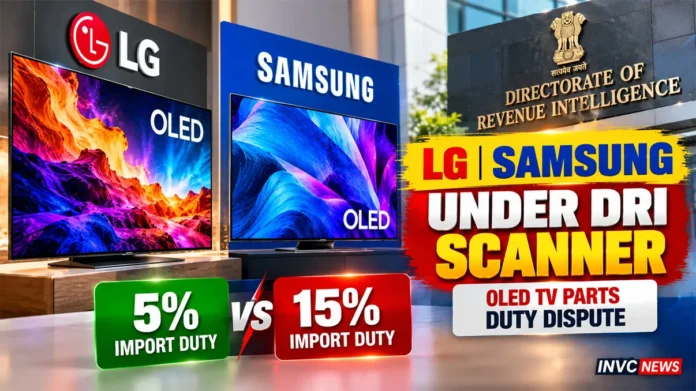
LG Samsung OLED TV tariff investigation India has put two of the country’s biggest premium television brands under regulatory scrutiny as the Directorate of Revenue Intelligence examines whether the companies paid a lower customs duty on imported OLED display components.
The investigation centres on imported glass display parts known as “open cells”, which LG Electronics and Samsung use to manufacture premium OLED televisions in India.
According to people familiar with the investigation, Indian authorities believe these OLED components should have attracted a 15% import duty.
However, the companies reportedly imported them under a concessional 5% tariff classification used for certain LCD and LED display parts.
That 10-percentage-point gap now sits at the heart of the dispute.
Crucially, the investigation remains ongoing. Authorities have not announced a final finding that either company evaded tax.
Why Is DRI Investigating LG and Samsung?
The dispute revolves around how OLED display components should be classified under India’s customs tariff system.
LCD and LED television display parts have historically received a concessional customs duty rate of 5% under the relevant framework.
OLED technology, however, uses a different display architecture.
The Directorate of Revenue Intelligence reportedly believes that the lower 5% concession does not automatically extend to OLED open cells.
Under the DRI’s interpretation, the imported OLED display components should instead attract a 15% customs duty.
LG and Samsung disagree with that interpretation.
The companies’ position, according to people familiar with the matter, is that OLED represents an advanced evolution of LED display technology and should therefore receive the same concessional tariff treatment.
That makes this as much a customs-classification dispute as a tax investigation.
DRI Officials Visited Samsung India Headquarters
The investigation has already moved beyond paperwork.
DRI officers visited Samsung India’s headquarters in Gurugram in recent weeks and questioned company officials about its OLED component imports.
Samsung has confirmed that it is reviewing the matter and cooperating with the relevant authorities.
The company has also said it remains committed to complying with applicable laws.
At this stage, Samsung has not accepted the DRI’s tariff interpretation.
LG Received Written Questions
Authorities have followed a somewhat different process with LG Electronics.
Instead of a reported headquarters visit, investigators sent LG written questions regarding its OLED imports.
LG submitted responses to those queries.
According to current reporting, LG also made a voluntary monetary deposit of an unspecified amount to cover possible additional duty that authorities may eventually seek.
A voluntary deposit does not by itself establish wrongdoing or a final tax liability.
LG had not issued a public response to the latest investigation when the matter was reported.
How Big Could the Tax Exposure Be?
There is no verified public figure yet for the amount of customs duty that authorities believe LG or Samsung may have underpaid.
That is important.
Any headline claiming that the companies already owe a specific amount would be premature.
Under India’s customs enforcement framework, authorities can issue demand notices after completing an investigation.
Depending on the findings and applicable law, penalties can also reach up to 100% of the duty determined to have been evaded.
Companies retain the right to challenge customs demands before adjudicating authorities and courts.
Therefore, both the final duty demand and any penalty remain uncertain.
Why OLED TVs Matter
OLED — Organic Light Emitting Diode — televisions sit at the premium end of the TV market.
Unlike conventional LCD panels that rely on a separate backlight, OLED pixels can produce their own light.
That allows manufacturers to offer deeper blacks, stronger contrast, thinner panels and premium picture quality.
LG has invested heavily in OLED televisions globally and in India.
Samsung has also expanded its OLED range as premium television demand grows.
Although OLED remains a relatively small part of overall television volumes, it has become strategically important because premium TVs generate significantly higher selling prices than mass-market models.
India OLED Market Is Still Small but Valuable
India’s overall television market was worth approximately $4.7 billion last year, according to market data cited in the investigation report.
OLED televisions accounted for only about 4% of the Indian market.
That share sounds small.
However, OLED models sit at the expensive end of the market, making their value contribution disproportionately important.
LG has said its India television business has been experiencing strong premium growth.
The company has reported roughly 26% share of India’s overall TV market by value and nearly 59% share of the OLED segment by value.
That explains why a customs dispute involving OLED components could matter financially even though OLED volumes remain modest.
India Imported $5.6 Billion of Displays and TV Parts
The investigation also exposes a broader issue for India’s electronics industry: dependence on imported display technology.
Government data shows India imported approximately $5.6 billion worth of displays and related TV components in the year ending March 2026.
That represented an increase of about 15% from the previous year.
India assembles and manufactures an increasing number of televisions domestically, but manufacturers still depend heavily on imported panels and high-value display components.
OLED open cells form part of that supply chain.
Industry Wants OLED Duty Cut to 5%
LG and Samsung are not alone in arguing that the tariff structure needs updating.
Electronics industry groups have already asked the government to bring OLED display components under the same 5% concessional duty regime available to LCD and LED display parts.
Industry bodies have argued that existing rules treat newer OLED technology differently from older display technologies.
They say this creates higher input costs for companies investing in premium television manufacturing.
Industry representatives have also argued that the disparity could weaken the economics of producing advanced displays in India.
That debate is now particularly significant because DRI’s investigation rests on the opposite interpretation: that current rules do not grant OLED components the lower rate.
Could OLED TV Prices Rise?
Consumers should not assume that LG or Samsung OLED television prices will immediately increase because of the investigation.
Neither company has announced a price hike linked to the DRI case.
However, the eventual tariff treatment could influence future manufacturing costs.
If authorities establish that imported OLED open cells attract 15% duty rather than 5%, manufacturers would face higher input costs unless the government changes the tariff structure.
Companies could respond in several ways.
They could absorb part of the additional cost.
They could renegotiate supply chains.
They could increase local manufacturing.
Or they could eventually pass some costs to consumers.
At present, none of those outcomes is certain.
Samsung Already Fighting Another India Customs Dispute
The OLED investigation comes as Samsung remains involved in another major customs dispute in India.
The company has been contesting a roughly $520 million tax demand connected to the alleged misclassification of imported telecom networking equipment.
Samsung has challenged that case.
The new OLED inquiry is separate.
Still, the two cases place additional attention on how multinational electronics companies classify imported technology under India’s complex customs system.
The Bigger Question: Can Tariff Rules Keep Up With Technology?
The dispute highlights a broader problem.
Technology often changes faster than customs classifications.
LCD dominated televisions for years.
LED-backlit LCD sets then became standard.
OLED, Mini-LED, MicroLED and other display technologies are now reshaping the premium market.
When tariff rules refer specifically to older technologies, disputes can emerge over whether newer products qualify for the same concessions.
That is exactly what appears to be happening here.
Authorities argue that the law must be applied according to its wording.
Manufacturers argue that advanced display technologies should receive equivalent treatment if the policy objective is to encourage domestic manufacturing.
What Happens Next?
The DRI will continue examining import records, tariff classifications and company submissions.
Investigators could close the matter without a major demand, seek additional customs duty, or proceed with formal notices depending on their findings.
LG and Samsung would then have legal avenues to challenge any adverse decision.
For consumers, there is no immediate change to existing OLED television ownership or warranties.
For the electronics industry, however, the stakes are much larger.
A final ruling on whether OLED open cells attract 5% or 15% duty could influence the cost structure of India’s premium television market and potentially shape future investment decisions in advanced display manufacturing.
For now, the central fact remains clear:
LG and Samsung are under investigation, but no final determination of tariff evasion has been announced.