NEW DELHI, India | September 24, 2026 —
Super El Niño India 2026 could bring a far more serious health threat than unusually hot afternoons.
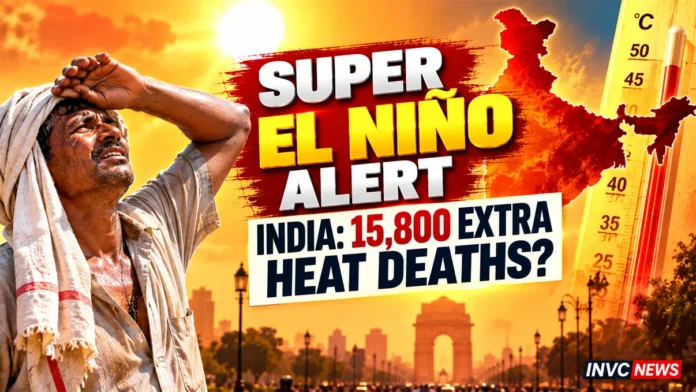
A new Climate Impact Lab analysis projects that India could record about 15,800 additional heat-related deaths between September 2026 and February 2027, compared with temperatures and mortality expected during the same months of a normal year.
The figure does not represent deaths already recorded. It is a model-based projection of excess mortality linked to unusually high temperatures expected during the ongoing El Niño.
More strikingly, researchers estimate that around 7,400 of India’s additional heat-related deaths could occur between December 2026 and February 2027.
And the danger may not end with February.
Researchers warn that heat-related mortality in India and Pakistan could continue rising as the Northern Hemisphere moves toward the 2027 summer.
Why the 15,800 Figure Matters
The Climate Impact Lab estimates that India could see 15,800 more heat-related deaths over the next six months than during comparable months in an average year.
India ranks among the countries facing the largest projected increase in heat mortality.
The biggest projected impacts include parts of Africa’s Sahel region, Nigeria, Indonesia, Sudan and India.
The analysis estimates:
India — 15,800 additional deaths
Indonesia — 19,300
Nigeria — 31,400
Sudan — 17,500
Brazil — 13,300
Across the Sahel region, researchers project approximately 66,800 additional deaths during the six-month forecast period.
Nearly Half of India’s Projected Deaths Could Come in Winter
Perhaps the most surprising number for India is 7,400.
That is the number of additional heat-related deaths the study projects for India during December 2026 through February 2027 alone.
Those three months account for almost half of the country’s six-month estimate.
This does not mean all of India will suddenly experience May-like heat during winter.
The researchers model temperature-related mortality at a local level. Their calculations account for regional climate, vulnerability and people’s ability to adapt.
A temperature that creates severe stress in one location may have a different mortality effect somewhere else.
Therefore, the projection measures how unusually warm conditions could alter mortality compared with what would normally be expected at that place and time of year.
Global Temperature Could Rise 1.2°C Above Normal
The scale of the projected warming explains the concern.
Climate Impact Lab says global land temperatures could average about 1.2°C above normal in the coming months, driven in large part by the current El Niño.
Researchers estimate that the world could experience 44% more extremely hot days than during a normal year.
They describe the event as a preview of temperatures that human-driven climate change could make normal roughly two decades from now.
That is why the report describes the current event as a kind of “postcard from the future.”
The central warning is not only about one El Niño.
It is about what today’s exceptional temperatures could reveal about a much hotter future.
451,000 Heat Deaths — But Understand the Timeline
One number associated with the report requires careful explanation.
Researchers project around 451,000 heat-related deaths globally during the first nine months of the El Niño period, from June 2026 through February 2027, compared with a normal year.
However, that is not the same as the six-month September-to-February forecast.
For the September 2026–February 2027 period specifically, the model projects approximately 239,000 ±11,000 additional deaths worldwide.
The distinction matters because headlines that simply combine “451,000 deaths” with a “next six months” timeline can misrepresent the study.
How Researchers Calculated the Death Estimates
Climate Impact Lab did not simply apply one global temperature formula to every country.
Researchers used previously developed relationships between temperature and excess mortality across 24,378 regions worldwide.
Those relationships account for differences in:
Local climate
Population vulnerability
Existing adaptation
Health risks
The ability of communities to cope with temperature extremes
Researchers then combined those relationships with long-range temperature forecasts from the ECMWF SEAS5 seasonal forecasting system.
The projected mortality changes are measured against the 1996–2025 average for corresponding months.
That makes the 15,800 figure an estimate of additional mortality above the expected baseline, rather than a forecast of India’s total deaths from all causes.
The Number Is a Projection, Not a Certainty
This distinction is critical.
Climate models and mortality models contain uncertainty.
The researchers incorporate uncertainty from both the seasonal temperature forecast and the estimated relationship between temperature and excess mortality.
The seasonal forecast itself uses a 51-member forecast ensemble.
Climate Impact Lab also says full methodological details will appear in an upcoming peer-reviewed journal publication.
Therefore, 15,800 should not be interpreted as a guaranteed final death toll.
Actual outcomes could change with weather conditions, public-health interventions, access to cooling, healthcare capacity and individual behaviour.
The researchers also plan to update their projections as El Niño progresses.
Why El Niño Can Make India Hotter
El Niño develops when parts of the central and eastern equatorial Pacific Ocean become unusually warm.
That ocean warming changes atmospheric circulation across large parts of the planet.
In India, El Niño has historically been associated with shifts in monsoon behaviour and higher temperatures, although its effect varies from one event and region to another.
Importantly, El Niño now operates against a much warmer global climate than it did several decades ago.
That means natural climate variability can temporarily add another layer of warming on top of the long-term rise in temperatures caused by greenhouse-gas emissions.
Who Faces the Greatest Heat Risk?
Extreme heat does not affect everyone equally.
People who work outdoors, people without reliable access to cooling, low-income households and people living in dense urban neighbourhoods can face greater exposure.
Older people, young children and people with some existing health conditions can also face greater danger during periods of extreme heat.
Workers in construction, agriculture, transport and other outdoor occupations can spend hours exposed to high temperatures.
Night-time heat presents another problem.
When temperatures remain high after sunset, the human body gets less opportunity to recover from daytime heat stress.
That can turn a multi-day heat episode into a serious public-health threat.
What Can Prevent Heat Deaths?
The report does not present the projected mortality as unavoidable.
Climate Impact Lab highlights several interventions backed by research.
These include early heat warnings, targeted health outreach, cooling centres, hydration stations, protections for outdoor workers and stronger health-system capacity.
Heat Action Plans can also help authorities prepare hospitals, communicate risks, adjust working hours and identify communities that need additional support.
The key advantage with El Niño is predictability.
Unlike an earthquake that arrives without meaningful long-range warning, seasonal climate conditions can often be identified months ahead.
That gives governments time to act before the most dangerous temperatures arrive.
India Cannot Treat Heat as Only a Summer Problem
The India projection carries another message.
Heat preparedness can no longer begin only when temperatures cross 45°C in May or June.
The Climate Impact Lab forecast suggests temperature-related mortality could rise during months traditionally viewed as relatively cool and then continue increasing as India approaches its next summer.
Researchers specifically warn that India and Pakistan could continue seeing rising heat-related mortality beyond the February 2027 forecast window.
That makes early planning particularly important.
A Warning — Not a Death Sentence
The figure 15,800 is alarming.
But it should not be read as an inevitable death toll.
It is a warning generated from climate forecasts, historical mortality relationships and assumptions about current levels of adaptation.
If temperatures develop differently, the projection can change.
If governments and communities improve preparedness, actual mortality can also fall.
That is precisely why the researchers released the forecast before the full impact occurs.
The larger message is simple.
India may be entering an unusually dangerous period of heat exposure, and the time to prepare is before the thermometer reaches its peak.