NEW DELHI, India | September 22, 2026 — If you have a cheque to deposit, cash to withdraw from a branch, a loan document to submit or any important banking work pending, do not leave it for the end of September.
India is heading towards a major banking disruption.
The United Forum of Bank Unions (UFBU) has decided to proceed with its three-day nationwide strike on September 28, 29 and 30, after the latest conciliation efforts failed to produce a breakthrough on its key demands.
But for customers, the real headache could begin two days earlier.
September 26 is the fourth Saturday.
September 27 is Sunday.
Then comes the three-day strike.
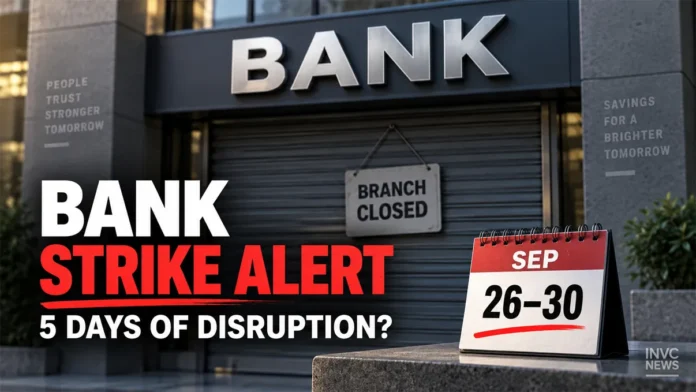
If the strike goes ahead as announced, many bank branches could therefore remain unavailable for normal customer-facing work for five consecutive days — September 26 to September 30.
That makes this much more than a routine labour dispute.
It could become a month-end banking headache.
Five Days Without Normal Branch Banking? Here Is the Calendar
The sequence is what makes the situation unusual:
September 26, Saturday: Scheduled bank holiday because it is the fourth Saturday.
September 27, Sunday: Weekly holiday.
September 28, Monday: Nationwide bank strike.
September 29, Tuesday: Nationwide bank strike.
September 30, Wednesday: Nationwide bank strike.
Banks are expected to reopen for normal working on October 1, subject to local holidays and individual bank arrangements.
For customers who depend on physical branches, that is a long gap.
And it arrives right at the end of the month, when salary processing, business payments, cheque clearing and account-related work often intensify.
Why Are Bank Employees Going on Strike?
At the heart of the dispute is a demand that has been simmering for years:
five-day banking.
Bank unions want all Saturdays to become holidays, bringing banks closer to a Monday-to-Friday working system.
The unions point to an agreement reached in the March 8, 2024 Settlement and Joint Note, under which the issue of declaring the remaining Saturdays as holidays was taken forward for government consideration.
For employees, the argument is straightforward.
Many government departments, financial institutions and corporate offices already follow a five-day working week.
Bank employees want the same structure.
For the government, however, changing the banking calendar also involves questions around customer access, working hours and continuity of financial services.
That is where negotiations have repeatedly become stuck.
PLI Dispute Adds More Heat
Five-day banking is the headline demand, but it is not the only issue.
UFBU has also raised objections to the revised Performance-Linked Incentive scheme and wants unresolved employee issues addressed through bilateral discussions.
The unions say the remaining issues have not received a satisfactory response.
The Finance Ministry, on the other hand, says most union concerns have already been substantially addressed and has urged employees to resolve the remaining differences through dialogue rather than a strike.
Neither side appears ready to blink yet.
And customers are now caught in the middle.
Government Makes Last Push to Stop the Strike
The Finance Ministry has appealed to bank employees not to participate in the September 28–30 strike.
The Department of Financial Services has also reviewed contingency arrangements with public-sector banks, regional rural banks and the Indian Banks’ Association.
It has sought security arrangements for critical banking infrastructure, including:
currency chests,
cheque-clearing centres,
data centres,
treasury operations,
ATMs,
IT infrastructure,
and cybersecurity systems.
The government clearly wants essential financial infrastructure to continue functioning even if branch staffing is badly hit.
But the unions have, for now, maintained their strike call.
Will Every Bank Be Completely Closed?
Not necessarily.
This is an important distinction.
The strike has been called by major bank employee and officer unions, and participation could significantly affect public-sector banks and other institutions where those unions have a strong presence.
However, that does not mean every branch of every bank across India will definitely remain locked.
Staff participation can vary.
Some branches may function with reduced manpower.
Some private banks may see less impact.
Banks are also preparing contingency arrangements.
So customers should treat this as a major disruption alert, not as a claim that every bank in India will be completely inaccessible for five days.
SBI and Other Banks Warn Customers
Major banks have already begun preparing customers.
The State Bank of India has circulated the government’s appeal to employees, while banks are advising customers to complete important branch transactions in advance.
Canara Bank has warned that branch operations could be affected on September 28, 29 and 30 and advised customers to use alternative banking channels where possible.
That is the clearest signal yet:
do not wait until Monday morning to discover whether your branch is functioning.
What Could Be Hit Hardest?
The biggest disruption is likely to affect services that require people, paper or physical movement.
These can include:
cash deposits and large cash withdrawals at branches,
cheque deposits and clearing,
demand drafts,
passbook-related work,
document verification,
loan processing,
account opening,
KYC work requiring branch intervention,
government-related banking work,
and some business transactions.
Cheque clearing could become particularly uncomfortable if staffing at processing centres is affected.
The Finance Ministry’s specific focus on protecting cheque-clearing infrastructure shows how seriously authorities are treating that risk.
Will UPI, Mobile Banking and ATMs Stop?
For most customers, here comes the relief.
UPI, mobile banking, internet banking, card payments and other automated digital services are expected to remain available.
A strike by employees does not automatically switch off banking servers.
However, there is a catch.
ATMs require cash replenishment and occasional physical maintenance.
If five consecutive days of branch disruption create unusually heavy cash demand, some locations could face temporary shortages.
Digital systems can also experience normal technical issues regardless of the strike.
So “digital banking available” should not be interpreted as “nothing can go wrong.”
Do These Five Things Before September 26
If you have important banking work, the safest strategy is simple.
Deposit important cheques early.
Do not assume a cheque submitted just before the long disruption will clear normally.
Withdraw essential cash in advance.
There is no reason to hoard cash, but leaving urgent needs until the strike begins makes little sense.
Finish branch-dependent KYC or loan paperwork.
Digital banking cannot solve every documentation issue.
Schedule business payments carefully.
Companies that rely on branch operations or cheque settlement should plan around the five-day window.
Keep alternative payment methods ready.
UPI, cards and net banking can cover most routine consumer needs.
And October Could Bring an Even Bigger Shock
September may not be the end of the dispute.
UFBU has warned that if its demands remain unresolved, it could move towards an indefinite strike from October 26.
That raises the stakes considerably.
A three-day strike is disruptive.
An indefinite strike would be a completely different challenge for banks, businesses and customers.
There is still time for negotiations before that stage arrives.
But after the latest talks failed to produce a settlement, neither customers nor banks can simply assume the dispute will disappear.
The Customer’s Bottom Line
For ordinary account holders, this is not really a debate about union negotiations.
It is much simpler.
Can you access your money and complete your banking work when you need to?
From September 26 to September 30, that question could become uncomfortable for anyone relying on branch banking.
Digital payments should soften the blow.
ATMs should remain available.
Online banking should continue.
But cheque clearing, cash-related work, paperwork and customer service could become much slower.
So there is one sensible move:
Do not wait for the shutter to come down.
If the work requires a bank employee sitting across the counter, finish it before September 26.
Because what is officially a three-day strike could feel like a five-day banking shutdown for millions of customers.