NEW DELHI, India | September 22, 2026 —
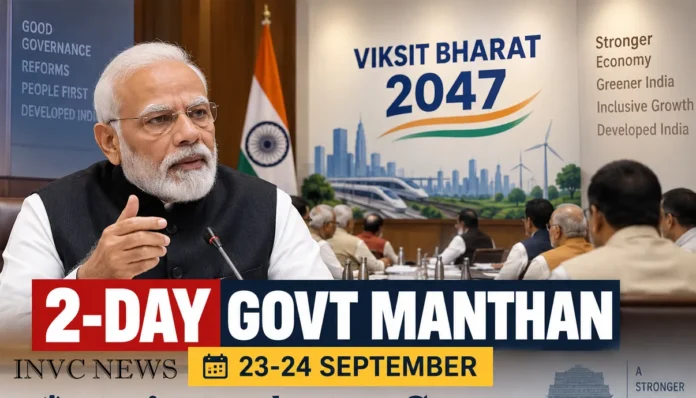
Prime Minister Narendra Modi will lead a two-day Chintan Shivir on September 23 and 24, bringing Union ministers together for an intensive review of governance, reforms, implementation of government programmes and the roadmap toward Viksit Bharat 2047.
The meeting comes at a significant point in the government’s current term and is expected to focus not only on what ministries have achieved so far, but also on where delivery needs to improve and which reforms require greater coordination.
Public reporting based on government sources indicates that ministers may make presentations on reforms undertaken by their ministries, while discussions are expected to cover implementation of schemes, inter-ministerial coordination, public-service delivery, time management and future priorities.
Two Days of Review, Reflection and Planning
Unlike a routine Cabinet meeting focused mainly on approving individual proposals, the September 23–24 exercise is expected to provide ministers with more time for detailed discussion.
The broad idea is to review how government decisions are translating into results on the ground.
Ministries are also expected to examine obstacles that may be slowing implementation and identify areas where coordination between departments can improve.
Reports suggest that ministers have been divided into several groups for discussions on themes including governance, communication and improvement in government functioning.
The emphasis is likely to remain on one central question:
What must the government do differently or faster to move India toward the Viksit Bharat 2047 goal?
Viksit Bharat 2047 at the Centre of the Exercise
The government defines Viksit Bharat 2047 as its long-term vision of making India a developed nation by the centenary of Independence.
The broader vision includes economic growth, social progress, environmental sustainability and good governance.
Prime Minister Modi has repeatedly linked administrative reforms with that objective.
At an earlier Council of Ministers meeting in May 2026, he said ministers had discussed ways to improve Ease of Living, Ease of Doing Business and advance reforms required for the Viksit Bharat vision.
The September Chintan Shivir is therefore expected to take that discussion further by examining implementation across ministries.
Ministers Could Present Reform Scorecards
One of the important features of the meeting is expected to be ministry-level presentations.
Ministers may explain reforms already undertaken, highlight implementation challenges and identify areas where policy changes could accelerate results.
The discussions are expected to examine issues such as:
- implementation of flagship government schemes;
- coordination between ministries and departments;
- speed and quality of public-service delivery;
- governance reforms and administrative efficiency;
- communication of government programmes;
- future policy priorities linked to Viksit Bharat 2047.
These themes have been reported ahead of the meeting, although the government has not yet published a complete session-by-session agenda.
From Announcing Schemes to Measuring Delivery
The timing of the Chintan Shivir makes implementation particularly important.
Large government programmes often involve several ministries, state governments and local authorities. Therefore, delays can arise even after policies receive approval.
A review at the level of the Council of Ministers gives the government an opportunity to examine where delivery gaps remain.
That could include questions such as whether benefits are reaching intended recipients on time, whether departments are sharing information efficiently and whether existing procedures can be simplified.
The emphasis, therefore, is expected to shift from simply announcing policies to assessing measurable outcomes.
Coordination Between Ministries Could Get Special Attention
Inter-ministerial coordination is expected to feature prominently in the deliberations.
Large policy areas such as infrastructure, investment, manufacturing, employment, digital services, agriculture, energy and social welfare frequently require multiple ministries to work together.
The Chintan Shivir could therefore be used to identify overlapping responsibilities and improve decision-making between departments.
Prime Minister Modi has previously stressed reforms aimed at improving Ease of Living and Ease of Doing Business as part of the Viksit Bharat strategy.
Government Looking Beyond Immediate Targets
The meeting also has a longer-term dimension.
Viksit Bharat 2047 requires policy planning that extends far beyond annual budgets or individual schemes.
Recent government discussions around the Viksit Bharat framework have covered investment, fiscal resilience, agriculture, technology, banking and the energy transition, indicating the breadth of the policy challenge.
That means the September 23–24 deliberations could serve as a bridge between immediate administrative priorities and the government’s longer-term development strategy.
Why This Chintan Shivir Matters
The significance of the meeting will ultimately depend on what follows it.
A brainstorming exercise can identify problems and priorities, but the real test will be whether ministries convert those discussions into faster execution, measurable reforms and better public services.
For the government, the two-day meeting provides an opportunity to assess its performance collectively rather than ministry by ministry.
For citizens and businesses, the key questions will be more practical:
Will schemes become easier to access?
Will approvals become faster?
Will departments coordinate better?
And will reforms translate into visible improvements in everyday governance?
Those are likely to remain the real benchmarks as the government moves from discussion to implementation.
The Chintan Shivir begins on Wednesday, September 23, and continues through Thursday, September 24.
What emerges from those two days could offer an important indication of the government’s reform priorities for the next phase of its Viksit Bharat 2047 roadmap.