By Team INVC | INVC NEWS
NEW DELHI, India | September 21, 2026 — Your name may be linked to a mobile number you have never used — and you may not even know it.
The Department of Telecommunications on Monday issued a fresh warning to mobile users across India after investigators uncovered fraudulent SIM cards activated using other people’s identity documents.
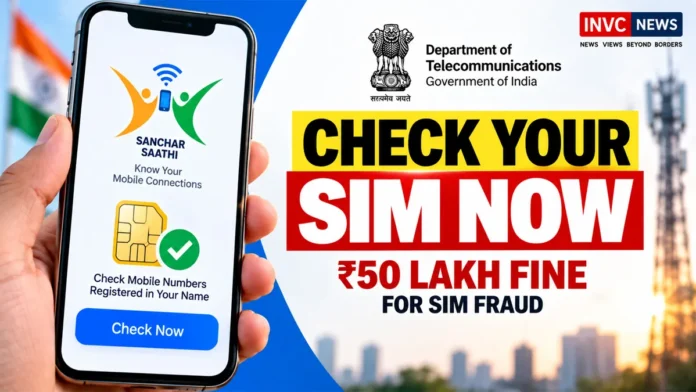
The government has asked citizens to check every mobile connection registered in their name through the Sanchar Saathi platform and immediately flag numbers they do not recognise.
The warning is serious.
Fraudulent SIM issuance, misuse of telecom identifiers and tampering with IMEI numbers can attract imprisonment of up to three years and a fine of up to ₹50 lakh under the Telecommunications Act, 2023.
For ordinary mobile users, the message is simple:
Check which SIM cards are registered in your name before somebody else misuses your identity.
25 SIM Cards Activated Using Other People’s Documents
The latest warning follows a cybercrime investigation involving a mobile connection Point of Sale agent in Chhattisgarh.
According to the Department of Telecommunications, the agent allegedly activated 25 mobile connections using citizens’ identification documents without their knowledge or consent.
Authorities subsequently blacklisted the Point of Sale operator, preventing it from issuing additional connections.
The suspicious mobile numbers were then analysed through the Department of Telecommunications’ Digital Intelligence Platform.
Connections requiring further scrutiny were sent for re-verification.
Those that failed the verification process were deactivated.
The case highlights a major digital-security risk:
A person does not necessarily have to knowingly purchase a fraudulent SIM card to become affected.
Someone else may misuse their documents.
Check Every Mobile Number Issued in Your Name
The government is urging citizens to use Sanchar Saathi to review all mobile connections linked to their identity.
The service can show users the mobile numbers issued in their name.
If a number appears that a person does not recognise or no longer requires, the platform allows action to be initiated against that connection.
This makes the check particularly important for anyone who has:
Changed mobile operators several times.
Submitted identity documents to multiple SIM retailers.
Lost an old SIM card.
Closed a number years ago.
Shared identity documents during mobile verification.
Or simply cannot remember how many active connections are linked to their name.
A two-minute verification could reveal a number the subscriber never knew existed.
Do Not Give Your SIM Card to Someone Else
DoT has also warned subscribers against handing over SIM cards registered in their own names to other people.
That includes selling, transferring, renting or lending a SIM for use by another person.
Why does this matter?
Because a mobile connection remains tied to the identity of the registered subscriber.
If that connection is later used for cyber fraud or another unlawful activity, investigators may initially trace it back to the person whose identity is associated with the SIM.
The government has therefore advised citizens not to treat SIM cards as transferable personal items.
A SIM registered in your name should remain under your control.
‘Mule SIMs’ Can Create Serious Trouble
Cybercriminals frequently depend on mobile numbers that cannot easily be traced back to the person actually committing the fraud.
Such connections may be used for fraudulent calls, fake banking messages, impersonation scams, OTP-based crimes and other illegal activities.
Some fraud networks obtain mobile connections through fake documentation.
Others persuade or pay people to provide SIM cards registered in their genuine identities.
These are sometimes described as mule SIMs.
DoT has specifically warned citizens against obtaining SIM cards in their own name and then loaning, renting or handing them over for such use.
IMEI Tampering Is Also Under the Scanner
SIM cards are not the only target of the government’s warning.
DoT has also cautioned against tampering with IMEI numbers.
IMEI — International Mobile Equipment Identity — is the unique identifier associated with a mobile device.
Users should avoid devices, modems, SIM boxes or other telecom equipment that use configurable, altered or tampered IMEI numbers.
Manipulating telecom identifiers can make devices harder to identify and can facilitate illegal communication activity.
That is why telecom laws treat such tampering seriously.
Buying a Used Phone? Check Its IMEI First
Sanchar Saathi can also help consumers verify whether a mobile handset appears genuine.
This becomes particularly useful when buying a second-hand or refurbished phone.
Users can check a handset’s IMEI and view information such as its brand, model and manufacturer.
You can normally find the IMEI on the phone’s packaging, purchase invoice or inside the handset settings.
On many phones, dialling *#06# also displays the IMEI.
What Should You Do Right Now?
Mobile users should take three basic precautions.
First, check all mobile numbers registered in your name through Sanchar Saathi.
Second, report or disconnect any connection that you do not recognise or no longer use.
Third, never knowingly allow another person to use a SIM registered in your identity for suspicious or commercial activity.
Consumers purchasing used mobile phones should also verify the handset’s IMEI before completing the transaction.
Why This Matters Even If You Have Never Faced Cyber Fraud
Most people think of cyber fraud only after money disappears from a bank account.
But telecom identity can become part of the fraud much earlier.
A mobile connection obtained in somebody else’s name can be used to create accounts, make fraudulent calls, receive OTPs or hide the identity of criminals.
That means protecting your telecom identity is increasingly becoming as important as protecting your banking credentials.
The Chhattisgarh investigation illustrates that risk clearly.
Twenty-five mobile connections were allegedly activated using the identities of people who had not knowingly asked for them.
For consumers, that leaves one important question:
Do you know exactly how many mobile numbers are currently registered in your name?
If the answer is no, this may be the right time to check.