
By Team INVC | INVC NEWS
KYIV, Ukraine | September 20, 2026 —
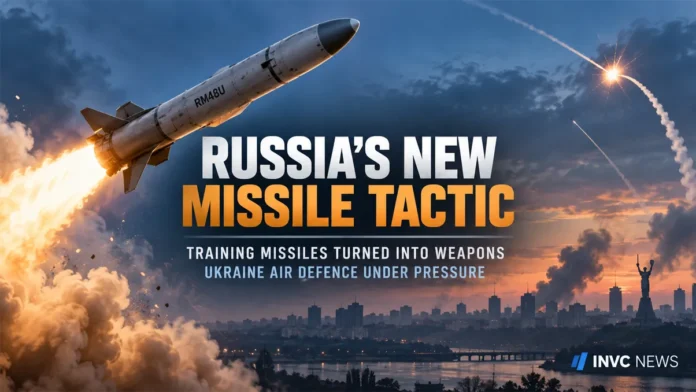
Russia has sharply increased its use of RM48U missiles originally designed as training targets, transforming them into battlefield weapons as Moscow intensifies its ballistic campaign against Ukraine and Kyiv faces growing pressure on its air-defence stocks.
Ukrainian data reviewed by Reuters shows that RM48U missiles accounted for more than half of 228 ballistic and hypersonic missiles launched at Ukraine during July and the first eight days of August 2026.
The shift gives Russia another way to sustain large-scale missile attacks while potentially preserving more capable weapons such as Iskander, KN-23 and Zircon missiles for future operations.
Russia Fired 87 RM48U Missiles in July
The scale of Russia’s shift became particularly visible in July.
Ukraine recorded 158 ballistic and hypersonic missile strikes during the month, the highest monthly number since Russia launched its full-scale invasion in February 2022, according to Ukrainian official data examined by Reuters.
Of those, 87 were identified as RM48U missiles.
During the first eight days of August, another 70 ballistic and hypersonic launches were recorded, including 36 RM48Us.
The figures represent confirmed strikes identified through Ukrainian ground analysis and therefore do not necessarily account for every missile Russia launched during the period.
What Is the RM48U Missile?
The RM48U was not originally designed as a conventional long-range strike weapon.
It was developed as a target missile used to train Russian air-defence crews, including units operating S-400 systems.
Russia has now adapted the weapon for ground attacks.
Ukrainian investigators and military specialists say the converted RM48U follows a ballistic trajectory but is less accurate and less powerful than purpose-built Iskander ballistic missiles.
That does not make it harmless.
Its speed and ballistic flight profile still make interception difficult, while its lower accuracy can increase risks beyond the intended target area.
Ukrainian Investigators Link RM48U to Deadly Railway Strike
Reuters examined evidence from a missile strike on a railway platform in the Brovary district near Kyiv, where eight people were killed.
Ukrainian investigators concluded that the weapon involved was an RM48U rather than Russia’s more commonly used Iskander missile.
Investigators based their assessment on the crater, missile fragments and damage patterns found at the scene.
Reuters said it could not independently verify every Ukrainian technical conclusion concerning the weapon.
That limitation is important because detailed battlefield assessments rely heavily on evidence gathered by authorities operating inside the conflict zone.
Why Russia May Be Using Training Missiles
Military analysts see a strategic logic behind the shift.
Sidharth Kaushal, a senior research fellow at London’s Royal United Services Institute, told Reuters that using large numbers of RM48Us could help Russia consume Ukrainian interceptor stocks while conserving more sophisticated missiles.
Ukraine’s data appears consistent with that pattern.
As RM48U use surged in July, the number of Iskander missiles fired reportedly fell to 38, compared with more than 100 during the previous month.
Russia has not publicly provided a comparable breakdown confirming the Ukrainian figures.
Winter Could Be the Bigger Concern
The timing matters because both sides are preparing for another winter of attacks against military and energy infrastructure.
Analysts cited by Reuters said Russia could be conserving some of its higher-value precision missiles for a heavier winter campaign.
Ukraine’s electricity generation, heating systems and other critical infrastructure have repeatedly come under attack during previous winters.
Russia says its military strikes legitimate military and military-related infrastructure. Ukraine and Western governments have accused Moscow of conducting attacks that cause extensive civilian and infrastructure damage.
Ukraine’s Patriot Stocks Under Pressure
Ukraine’s ability to intercept ballistic missiles depends heavily on advanced Western systems, particularly the U.S.-made Patriot.
Reuters reported that Ukraine has faced a serious shortage of Patriot interceptors as Russia increases the frequency of ballistic attacks.
The problem is partly economic.
Air-defence interceptors can be significantly more expensive than some of the incoming weapons they are used against.
If Russia can repeatedly launch cheaper or repurposed missiles, Ukraine may be forced to decide which threats justify using scarce high-end interceptors.
That imbalance has become an increasingly important feature of the air war.
Russia May Have a Larger RM48U Stockpile
The Institute for the Study of War estimated recently that Russia could have around 400 RM48U missiles available, compared with roughly 100 Iskanders, according to Reuters.
Stockpile estimates during wartime carry significant uncertainty because neither Moscow nor Kyiv provides comprehensive public inventories.
Still, the available figures help explain why repurposed missiles could allow Russia to maintain a high tempo of attacks.
Air War Intensifies as Ground Front Remains Difficult
The growing missile campaign reflects a broader change in the war.
Ground fighting continues across eastern Ukraine, but increasingly dense drone surveillance, mines, artillery and precision weapons have created what soldiers describe as highly dangerous zones around the front.
At the same time, both countries have expanded long-range attacks.
Russia has launched hundreds of ballistic missiles and drones against targets across Ukraine.
Ukraine, which possesses a much smaller missile arsenal, has increasingly relied on long-range drones to strike Russian oil refineries, ports, ships and military installations.
Ukraine Also Expands Long-Range Drone Campaign
Ukraine’s long-range strikes have increasingly focused on energy infrastructure inside Russia.
Kyiv argues that Russian oil and fuel installations support Moscow’s military operations.
Russia describes Ukrainian attacks on its territory as terrorism or attacks against civilian infrastructure, depending on the target.
The result is an expanding air campaign in which infrastructure hundreds of kilometres from the front has become part of the conflict.
Civilian Risk Remains a Central Concern
Less accurate ballistic weapons present an additional danger in populated areas.
Even when military or industrial installations are the stated targets, a missile with a wider margin of error can strike surrounding infrastructure.
Reuters reported that Ukraine recorded its highest monthly civilian death toll in years during July as the intensity of Russian aerial attacks increased.
International humanitarian law requires parties to distinguish between military targets and civilians and to take precautions to minimise civilian harm.
Both Russia and Ukraine have accused the other of violating those obligations during the war.
A New Phase of the Missile War
The widespread use of RM48U missiles shows how the Russia–Ukraine conflict continues to transform weapons originally built for entirely different purposes.
Drones, converted missiles and rapidly modified defence technologies have become central to a war increasingly defined by production capacity and the ability to exhaust an opponent’s defences.
For Ukraine, the immediate challenge is maintaining enough interceptors to protect cities and infrastructure.
For Russia, the RM48U offers a way to sustain pressure while potentially conserving more advanced missiles.
As another winter approaches, that calculation could become increasingly important to both sides.