By Team INVC | INVC NEWS
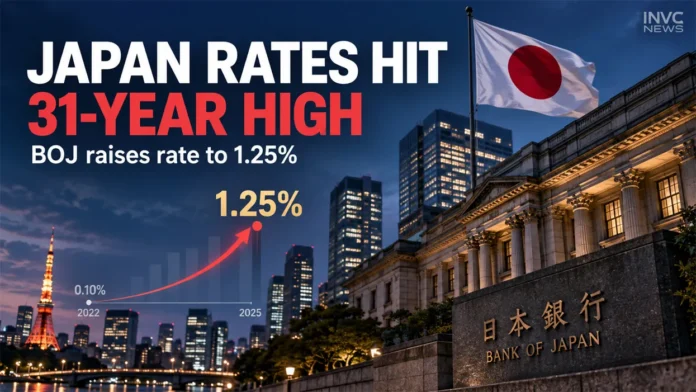
TOKYO, Japan | September 19, 2026 — The Bank of Japan has raised its benchmark interest rate from 1.00% to 1.25%, taking borrowing costs to their highest level in 31 years as policymakers step up efforts to contain inflation and manage persistent pressure on the yen.
The quarter-percentage-point increase marks another major shift away from Japan’s decades-long era of ultra-low and negative interest rates.
The decision also puts Japan more firmly into the global monetary tightening cycle as major central banks continue responding to inflation, energy-price pressures and uncertainty across financial markets.
Bank of Japan Interest Rate Hits 31-Year High
The Bank of Japan increased its short-term policy rate by 25 basis points to 1.25%.
The move was approved by a 7-2 vote, showing that while a clear majority supported tighter monetary policy, some policymakers remained concerned about the strength of Japan’s economy and the risks of raising borrowing costs too quickly.
At 1.25%, Japan’s benchmark rate is now at its highest level in around three decades.
However, the distinction is important: this is not the biggest single rate increase in 31 years. Instead, the new 1.25% level itself is the highest in 31 years.
Why Did BOJ Raise Rates?
Inflation remains at the centre of the Bank of Japan’s decision.
For years, Japan struggled with weak price growth and deflation. The central bank responded by keeping interest rates extremely low and buying large amounts of government bonds.
That environment has changed.
Price pressures have become more persistent, wages have risen and higher energy costs have created additional inflation risks.
The BOJ now faces a very different challenge: preventing inflation from moving too far above its long-standing 2% target.
Oil Prices Add to Inflation Pressure
Higher global oil prices have complicated the outlook for Japan, which imports a large share of its energy requirements.
More expensive crude oil can increase transportation, electricity and manufacturing costs.
Those pressures can eventually reach consumers through higher prices for food, goods and services.
The BOJ is therefore watching energy markets closely as it decides how far and how quickly interest rates may need to rise.
Yen Falls Despite Interest Rate Hike
Normally, higher interest rates can support a currency by making assets denominated in that currency more attractive to investors.
This time, however, the Japanese yen weakened following the BOJ decision.
Traders focused on uncertainty over how aggressively the central bank will continue raising rates.
The presence of two dissenting policymakers also contributed to doubts about the pace of future tightening.
That market reaction highlights a difficult problem for Japan.
Simply raising interest rates does not guarantee a stronger yen if investors remain uncertain about future policy.
Nikkei Rises After BOJ Decision
Japanese equities also produced an interesting response.
The Nikkei 225 gained around 1.4% following the rate decision.
That suggests investors had largely anticipated the increase and were more focused on the possibility that future rate hikes could remain gradual.
For stock markets, a slower tightening cycle can sometimes be viewed positively because aggressive increases in borrowing costs can hurt corporate profits, consumer spending and economic growth.
What Higher Rates Mean for Japan
Higher interest rates affect almost every part of an economy.
Japanese households could eventually face higher costs on mortgages and other loans.
Companies may also pay more when borrowing money for investment and expansion.
At the same time, savers could benefit from better returns on deposits and fixed-income products.
Banks may also see changes in profitability as the gap between lending and deposit rates evolves.
For the Japanese government, higher rates present another challenge because Japan carries one of the largest public-debt burdens among major economies.
Japan Moves Further Away From Negative Rates
The latest move is particularly significant when viewed against Japan’s recent monetary history.
For years, the Bank of Japan maintained some of the world’s most aggressive monetary stimulus.
Negative interest rates were used to encourage lending, spending and investment.
The bank eventually ended its negative-rate policy as inflation became more sustainable.
The increase to 1.25% confirms that Japan has now entered a fundamentally different phase of monetary policy.
The debate is no longer about how to create inflation.
It is increasingly about how to prevent price pressures from becoming excessive.
Could BOJ Raise Rates Again?
Governor Kazuo Ueda has indicated that future decisions will depend on economic data, inflation trends, wages and financial-market conditions.
The central bank has not committed to a fixed schedule of increases.
However, policymakers have left the door open to further tightening if inflation remains persistent.
Oil prices, the yen, wage negotiations and consumer spending will therefore become especially important indicators in the coming months.
Why Global Investors Are Watching Japan
Japan plays an unusually important role in global financial markets.
For years, investors borrowed cheaply in yen and invested that money in higher-yielding assets elsewhere.
This strategy is commonly known as the yen carry trade.
As Japanese rates rise, the economics of those trades can change.
Investors may reduce leveraged positions, shift money between currencies or reassess investments in stocks and bonds around the world.
That means even a relatively small BOJ rate move can have consequences far beyond Japan.
Impact on Global Stock Markets
The immediate global reaction has been mixed rather than a simple market-wide selloff.
Currency markets responded quickly, while bond yields and equities also reflected changing expectations for central-bank policy.
US and European markets are simultaneously dealing with their own inflation concerns, higher energy prices and changing interest-rate expectations.
Therefore, Japan’s move adds another layer of uncertainty to an already complicated environment for global investors.
What Indian Investors Should Watch
Indian investors should pay particular attention to three areas.
First, movements in the yen can affect global risk appetite and international fund flows.
Second, higher global borrowing costs can influence foreign investment into emerging markets.
Finally, changes in Japanese monetary policy can affect bond yields, currency trades and institutional portfolio decisions worldwide.
The direct effect on Indian equities may vary from session to session, but a sharp unwind in global carry trades can increase volatility across emerging markets.
A Historic Shift for Japan
Japan spent decades fighting weak inflation with extraordinarily cheap money.
That era is steadily disappearing.
By lifting the policy rate to 1.25%, the highest level in 31 years, the Bank of Japan has sent another clear signal that its monetary-policy priorities have changed.
The question for markets is no longer whether Japan will leave ultra-low interest rates behind.
It is how far rates will ultimately rise—and how global markets will adjust as one of the world’s biggest sources of cheap money becomes more expensive.