By Team INVC | INVC NEWS
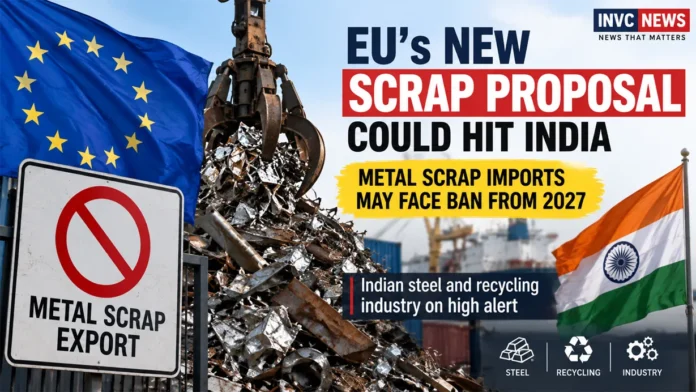
BRUSSELS, Belgium | September 19, 2026 — A new European Union waste-shipment proposal could sharply restrict metal scrap exports to India from May 2027, raising concerns for Indian steel, aluminium and recycling companies that depend on imported recyclable raw materials.
Under the European Commission’s proposed exemption list for non-OECD countries, India could lose access to several categories of EU metal waste, including aluminium scrap, unless it secures approval before the new regime takes effect.
The move does not mean India has banned European scrap imports. Instead, the restrictions would operate from the European side by preventing EU exporters from sending covered waste streams to India.
Why India Could Lose Access to EU Metal Scrap
The European Union’s revised Waste Shipment Regulation introduces tougher rules for sending non-hazardous waste to countries outside the OECD.
From May 21, 2027, exports of so-called green-listed non-hazardous waste to non-OECD countries will generally be prohibited unless the destination country appears on an approved EU list.
India is among the countries that formally requested continued access.
However, under the Commission’s current proposal, India would not receive an exemption for certain metal waste categories.
If the proposal remains unchanged, shipments of affected metal scrap from European Union countries to India would therefore stop when the new rules take effect.
Proposal Is Not Yet the Final Word
A critical point for Indian industry is that the process is still underway.
The European Commission has opened a public consultation on the proposed exemption list until October 16, 2026.
The first list of authorised non-OECD countries is expected to be adopted by November 21, 2026.
That leaves time for governments, recycling companies and industry associations to submit evidence and argue for changes.
India could also seek approval again later because the EU says the authorised-country list will be reviewed regularly and updated at least once every two years.
Why the EU Is Tightening Waste Export Rules
Brussels says the new rules are intended to ensure that waste exported outside the European Union is processed under environmentally sound conditions.
Countries seeking permission to receive EU waste must demonstrate that they have adequate systems for handling and recycling the materials safely.
Metal waste is receiving particularly close scrutiny because European regulators say some scrap streams can contain persistent or toxic heavy metals.
The Commission therefore wants stronger evidence that imported waste will be handled without creating unacceptable environmental or health risks.
India Is a Major Buyer of European Scrap
The potential restriction matters because India is an important destination for European metal scrap.
India is also one of the largest buyers of EU aluminium scrap.
Domestic steelmakers, aluminium producers and recycling companies use imported scrap as a secondary raw material, particularly where high-quality recyclable metal is needed.
Any disruption could therefore affect both availability and pricing.
Indian Steel Industry Warns of Higher Costs
Indian industry had raised concerns about the EU’s waste-shipment rules even before the latest proposal emerged.
The Engineering Export Promotion Council of India has said Europe is an important supplier of high-quality ferrous scrap.
Industry representatives have warned that restrictions could tighten supply and push up costs for Indian steelmakers.
Such concerns are especially significant as India expands steel production while simultaneously trying to increase the share of recycled material in manufacturing.
India Had Already Asked EU for Relief
New Delhi had earlier sought relief from the European Union over planned restrictions on scrap exports.
Indian officials and industry representatives raised the issue because of concerns that restricting recyclable raw materials could undermine manufacturing competitiveness.
The Commerce Ministry had also considered government-to-government discussions with Brussels over the Waste Shipment Regulation.
India submitted a formal application requesting continued access to recyclable materials under the new EU system.
The latest draft, however, suggests that India’s request has not yet secured the metal-waste exemption industry had hoped for.
EU Earlier Dropped 15% Aluminium Scrap Export Duty
The latest development follows another major policy debate over European metal scrap.
The European Commission had earlier considered imposing a 15% export duty on aluminium scrap.
That proposal was later dropped after objections, including concerns from India, the biggest buyer.
The Commission has argued that its broader waste-shipment rules could achieve similar objectives through environmental regulation rather than a direct trade tariff.
That shift is significant because a restriction under waste rules could potentially be broader than an export duty.
European Industry Also Divided
The policy has generated concern inside Europe as well.
European Aluminium has argued that more scrap should remain within the bloc to support European smelters and recycling capacity.
European recycling groups, however, have warned that cutting off major Asian markets could damage scrap collectors and recyclers by reducing competition and export demand.
The debate therefore involves competing priorities: environmental standards, access to recycled raw materials, European industrial policy and international trade.
Why Scrap Matters for Green Steel
Metal scrap is becoming increasingly valuable as steel and aluminium industries attempt to lower carbon emissions.
Recycling aluminium requires significantly less energy than producing primary aluminium from mined raw materials.
Scrap-based steel production can also reduce emissions when compared with several conventional production routes.
India is rapidly expanding both steel capacity and recycling infrastructure.
That means reliable access to high-quality scrap could become even more strategically important over the coming decade.
Could Indian Consumers Eventually Feel the Impact?
The immediate impact would fall primarily on recyclers, metal processors, steelmakers and aluminium producers.
However, persistent shortages or higher raw-material costs can eventually move through manufacturing supply chains.
Industries using steel and aluminium include automobiles, construction, consumer appliances, machinery, packaging and infrastructure.
The actual impact would depend on how much European material India can replace through domestic scrap collection or imports from other markets.
What Happens Next?
Three dates now matter.
First, stakeholders have until October 16, 2026 to respond to the European Commission’s consultation.
Second, the EU is expected to establish its first authorised-country list by November 21, 2026.
Finally, the new restrictions on non-hazardous waste exports to non-OECD countries are scheduled to apply from May 21, 2027.
Until the exemption list is finalised, it would be premature to describe the restriction as an irreversible ban.
However, the current proposal clearly creates a significant risk for India’s access to European metal scrap.
For India’s steel, aluminium and recycling industries, the next few months could therefore determine whether a major source of recyclable raw material remains open—or becomes significantly harder to access.