By Team INVC | INVC NEWS
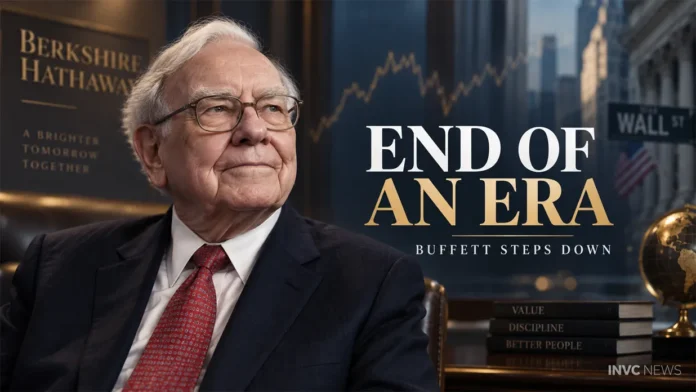
OMAHA, United States | September 19, 2026 — Legendary investor Warren Buffett has stepped down as Chairman of Berkshire Hathaway, ending a leadership era that lasted more than half a century at one of the world’s most closely watched companies.
The 96-year-old billionaire will become Chairman Emeritus with immediate effect and will remain a member of Berkshire Hathaway’s Board of Directors.
His son, Howard Buffett, has succeeded him as Chairman.
However, Howard Buffett is not taking over the day-to-day management of Berkshire Hathaway. Chief Executive Officer Greg Abel continues to run the company and make its key operating and capital-allocation decisions.
The distinction marks the final stage of a succession plan that Berkshire has prepared for years.
Warren Buffett Ends 56-Year Run as Chairman
Warren Buffett had served as Berkshire Hathaway’s Chairman since 1970.
His association with the company goes back even further. Buffett took control of Berkshire in 1965 and transformed what had once been a struggling textile business into one of the world’s most valuable corporate empires.
Over six decades, Berkshire expanded across insurance, railroads, energy, manufacturing, retail and consumer businesses while building a massive investment portfolio.
Buffett’s departure from the Chairman’s position therefore represents one of the most significant leadership transitions in modern corporate history.
Buffett: ‘The Timing Is Right to Complete the Transition’
In a letter to Berkshire shareholders dated September 18, Buffett said the time had arrived to complete the company’s leadership transition.
He praised Greg Abel’s performance as CEO and said Abel had taken control of the role “in every respect.”
Buffett made clear that important decisions were already being made by Abel.
That means the Chairman transition does not represent an abrupt change in who runs Berkshire’s businesses.
Instead, it completes a carefully planned division of responsibilities between management and board leadership.
Howard Buffett Becomes Berkshire Chairman
Howard Buffett, 71, will now serve as Chairman of Berkshire Hathaway.
He has been a Berkshire director since 1993, giving him more than three decades of experience on the company’s board.
Warren Buffett described his son’s primary responsibility in unusually clear terms.
Greg Abel runs the company. Howard Buffett will protect Berkshire’s culture and values.
That is the most important point for investors trying to understand the new leadership structure.
Howard’s role is primarily one of governance, continuity and preserving the corporate philosophy built by Warren Buffett and his longtime business partner Charlie Munger.
Greg Abel Remains the Man Running Berkshire
The biggest misconception surrounding the announcement could be that Howard Buffett has replaced his father as the person operating Berkshire Hathaway.
He has not.
Greg Abel remains Berkshire Hathaway’s CEO and the executive responsible for running the company.
Abel formally succeeded Warren Buffett as Chief Executive Officer at the beginning of 2026 after Buffett announced the succession plan in May 2025.
Before becoming CEO, Abel had overseen Berkshire’s non-insurance operations.
Buffett’s latest letter strongly backed Abel’s leadership and indicated that he has been making important decisions independently.
In practical terms, Berkshire’s new structure now looks clear:
Greg Abel — Chief Executive Officer and operational leader
Howard Buffett — Chairman and guardian of Berkshire’s culture
Warren Buffett — Chairman Emeritus and Director
Warren Buffett Is Not Leaving Berkshire Completely
Buffett’s decision should not be described as a complete departure from Berkshire Hathaway.
He will remain on the Board of Directors and retain the honorary title of Chairman Emeritus.
Berkshire also said he will continue to provide his judgment and perspective.
Buffett remains a major Berkshire shareholder as well.
Therefore, one of Wall Street’s most famous investors will still have a connection with the company he shaped for more than six decades, even though formal control has now passed to the next leadership generation.
From Textile Company to Trillion-Dollar Empire
Buffett’s Berkshire story remains one of the most remarkable transformations in business history.
When Buffett became involved with Berkshire, it was primarily a struggling textile manufacturer.
He gradually turned the company into a holding conglomerate built around insurance operations, operating businesses and long-term equity investments.
Berkshire today owns businesses including GEICO, BNSF Railway, Dairy Queen and numerous industrial, energy, manufacturing and retail companies.
Its enormous equity portfolio has also included major stakes in companies such as Apple and Coca-Cola.
By 2026, Berkshire had grown into a company worth around $1 trillion.
The Investment Philosophy That Made Buffett Famous
Warren Buffett became globally known as the “Oracle of Omaha” because of his disciplined approach to investing.
Instead of constantly buying and selling stocks, Buffett focused on acquiring businesses he believed had durable advantages, strong management and the ability to generate cash over long periods.
His approach emphasized patience.
Buffett frequently preferred holding high-quality businesses for years or decades rather than attempting to profit from short-term market movements.
That philosophy influenced generations of investors around the world.
Berkshire Enters the Post-Buffett Era
The leadership transition also creates a fascinating question for investors.
Can Berkshire Hathaway preserve its unique culture without Warren Buffett occupying its most powerful positions?
The company has spent years preparing for that moment.
Abel has already assumed responsibility for operations and investment decisions, while Howard Buffett’s Chairmanship provides continuity at board level.
Berkshire also maintains one of corporate America’s strongest balance sheets, including an enormous cash position that gives its leadership substantial flexibility for acquisitions and investments.
Why Howard Buffett Was Chosen
Howard Buffett has followed a very different career path from his father.
He has worked extensively in agriculture, conservation and philanthropy and has served on several corporate boards.
However, his long association with Berkshire gives him deep familiarity with the company’s unusual decentralized culture.
Warren Buffett has repeatedly emphasized that preserving Berkshire’s culture is more important than selecting a Chairman who personally makes investment decisions.
That explains why the responsibilities have been divided.
Abel manages.
Howard protects the culture.
Warren Buffett remains available as Chairman Emeritus.
End of an Era — But Not the End of Buffett’s Influence
For global investors, September 18, 2026 will nevertheless remain a historic date.
Warren Buffett occupied Berkshire Hathaway’s Chairman position for 56 years.
During that period, the company evolved from a struggling textile operation into a global business powerhouse, while Buffett became one of the most influential investors of modern times.
The Chairman’s title has now moved to Howard Buffett.
The CEO’s responsibilities already belong to Greg Abel.
And Warren Buffett has moved into the background as Chairman Emeritus.
The Buffett era at Berkshire Hathaway has not disappeared overnight—but the company’s post-Warren Buffett era has officially begun.