By Team INVC | INVC NEWS
NEW DELHI, India | September 18, 2026 —
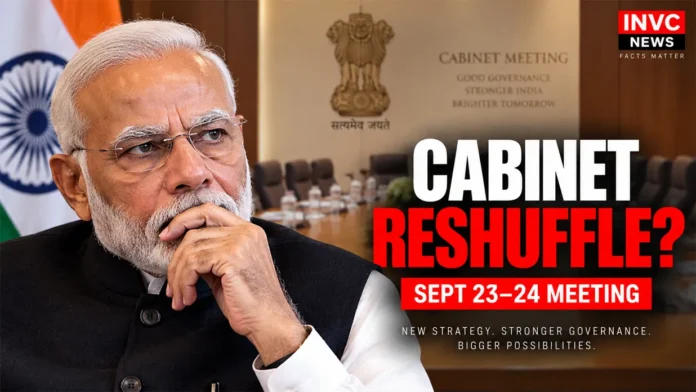
A two-day meeting of Prime Minister Narendra Modi and Union Cabinet ministers next week was initially being viewed as a high-level governance review.
Now, another question is rapidly moving to the centre of India’s political conversation:
Could the September 23–24 Chintan Shivir be followed by changes in the Union Cabinet?
Speculation over a possible Modi Cabinet reshuffle in 2026 has intensified after fresh reports linked the upcoming ministerial review with discussions over government performance, allocation of responsibilities and possible induction of new faces.
There is, however, one crucial distinction.
No Union Cabinet reshuffle has been officially announced.
Neither the Prime Minister’s Office nor the government has confirmed that the September 23–24 exercise will result in ministerial changes.
What has been confirmed through multiple reports is that Prime Minister Narendra Modi will bring Cabinet ministers together for two days of intensive discussions on governance, reforms, communication, coordination and the government’s priorities for the months ahead.
That combination—a full Cabinet review, recent assessment of Ministers of State and continuing political speculation—is what has made the meeting unusually important.
Why the September 23–24 Meeting Has Suddenly Become Politically Significant
The Chintan Shivir is expected to take place at Seva Teerth in New Delhi.
Cabinet ministers are expected to participate in discussions covering government performance, implementation of major programs, coordination between ministries and future priorities.
Prime Minister Narendra Modi has reportedly directed the formation of more than half a dozen groups of ministers, with roughly eight ministers in each group, to brainstorm on different subjects before the larger meeting.
The subjects under consideration reportedly include governance, communication and ways to improve the functioning of government.
On paper, this is a governance exercise.
Politically, however, its timing has triggered a much larger debate.
Cabinet Reshuffle Speculation Gets Fresh Fuel
Reports published on September 18 said discussions around a possible expansion or reorganisation of the Union Council of Ministers have continued alongside the government’s performance-review exercise.
Some reports have suggested that new faces, redistribution of portfolios and broader political representation are among the possibilities being discussed in political circles.
None of these possibilities has been formally confirmed.
That matters because Cabinet reshuffles routinely generate speculation around individual ministers long before an actual decision is taken.
At this stage, the most reliable conclusion is narrower:
PM Modi is reviewing the functioning and priorities of his government, while speculation about changes in the Council of Ministers has intensified.
Anything beyond that remains unconfirmed unless an authoritative announcement follows.
Ministers’ Performance Is Already Under Review
The September meeting does not appear in isolation.
Prime Minister Narendra Modi recently held an interaction with Ministers of State and sought feedback on the functioning of ministries and progress across departments.
Reports on that exercise said ministers presented information about work undertaken, outcomes and future action plans.
Ministerial communication and digital outreach have also received attention in recent months.
Taken together, these exercises indicate a wider review of government functioning.
They do not, by themselves, prove that a reshuffle has been finalised.
Still, political observers will closely watch whether the performance exercise eventually translates into changes in portfolios or personnel.
Why a Performance Review Matters Before Any Possible Reshuffle
Cabinet changes are not necessarily driven by a single factor.
Governments may alter ministerial responsibilities for administrative, political or coalition-management reasons.
Performance can become one consideration.
Workload can become another.
Some ministers may be holding multiple major responsibilities, while the government may also want greater representation for particular regions or sections of society.
Reports in recent weeks have discussed possible redistribution of additional portfolios, induction of new faces and changes designed to separate organisational responsibilities from government roles.
For now, those remain possibilities rather than decisions.
That distinction should remain central to any discussion of the Modi Cabinet reshuffle.
2021 Chintan Shivir Adds to the Curiosity — but Does Not Prove Anything
There is also a historical reason political circles are watching the forthcoming meeting closely.
A similar Chintan Shivir was held in October 2021 during the second Modi government’s term.
That session came only months after a major Union Cabinet reshuffle.
The 2021 meeting focused on governance and policymaking, with ministers participating in presentations and discussions designed to improve government functioning.
The forthcoming September 2026 exercise is expected to use a broadly similar brainstorming format.
However, the sequence from 2021 cannot automatically be applied to 2026.
A previous reshuffle occurring around a similar governance exercise does not establish that another reshuffle will follow this month’s meeting.
2027 Assembly Elections Add Another Political Layer
The political calendar also matters.
Important Assembly elections are due in 2027, with Uttar Pradesh and Punjab among the states drawing particular national attention.
Whenever a government considers organisational or ministerial changes ahead of a demanding electoral cycle, questions naturally emerge over regional representation and political messaging.
That does not mean the September meeting is an election-planning exercise.
Its reported agenda remains focused primarily on governance, reforms and coordination.
Still, the wider political environment explains why every ministerial review is now being examined for clues about what Prime Minister Narendra Modi may do next.
Will New Faces Enter the Modi Cabinet?
This is currently the most searched—and least settled—part of the story.
Several names have appeared in speculative media reports over recent weeks.
INVC NEWS is not treating those names as confirmed candidates.
There is currently no official list identifying ministers who may be dropped, portfolios that may change or leaders who may enter the government.
Until a formal announcement is made, individual-name speculation should be treated cautiously.
The stronger story is the structural one:
Prime Minister Narendra Modi is undertaking an extensive review of governance at a point when his government is moving deeper into its third term.
Whether that review results in personnel changes remains the unanswered question.
Could Existing Portfolios Be Redistributed?
Portfolio redistribution may prove just as important as the induction of new ministers.
A reshuffle does not always mean a large number of ministers entering or leaving government.
Sometimes the most consequential changes involve moving responsibilities between existing ministers.
Reports have suggested that allocation of additional portfolios is among the issues receiving attention in discussions around possible changes.
Again, there is no officially confirmed portfolio list.
Any final configuration would become known only through an official government announcement.
Governance, Delivery and Coordination Will Be at the Centre
Away from the political speculation, the substance of the Chintan Shivir is significant in its own right.
Ministers are expected to examine how efficiently government decisions are being implemented.
Inter-ministerial coordination is likely to receive particular attention because many flagship programs require several departments to work together.
Communication is another expected theme.
Government websites and their usability have also reportedly figured in recent discussions, fitting into the larger emphasis on improving public-service delivery.
These issues suggest that the meeting will look not only at what the government wants to achieve, but also at whether its administrative machinery is delivering those objectives efficiently.
What Could Happen After September 24?
Three broad outcomes are possible after the meeting.
The government could simply announce new governance priorities and implementation targets without making personnel changes.
A smaller exercise could involve redistribution of responsibilities among existing ministers.
Alternatively, Prime Minister Narendra Modi could eventually decide on a broader Cabinet expansion or reshuffle.
At present, none of those outcomes has been officially announced.
The most important signals will therefore come only after the two-day meeting concludes.
Why September 24 Could Become the Date Political Delhi Watches Closely
The significance of the Chintan Shivir now goes beyond the discussions scheduled inside the meeting room.
Ministers’ performance is under review.
Governance priorities are being reassessed.
Coordination and communication are on the agenda.
Meanwhile, speculation around changes in the Council of Ministers has intensified.
That creates a politically important window around September 23 and 24.
Yet speculation must not be confused with confirmation.
As of September 18, there is no official announcement of a Modi Cabinet reshuffle, no confirmed date for such an exercise and no verified list of ministers who may enter or leave the government.
For now, the September 23–24 Chintan Shivir is the confirmed event.
What comes immediately after it may determine whether the political speculation turns into an actual government restructuring—or remains only speculation.