By Team INVC | INVC NEWS
WASHINGTON, United States | September 18, 2026 —
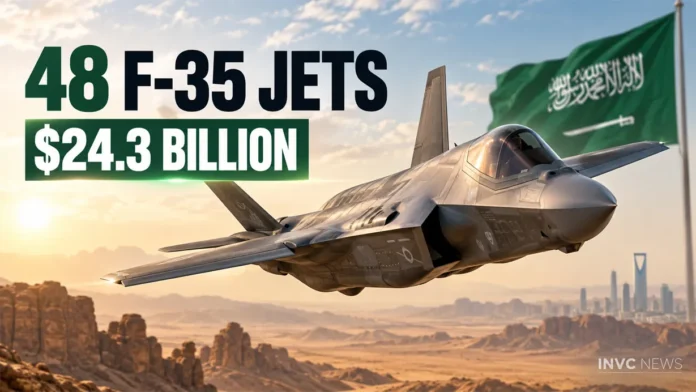
The United States has cleared a potential $24.3 billion sale of 48 F-35 Lightning II stealth fighter jets to Saudi Arabia, opening the way for one of the most consequential US-Saudi defence deals in years.
The package goes far beyond the aircraft themselves.
It includes 48 F-35 fighter jets, 49 Pratt & Whitney engines, associated equipment, training and support, according to the US approval announced on September 17.
However, the deal is not yet a completed aircraft purchase.
The US State Department has approved the possible Foreign Military Sale, and the proposal now remains subject to the American congressional review process before it can move toward final contracting and eventual delivery.
If completed, Saudi Arabia would become one of the few countries in the world to operate the advanced fifth-generation F-35.
And in the Middle East, the consequences would extend well beyond the Royal Saudi Air Force.
Saudi Arabia Could Get 48 F-35 Fighter Jets
The proposed sale covers 48 Lockheed Martin F-35 Lightning II aircraft.
The package also includes one more engine than aircraft — 49 Pratt & Whitney engines — allowing for an additional spare engine as part of the overall support structure.
Other elements of the proposed deal include equipment, logistics, training and technical assistance required to operate and maintain the aircraft.
The estimated total value is $24.3 billion.
That figure represents the maximum estimated package announced through the US foreign military sales process. Final contract values can change depending on equipment, configuration and agreements reached later.
What Makes the F-35 So Important?
The F-35 is not simply another fighter aircraft.
It is a fifth-generation combat platform designed around stealth, advanced sensors, electronic warfare systems and networked battlefield operations.
Its ability to combine information from multiple sensors allows pilots to build a detailed picture of threats around them.
Stealth characteristics also make the aircraft harder for conventional radar systems to detect than older fighter designs.
For Saudi Arabia, acquiring the F-35 would therefore represent a major technological step beyond much of its existing combat fleet.
The Royal Saudi Air Force already operates sophisticated US-made fighters, including variants of the F-15.
The F-35 would add a different set of capabilities.
Why Saudi Arabia Wants the F-35
Saudi Arabia has sought advanced US combat aircraft for years as it modernizes its armed forces.
Regional security has also become increasingly complicated.
Missiles, drones and long-range weapons have transformed the military environment across the Gulf and wider Middle East.
Saudi Arabia has faced drone and missile threats connected to the conflict with Yemen’s Houthi movement, while tensions involving Iran have added another layer of risk to regional security.
The F-35 deal would therefore become part of a much broader Saudi military modernization programme rather than an isolated purchase.
Israel Is Central to the Debate
One issue is certain to receive close attention as the proposal moves forward: Israel’s qualitative military edge.
Israel is currently the only country in the Middle East operating the F-35.
US policy and law have long required Washington to consider Israel’s ability to maintain a qualitative military advantage when approving major weapons transfers to other countries in the region.
That does not automatically prevent a Saudi purchase.
But it means questions about aircraft configuration, capabilities and safeguards could become important during the review and implementation process.
Israeli officials have previously expressed concern over the possibility of advanced F-35 aircraft being sold to Saudi Arabia.
The issue is therefore likely to remain part of the wider diplomatic discussion around the sale.
Congress Still Has a Role
The phrase “US approves the deal” needs one important explanation.
The State Department’s approval is a major step, but it does not mean 48 aircraft are immediately heading to Saudi Arabia.
Major US arms sales normally pass through a congressional notification and review process.
Lawmakers can scrutinize the proposed sale and raise objections.
That scrutiny could involve several issues, including regional security, technology protection, Saudi Arabia’s human-rights record and Israel’s military edge.
Only after the relevant processes are completed can the transaction advance toward contracts, manufacturing, training and eventual delivery.
Therefore, there is no immediate delivery date simply because the sale has received State Department approval.
$24.3 Billion Deal Deepens US-Saudi Defence Relationship
Saudi Arabia has long been one of the largest customers of American defence equipment.
Its military operates a wide range of US systems, including fighter aircraft, helicopters, air-defence systems, armoured vehicles and other platforms.
The proposed F-35 sale would deepen that relationship further.
For US defence companies, the deal could also generate long-term business beyond aircraft manufacturing.
Modern fighter programmes require years of training, spare parts, software support, maintenance and technical assistance.
The economic value of the relationship can therefore extend well beyond the initial purchase.
Lockheed Martin Stands at the Center of the Deal
The F-35 is manufactured by Lockheed Martin, while Pratt & Whitney produces its F135 engine.
The proposed Saudi package would place both companies at the centre of another major international F-35 programme if the sale ultimately proceeds.
The F-35 already operates across the United States and a growing number of allied and partner air forces.
Adding Saudi Arabia would expand the aircraft’s footprint into one of the world’s most strategically important regions.
Could This Change the Middle East Air-Power Balance?
A completed Saudi F-35 purchase would significantly upgrade the kingdom’s combat-air capabilities.
That does not by itself determine the regional military balance.
Aircraft numbers, pilot training, weapons packages, maintenance, intelligence networks, air defence, operational doctrine and restrictions on exported technology all matter.
Still, the possibility of a second Middle Eastern state operating F-35s would represent a notable change from the current situation, in which Israel is the region’s only operator.
That is why the sale is attracting attention far beyond Washington and Riyadh.
Iran Will Be Watching Closely
The deal also comes against a backdrop of continuing regional tension involving Iran.
Saudi Arabia and Iran restored diplomatic relations in 2023, but security competition across the wider region has not disappeared.
Iran possesses large missile and drone arsenals and maintains relationships with armed groups across several countries.
Saudi Arabia, meanwhile, has invested heavily in air and missile defence as well as modern combat aircraft.
A future Saudi F-35 fleet would add another major capability to that security equation.
Exactly how Tehran responds diplomatically or militarily cannot yet be determined.
What Happens Next?
The announcement starts an important phase rather than ending the process.
The key steps to watch now include:
US congressional review of the proposed sale.
Any conditions or restrictions attached to the package.
Discussions surrounding Israel’s qualitative military edge.
Final contracting between the parties.
Production and training schedules.
The eventual configuration of Saudi F-35 aircraft.
Even after political approvals are complete, sophisticated aircraft such as the F-35 normally require a lengthy process before becoming operational.
Pilots and ground crews must be trained.
Infrastructure must be prepared.
Maintenance systems need to be established.
And aircraft must be manufactured and delivered.
Why This $24.3 Billion Deal Matters
The headline number is enormous.
$24.3 billion.
But the larger story is not simply how much Saudi Arabia could spend.
It is what the purchase represents.
For Riyadh, the deal would accelerate the modernization of its air force.
For Washington, it would deepen a decades-old security relationship with Saudi Arabia.
For Israel, it raises questions about maintaining its qualitative military edge.
And across the Middle East, it would place one of the world’s most advanced fighter aircraft in another major regional air force.
The State Department has opened the door.
Congress now becomes part of the process.
Only after those remaining steps will it become clear when — and under exactly what conditions — Saudi Arabia could begin operating the F-35.