By Team INVC | INVC NEWS
NEW DELHI, India | September 15, 2026 —
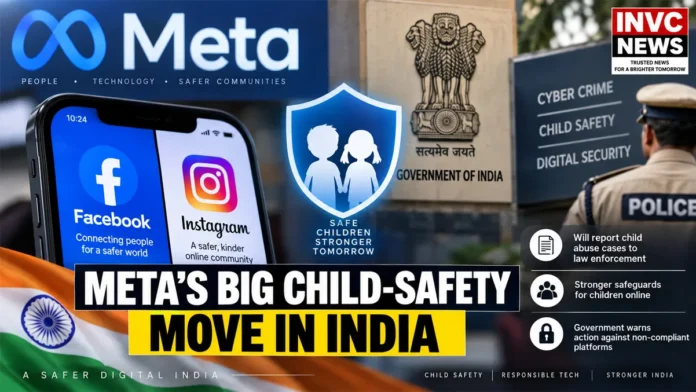
Meta child safety India measures are set for a significant change after the technology company agreed to report child sexual abuse cases and other child-safety matters to appropriate law-enforcement agencies in India, according to government sources.
The development follows growing scrutiny of online platforms over harmful content involving children and sustained engagement between the Indian government and major social-media companies.
Government sources described children’s online safety as a fundamental and “non-negotiable” requirement for any social-media platform operating in India. Officials, however, stressed that Meta’s commitment represents only an initial step and said substantially more work remains necessary to make digital platforms safer for children.
Meta agrees to report child-safety cases
Under the commitment outlined by government sources, Meta will report child-safety-related matters to appropriate Indian law-enforcement agencies.
The move assumes particular significance in cases involving Child Sexual Exploitation and Abuse Material, commonly referred to as CSEAM, and other forms of sexual abuse involving children online.
Until now, questions surrounding how platforms identify, report and act on such material have attracted increasing attention from regulators, courts and child-protection authorities.
Government sources said Meta’s decision marks a first step toward strengthening online safeguards. At the same time, authorities made clear that reporting alone will not settle the broader issue.
Government puts other social-media platforms on notice
The Centre is also engaging with other online platforms and wants companies to proactively identify and remove harmful material involving children.
That means the government’s focus extends beyond responding after prohibited material appears online. Authorities increasingly expect platforms to build systems capable of detecting harmful content and acting rapidly when they identify it.
The government has also warned that it could take action against platforms that fail to adopt proactive measures for protecting children.
That warning potentially raises the stakes for the wider technology industry because India’s regulatory framework already imposes due-diligence requirements on online intermediaries.
Why Meta is facing increased scrutiny in India
Meta’s latest commitment comes after Indian authorities intensified scrutiny of its platforms over allegations involving Child Sexual Exploitation and Abuse Material.
Representatives of Meta India appeared before the National Commission for Protection of Child Rights on September 9 as part of an inquiry into alleged advertisements connected with CSEAM.
The NCPCR had earlier taken suo motu cognisance of a media investigation concerning alleged advertisements on Meta-owned platforms and sought an explanation from Meta Platforms.
Separately, the National Human Rights Commission directed Delhi Police to investigate allegations involving paid advertisements on Instagram that allegedly promoted access to child sexual abuse material.
Authorities have also examined whether mandatory reporting requirements under India’s Protection of Children from Sexual Offences Act were followed.
These remain allegations under regulatory and investigative scrutiny, and the latest reporting does not establish criminal liability against Meta.
India’s rules already demand stronger protection
India has an existing legal framework governing harmful online content.
The government has said the Information Technology Act and the Information Technology (Intermediary Guidelines and Digital Media Ethics Code) Rules impose due-diligence responsibilities on online intermediaries.
Significant social-media intermediaries must also make reasonable efforts to deploy technical measures, including automated tools, to proactively identify certain categories of previously removed or prohibited material involving child sexual abuse or exploitation.
Government information released in August also said platforms must act rapidly after receiving qualifying complaints involving nudity, sexual acts or certain intimate imagery.
Therefore, Meta’s latest commitment should be viewed as part of a wider regulatory push rather than as an isolated company announcement.
Facebook and Instagram safeguards face closer attention
The development carries particular importance because Meta operates some of India’s most widely used social platforms, including Facebook and Instagram.
Children and teenagers increasingly interact with social networks, messaging services, short-form videos and recommendation systems. Consequently, policymakers around the world have focused on how algorithms, advertising systems and moderation tools handle potentially harmful material.
India’s current approach signals that platforms may increasingly need to demonstrate not only that they remove prohibited material after receiving a complaint, but also that their systems can detect risks proactively and cooperate effectively with law-enforcement agencies.
What happens next?
Attention will now shift to how Meta implements its commitment in practice.
Key questions include how quickly cases reach Indian authorities, how evidence is preserved, how potentially illegal material is detected and whether other large social-media companies adopt comparable mechanisms.
The government has already indicated that it intends to continue engaging with other platforms.
For users, parents and child-safety advocates, the effectiveness of these measures will ultimately depend on enforcement, detection technology, response times and cooperation between platforms and Indian authorities.
Meta’s agreement nevertheless represents an important development in India’s expanding effort to make online platforms more accountable for child safety.