By Team INVC | INVC NEWS
NEW DELHI, India | September 15, 2026 —
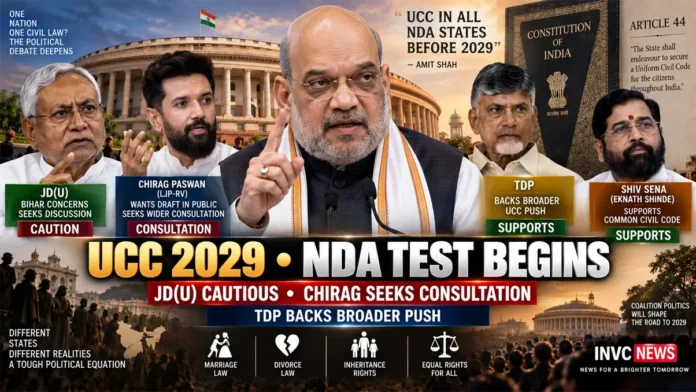
Uniform Civil Code 2029 has moved from a BJP policy promise into a complicated test of NDA coalition politics after Union Home Minister Amit Shah declared that all 21 BJP- and NDA-ruled states would implement a Uniform Civil Code before the 2029 Lok Sabha elections.
The political response inside the ruling alliance is proving more nuanced than a simple yes-or-no divide.
Janata Dal (United), the BJP’s crucial ally in Bihar, has signaled strong reservations and wants direct talks with Shah before taking the process forward. Lok Janshakti Party (Ram Vilas) chief Chirag Paswan has called for the draft to be made public and subjected to wider stakeholder consultation before his party announces its final position.
The Telugu Desam Party, however, has moved toward supporting the broader UCC objective, while Eknath Shinde’s Shiv Sena has long backed the principle of one common civil framework.
The emerging picture is therefore not an outright NDA rebellion.
It is a much more politically significant challenge: Can the BJP turn one of its oldest ideological commitments into law across 21 diverse coalition-governed states without upsetting the regional parties that help hold the alliance together?
Amit Shah Sets a 2029 Political Clock
Shah brought the issue back to the center of national politics when he said he was confident that UCC would be implemented across all 21 BJP- and NDA-governed states before the next Lok Sabha election.
That statement did more than restate BJP ideology.
It created a deadline.
Every NDA state government can now expect questions about when it will begin consultations, appoint expert panels, prepare draft legislation and introduce a bill.
The BJP has spent years presenting the Uniform Civil Code as part of its larger agenda of equal civil laws.
However, a state-by-state rollout now brings regional allies directly into the process.
That is where political arithmetic becomes more complicated.
JD(U) Becomes the Biggest Question Mark
The sharpest uncertainty comes from Bihar.
JD(U) working president Sanjay Jha has said party leaders will meet Amit Shah to discuss the issue before taking a definitive position.
Other JD(U) voices have gone further and reiterated the party’s longstanding caution over implementing UCC in Bihar.
The party’s position matters because JD(U) is not a peripheral NDA partner.
It is one of the alliance’s major political forces and has traditionally emphasized Bihar’s social diversity, caste coalitions, minority communities and regional political sensitivities.
JD(U)’s history on UCC has also been more cautious than the BJP’s.
The party has previously argued that reform affecting personal laws should proceed through broad consultation and should avoid hurting the customs or interests of any community.
That leaves Shah’s 21-state deadline facing its first serious coalition test.
Bihar Could Become the Most Difficult UCC Battlefield
Bihar presents a political environment very different from states where the BJP has greater freedom to pursue its own ideological agenda.
The NDA coalition there depends on multiple regional parties and carefully constructed social alliances.
UCC touches marriage, divorce, inheritance, succession, adoption and other personal-law questions.
Any proposal can therefore affect religious groups, tribal communities, caste-based political constituencies and regional customs differently.
For JD(U), the issue is not simply whether the idea of legal equality sounds attractive.
The party must also calculate how a particular draft would operate inside Bihar.
That distinction explains why the final text could matter more to regional allies than Shah’s broad political announcement.
Chirag Paswan Wants the Draft Before Giving His Verdict
LJP (Ram Vilas) chief Chirag Paswan has taken a cautious but not confrontational position.
Rather than rejecting UCC outright, he has emphasized India’s social diversity and called for the proposed draft to be placed in the public domain.
His position is essentially: show the law first, consult everyone, then decide.
Paswan has pointed to India’s different customs, traditions and constitutional protections as reasons for undertaking extensive consultations.
That approach gives the BJP room to negotiate.
At the same time, it prevents the party from assuming that every NDA constituent has already signed off on the final form of UCC.
This is an important distinction.
A coalition partner can support the principle of equality before civil law while still disagreeing with specific provisions in a draft.
TDP’s Position Reduces Talk of a Full NDA Revolt
The political picture became more balanced after the Telugu Desam Party signaled support for the UCC direction.
TDP’s position matters enormously because Andhra Pradesh Chief Minister N. Chandrababu Naidu leads one of the NDA’s most important regional parties.
The party has historically emphasized consultation on socially sensitive issues.
Its latest support therefore reduces the possibility of describing the current situation as a broad coalition revolt against Shah.
Instead, the alliance is displaying different degrees of enthusiasm.
Some partners are ready to back UCC.
Others want safeguards.
Still others want to see the draft before committing.
That is classic coalition politics rather than a straightforward ideological split.
Eknath Shinde’s Shiv Sena Is Firmly in the Pro-UCC Camp
The Shiv Sena led by Eknath Shinde does not present the BJP with the same problem.
Shinde has repeatedly supported a Uniform Civil Code and has linked the position to the political legacy of Balasaheb Thackeray.
For the Shiv Sena, UCC sits comfortably alongside long-established ideological positions on national integration and common civil rules.
That gives the BJP an important ally in Maharashtra.
However, support from Maharashtra does not automatically solve the Bihar problem or the concerns that could emerge in tribal and northeastern regions.
Why BJP Cannot Treat All 21 States the Same
The phrase “21 NDA-ruled states” sounds politically powerful.
Legally and socially, however, those states are not identical.
India contains different religious traditions, tribal customary laws, family practices and regional legal arrangements.
A model acceptable in Uttarakhand may require substantial modifications elsewhere.
States with large tribal populations face especially sensitive questions.
Constitutional protections under the Fifth and Sixth Schedules and special provisions applying to parts of the Northeast add another layer of complexity.
Shah has previously indicated that tribal rights and traditional practices would be protected.
The details of those protections could ultimately decide whether regional allies accept individual state bills.
What Uniform Civil Code Actually Covers
The UCC debate often becomes politically charged before the legal details are discussed.
At its core, a Uniform Civil Code seeks common civil rules in personal-law areas such as marriage, divorce, inheritance, succession, adoption and maintenance.
India currently applies different legal frameworks in some of these areas depending on religion and other circumstances.
Supporters argue that common rules could strengthen equality, particularly for women, and ensure that citizens enjoy similar civil rights regardless of religious identity.
Critics argue that India’s diversity requires greater protection for cultural, religious and customary practices.
That conflict between equality and diversity sits at the heart of the debate.
Article 44 Gives UCC a Constitutional Foundation
The Constitution itself contains a reference to Uniform Civil Code.
Article 44, part of the Directive Principles of State Policy, says the State should endeavor to secure a Uniform Civil Code for citizens throughout India.
However, Directive Principles are not automatically enforceable rights.
A government must still enact legislation through the appropriate constitutional process.
That means Shah’s announcement does not itself change anyone’s marriage, inheritance or divorce rights.
Existing laws remain in force until a legislature passes new provisions and they are formally implemented.
Uttarakhand Has Become BJP’s Political Template
Uttarakhand has already provided the BJP with a working example of state-level UCC implementation.
Its experience gives the party a model it can point to as other NDA governments consider their own legislation.
However, BJP leaders are unlikely to be able to simply copy and paste one state’s law into every other state.
Local political conditions matter.
Demography matters.
Tribal safeguards matter.
Regional coalition partners matter.
The final UCC process could therefore produce significant differences between states even if they all move toward a broader common-law objective.
The Bigger BJP Strategy Is Becoming Clear
Shah’s statement also reveals something about the BJP’s national strategy.
Instead of waiting only for one sweeping central law, the party can build UCC state by state.
That approach offers several advantages.
It allows individual governments to test different frameworks.
It gives policymakers time to address legal challenges.
It also keeps UCC politically active across multiple election cycles leading toward 2029.
Most importantly, every state that implements a UCC gives the BJP another example to use in the national debate.
By 2029, the party could argue that what once appeared to be a controversial national proposal has already become established policy across much of NDA-governed India.
But Coalition Politics Could Slow the Timeline
The same state-by-state strategy also creates a weakness.
The BJP does not govern every NDA state alone.
Regional partners have their own voter bases, political histories and ideological boundaries.
A central declaration therefore cannot automatically become identical legislation in every state.
JD(U)’s response demonstrates that clearly.
Chirag Paswan’s demand for consultation reinforces the point.
The process could become less about whether UCC happens and more about what exemptions, safeguards and state-specific provisions are necessary to keep coalition partners comfortable.
Opposition Parties See an Opening
The differing NDA reactions have given opposition parties a political opportunity.
Critics are asking whether Shah can realistically promise implementation in every NDA state before securing explicit agreement from all alliance partners.
AIMIM chief Asaduddin Owaisi has attacked the proposal and questioned whether NDA allies have an independent political voice.
Congress leaders have also argued that major personal-law reform requires constitutional sensitivity and broad consensus.
The opposition is likely to focus heavily on disagreements within the NDA rather than debate UCC solely as a BJP-versus-opposition issue.
That strategy could be particularly effective in Bihar, where regional political identities remain powerful.
BJP Will Frame UCC Around Equality
The BJP’s counterargument is equally predictable.
It will present UCC as a question of equality before civil law rather than religious interference.
Party leaders are likely to emphasize women’s rights, uniformity in marriage and inheritance provisions and the constitutional language of Article 44.
The BJP can also argue that consultation and local safeguards do not contradict the broader objective.
That gives the party room to negotiate with allies without abandoning its political commitment.
This Is Not Yet an NDA Crisis
It would be premature to describe the current disagreement as a coalition rupture.
TDP supports the broader push.
Shiv Sena supports UCC.
Chirag Paswan has not rejected it.
JD(U) wants discussions and has raised serious Bihar-specific reservations.
The immediate problem for BJP is therefore not alliance survival.
It is consensus management.
Yet that challenge should not be underestimated.
Amit Shah has publicly attached a 2029 deadline to the policy.
Every delay or refusal by an NDA state can now be presented politically as a test of whether the BJP can deliver its own promise.
Bihar May Decide How Flexible the BJP Is Willing to Be
The coming discussions between JD(U) leaders and Amit Shah could become especially important.
If the two sides find common ground through exemptions, consultations or a Bihar-specific framework, the BJP can argue that coalition consensus remains intact.
If JD(U) maintains an outright refusal to implement UCC in Bihar, Shah’s declaration that all 21 NDA-governed states will adopt it becomes much harder to deliver literally.
That makes the Bihar conversation far more than a regional dispute.
It could determine how flexible the BJP’s entire state-by-state UCC model becomes.
Uniform Civil Code 2029 Is Now a Coalition Test
Amit Shah has successfully pushed UCC back to the center of Indian politics.
The next phase will be harder.
Announcing a deadline is one thing.
Turning the same ideological goal into workable law across 21 politically and socially different states is another.
BJP enters that process with strong support from some allies.
It also faces caution from others.
That tension could ultimately shape the UCC more than the original announcement itself.
The political battle is therefore no longer simply BJP versus the opposition. It is now also about how far the BJP can push a core ideological goal while keeping every major NDA partner inside the tent on the road to 2029.