By Team INVC | INVC NEWS
NEW DELHI, India | September 14, 2026 —
The BRICS Summit 2026 key decisions could shape debates over global finance, artificial intelligence, trade, climate policy and international governance for years after leaders left New Delhi.
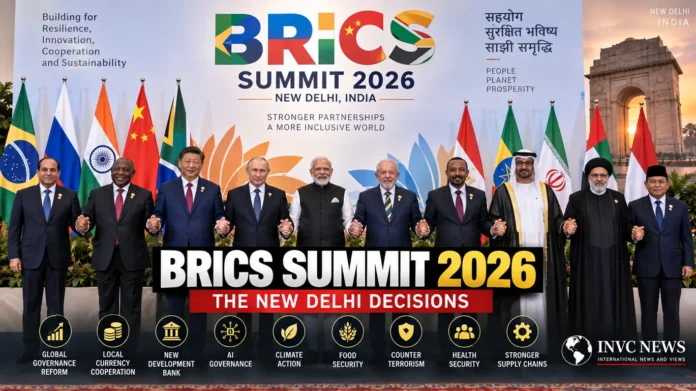
The 18th BRICS Summit, held in the Indian capital on September 12–13, brought together leaders of the expanded grouping at a moment of intense geopolitical tension.
Yet the summit produced a consensus-backed New Delhi Declaration, giving the bloc a common position on issues ranging from United Nations reform and cross-border payments to terrorism, health security, food supplies and artificial intelligence.
For readers trying to understand what BRICS actually decided in 2026 — rather than simply what individual leaders proposed — these are the outcomes that matter most.
What Was the BRICS Summit 2026?
BRICS began as a grouping of Brazil, Russia, India, China and South Africa.
Its membership later expanded to include Egypt, Ethiopia, Iran, the United Arab Emirates and Indonesia.
The 2026 summit marked the 20th anniversary of BRICS cooperation and took place under India’s chairship.
India selected the theme:
Building for Resilience, Innovation, Cooperation and Sustainability.
More than 400 meetings and engagements across around 30 Indian cities contributed to the wider BRICS process during the year.
The New Delhi summit then brought many of those negotiations into a single political declaration.
1. BRICS Backed Major Reform of Global Governance
One of the summit’s most important long-term messages concerned the structure of global institutions.
BRICS leaders called for a more representative international system that gives emerging and developing economies a greater role in global decision-making.
The New Delhi Declaration again backed comprehensive reform of the United Nations, including the UN Security Council.
It specifically called for greater representation for developing nations from Africa, Asia and Latin America.
China and Russia, both permanent members of the Security Council, also reiterated support for the aspirations of India and Brazil to play a greater role at the UN, including in the Security Council.
This remains politically significant even though it does not itself create new permanent seats.
UN Security Council reform requires a much broader international agreement.
2. IMF and World Bank Reform Became a Major Financial Demand
BRICS also renewed pressure for reform of the institutions created under the Bretton Woods system.
Leaders argued that the governance of the International Monetary Fund and World Bank should better reflect the economic weight of emerging and developing countries.
The declaration called for greater representation of emerging-market and developing economies in leadership, quota allocation and voting power.
BRICS also pushed for meaningful IMF quota realignment under the 17th General Review of Quotas.
This issue matters because voting shares influence how much power countries hold inside the global financial architecture.
For BRICS, reforming existing institutions remains as important as creating alternative mechanisms.
3. No BRICS Currency — But Local-Currency Trade Moves Forward
One of the biggest misconceptions surrounding BRICS concerns the idea of a common currency.
The 2026 summit did not launch a BRICS currency.
Instead, members continued work on more efficient cross-border payment systems.
The BRICS Payment Task Force is studying interoperability between payment and financial messaging systems.
Members also discussed expanding trade settlements and investment transactions using their national currencies.
The language remains deliberately flexible.
Each country retains its own financial regulations and monetary priorities, and the declaration acknowledges that there is no single model suitable for every member.
Therefore, the most accurate description is:
BRICS is exploring alternatives and additions to existing cross-border payment channels, not replacing national currencies with one BRICS currency.
That distinction will remain important whenever speculation about “BRICS de-dollarization” resurfaces.
4. New Development Bank Gets a Bigger Role
The summit reaffirmed support for the New Development Bank, or NDB.
BRICS leaders want the bank to increase its ability to finance infrastructure and sustainable-development projects across emerging economies.
The declaration encouraged the NDB to:
expand local-currency financing, diversify funding sources, mobilize more capital and support infrastructure, resilience and economic integration.
Leaders also supported further expansion of NDB membership.
India’s chairship additionally helped launch a BRICS-NDB Knowledge Portal, designed to preserve policy experience and knowledge across different BRICS chairships.
The NDB therefore remains one of the bloc’s most tangible financial institutions.
5. BRICS Took a Common Position on Artificial Intelligence
Artificial intelligence emerged as another major pillar of the New Delhi summit.
BRICS countries recognized AI’s potential to drive economic growth and sustainable development while also acknowledging safety, security and reliability risks.
The leaders committed to implementing the BRICS Leaders’ Statement on the Global Governance of Artificial Intelligence.
Their approach emphasizes wider access to AI resources, international cooperation, trustworthy AI systems and the interests of the Global South.
The declaration also discusses AI applications across healthcare, education, finance, energy systems, tourism and the green economy.
That makes AI governance one of the most important emerging areas of BRICS cooperation.
Separately, Chinese President Xi Jinping announced plans for China to lead work on a BRICS AI Open Source Zone.
That initiative should be treated as a China-led proposal within broader BRICS cooperation rather than as a single common BRICS AI platform already operating today.
6. Food Security and a BRICS Grain Exchange Remain on the Agenda
BRICS members account for a substantial share of global agricultural production.
The New Delhi Declaration therefore devoted considerable attention to food security.
Leaders supported continued work toward a proposed BRICS Grain Exchange.
The concept could eventually provide a platform for grain trading among participating economies and potentially expand into other agricultural commodities.
However, the exchange has not yet become a fully operational common BRICS marketplace.
The declaration says members will continue discussions over its structure and functioning.
BRICS also backed a farmer-focused network known as AGRIN — Agro-Inputs, Genetic Resources and Information Network.
Additional cooperation will focus on digital agriculture, agroecology, regenerative farming and climate resilience.
7. India Secured Strong BRICS Language Against Terrorism
The New Delhi Declaration contains significant counterterrorism language.
BRICS leaders condemned terrorism in all its forms and manifestations and rejected attempts to associate terrorism with any religion, nationality or civilization.
They also condemned the April 22, 2025 terrorist attack in Jammu and Kashmir in which 26 people were killed.
The declaration specifically addresses:
cross-border movement of terrorists, terrorist financing, safe havens and the need for action against UN-designated terrorist individuals and organizations.
Members also called for zero tolerance toward terrorism and rejected double standards in counterterrorism.
For India, this section represented an important diplomatic outcome because it placed cross-border terrorism inside a consensus document approved by the entire bloc.
8. BRICS Called for Restraint in the Middle East
Geopolitical tensions created one of the summit’s biggest tests.
BRICS includes Iran as well as the United Arab Emirates, making a common declaration during escalating Middle East hostilities especially difficult.
Despite those differences, members reached consensus.
The New Delhi Declaration expressed deep concern over escalating Middle East tensions and called for maximum restraint.
It emphasized dialogue, consultation and diplomacy as the preferred mechanisms for resolving international disputes.
The ability to reach consensus despite major differences became one of the summit’s most politically significant outcomes.
9. Climate Finance and Carbon Markets Move Higher on the Agenda
Climate policy formed another substantial part of the summit.
BRICS countries reaffirmed their commitment to the Paris Agreement while arguing that developing economies need greater access to finance and technology.
Members supported implementation of cooperation under the BRICS Carbon Markets Partnership.
The declaration also emphasized adaptation finance, climate-resilient infrastructure and community-based adaptation.
Importantly, BRICS opposed unilateral climate-related trade measures that members view as discriminatory or protectionist.
This issue is likely to remain important as carbon-border rules increasingly affect international trade.
10. BRICS Built New Mechanisms for Health Security
Some of the summit’s most practical decisions came in healthcare.
Members welcomed work on a BRICS Integrated Early Warning System for infectious diseases.
They also endorsed the BRICS Mission for Healthy Lifestyle and a joint roadmap covering 2026–2029.
Mental health received significant attention as well.
The summit backed a network of Centres of Excellence, with India’s NIMHANS serving as the coordinating center.
Members also supported deeper cooperation in digital health, medical-product regulation, vaccines, traditional medicine and preparedness for future public-health emergencies.
11. Small Businesses Could Benefit From New Financing Cooperation
The summit addressed a problem that affects businesses across emerging markets: access to working capital.
BRICS welcomed the Jaipur Consensus for studying an invoice-discounting mechanism across member economies.
Such a system could eventually help export-oriented MSMEs unlock cash tied up in unpaid invoices.
Members also adopted guiding principles intended to improve credit assessment for export-oriented small businesses.
The initiative remains under development, but it represents a highly practical area of economic cooperation.
12. Supply Chains, Transport and Special Economic Zones Gain Importance
BRICS countries agreed to strengthen cooperation on global value chains and supply resilience.
The summit welcomed the BRICS Global Value Chain Action Plan 2026–2030 and a Logistics Supply-Chain Cooperation Framework.
Members also discussed stronger cooperation between Special Economic Zones.
China separately proposed a BRICS Special Economic Zone partnership and said it would host a BRICS Service Trade Forum in 2027.
These initiatives reflect an important change in BRICS.
The grouping increasingly wants to move beyond political declarations toward practical trade, infrastructure and industrial cooperation.
13. Workers, Skills and Remote Employment Enter the BRICS Framework
Employment policy also gained a stronger international dimension.
Members backed BRICS CONNECT, a cooperation network focused on employability, new skills and technologies.
The declaration also notes an initiative to establish an International Digital Platform for Remote Employment among BRICS countries.
Another priority involves protecting migrant workers by improving portability of social-security benefits and preventing duplicate contributions.
These initiatives could become increasingly relevant as digital work allows employees to work across borders without traditional relocation.
14. India Proposed a BRICS Reform Roadmap
Prime Minister Narendra Modi used the summit to argue that BRICS must become better at converting declarations into measurable outcomes.
He proposed a BRICS Continuity and Implementation Mechanism so that projects continue even when the rotating chair changes.
PM Modi also suggested developing 10 proposals for global-governance reform into a future BRICS Reform Roadmap.
These should be understood as Indian proposals for BRICS’s next phase rather than completed institutions established immediately by the New Delhi Declaration.
That distinction matters when measuring the summit’s actual outcomes.
Why the 2026 New Delhi Summit Matters
The biggest lesson from BRICS Summit 2026 is that the grouping is trying to transform itself from a diplomatic forum into a broader platform for practical cooperation.
It did not create a new currency.
It did not replace the IMF or World Bank.
It did not establish a new global order overnight.
Instead, the summit advanced a series of mechanisms that could gradually increase cooperation between large emerging economies.
Those mechanisms include local-currency payments, NDB financing, AI governance, food security, climate finance, health networks, supply chains and institutional reform.
The New Delhi Declaration also showed that countries with major geopolitical differences can sometimes still find common ground.
That may prove to be the summit’s most enduring significance.
What Happens After BRICS Summit 2026?
China will hold the BRICS chairship in 2027 and host the 19th BRICS Summit.
That makes implementation the next big test.
Several New Delhi initiatives require further technical negotiations before they become operational.
Future progress on payments, trade finance, the Grain Exchange, AI cooperation, climate mechanisms and institutional reform will determine whether the 2026 summit becomes a genuine turning point or mainly another ambitious declaration.
For India, the summit established a detailed agenda.
For BRICS, the harder task begins after New Delhi: turning consensus into results.