By Team INVC | INVC NEWS
MUMBAI, India | September 14, 2026 —
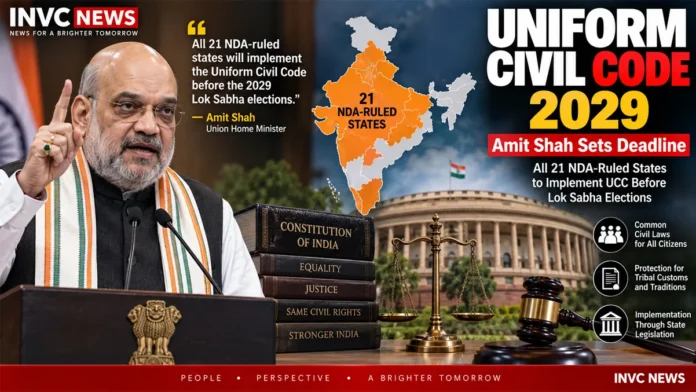
Uniform Civil Code 2029 has moved firmly to the center of India’s political debate after Union Home Minister Amit Shah said all 21 states governed by the BJP-led National Democratic Alliance will implement the UCC before the next Lok Sabha elections.
Shah’s declaration sets a clear political timeline for one of the Bharatiya Janata Party’s longest-standing ideological commitments and signals that the party intends to push the issue aggressively across states during the next three years.
The announcement could trigger a fresh nationwide debate over personal laws, religious freedom, gender equality, tribal customs and the constitutional principle of a Uniform Civil Code.
Amit Shah Sets 2029 Deadline for UCC
Speaking in Mumbai, Shah said NDA governments in all 21 states would implement a Uniform Civil Code before the 2029 Lok Sabha elections.
His remarks transform the UCC from a broad political objective into a state-by-state implementation roadmap.
The Union Home Minister presented the move as part of the government’s commitment to equal civil rights.
Under a UCC framework, common civil rules would broadly govern matters such as marriage, divorce, inheritance and adoption instead of separate personal laws applying on the basis of religion.
However, individual state legislation and its exact provisions can differ.
Why the 21-State Announcement Matters
The political significance goes well beyond the number of states involved.
Until now, much of the national debate has focused on whether India should enact a single nationwide UCC.
Shah’s latest statement points toward another route: NDA-led states can move individually and introduce their own UCC legislation.
That strategy could allow the BJP to expand the policy gradually without waiting for one nationwide law covering the entire country.
It could also turn UCC into a major electoral issue before 2029.
Tribal Communities to Remain Protected, Shah Says
One of the most sensitive issues surrounding UCC concerns India’s tribal communities.
Shah has previously said that implementation would not interfere with tribal rights, traditions and customary practices.
The government has repeatedly attempted to address concerns that a common civil framework could affect long-established tribal customs.
This distinction will become increasingly important as more states draft their own legislation.
States with large tribal populations may need specific exemptions and safeguards before moving ahead.
What Is the Uniform Civil Code?
A Uniform Civil Code aims to create a common set of civil laws for citizens regardless of religion.
Personal-law matters can include:
- Marriage
- Divorce
- Inheritance
- Succession
- Adoption
- Maintenance
- Family-related civil rights
Article 44 of the Constitution says the State shall endeavor to secure a Uniform Civil Code for citizens throughout India.
However, Article 44 forms part of the Directive Principles of State Policy rather than an automatically enforceable fundamental right.
Successive governments have therefore debated the issue for decades without introducing a single nationwide civil code.
UCC Has Long Been a Core BJP Promise
The Uniform Civil Code has remained one of the BJP’s major policy commitments for years.
Alongside issues such as the abrogation of Article 370, the party has consistently included UCC in its broader political agenda.
BJP leaders argue that citizens should have equal civil rights regardless of religious identity.
Supporters also maintain that common rules can strengthen gender equality in areas such as marriage, divorce and inheritance.
Critics, however, question whether one framework can adequately accommodate India’s extensive religious, cultural and customary diversity.
That disagreement ensures the issue will remain politically contentious.
States Could Become the Main UCC Battleground
Shah’s latest announcement suggests that state legislatures may now become the principal arena for the UCC debate.
Individual governments can establish committees, prepare draft legislation, hold consultations and bring bills before their respective assemblies.
That process also means there may not be one identical UCC model across all NDA states.
Each state could address local customs and demographic circumstances while pursuing a broader objective of civil-law uniformity.
The details will therefore matter as much as the political announcement.
What Changes for Marriage and Divorce?
A UCC can potentially standardize rules governing marriage registration, minimum age, divorce procedures and maintenance.
However, the actual changes depend entirely on the legislation adopted by each state.
The announcement itself does not automatically change anyone’s marriage or divorce rights.
Existing laws continue to apply until the relevant legislature passes a new law and it enters into force.
That distinction is important amid the political debate.
What Could Change in Inheritance?
Inheritance and succession represent another major area covered by personal laws.
Different religious communities currently follow different legal provisions in certain circumstances.
A UCC could seek greater uniformity in inheritance rights.
Supporters argue that common provisions may strengthen equality.
Opponents and community organizations may seek protections for established customs.
State governments will therefore face considerable scrutiny over the precise wording of future bills.
Opposition Likely to Challenge BJP’s UCC Push
The 2029 deadline is certain to intensify the political battle between the NDA and opposition parties.
Critics of the BJP have historically argued that civil-law reform should emerge through broad consultation rather than political majorities alone.
Opposition parties may also question whether state-level UCC laws can genuinely produce national uniformity if different states adopt different provisions.
The BJP, meanwhile, is likely to frame implementation around equality before civil law and its record of fulfilling long-standing commitments.
That makes UCC a potentially powerful campaign issue.
Amit Shah Also Talks About NRC
Shah’s wider political remarks also touched on the National Register of Citizens.
He indicated that discussions remain underway around the NRC, including issues connected with Manipur.
Unlike the UCC announcement, however, no comparable nationwide deadline for NRC implementation was announced.
The two issues should therefore not be treated as the same policy process.
UCC Could Shape the Road to the 2029 Election
The timing of Shah’s announcement is particularly important.
By setting the next Lok Sabha election as the deadline, the BJP has created a measurable political target.
Every NDA-ruled state will now face questions about when it will form committees, draft legislation, begin consultation and bring a bill before its assembly.
The issue could consequently shape state politics long before the national election campaign begins.
What Happens Next?
The immediate focus will move to NDA-ruled states that have not yet completed their UCC process.
Governments may establish expert panels or law commissions before producing draft legislation.
Public consultations could follow.
State cabinets would then need to approve proposals before bills reach legislatures.
Some states may move quickly, while others could take considerably longer because of legal, political or social complexities.
No Nationwide UCC Has Automatically Taken Effect
For readers, one distinction remains essential.
Amit Shah’s announcement does not mean a nationwide Uniform Civil Code took effect on September 14, 2026.
It is a political and policy commitment setting a deadline for NDA-ruled states.
Actual legal changes require legislation and notification in the relevant jurisdiction.
That means residents should rely on the law currently in force in their state until their government formally announces changes.
The Bigger Political Message
By setting a 2029 deadline, Amit Shah has moved the Uniform Civil Code debate into a new phase.
The question is no longer limited to whether the BJP supports UCC.
The political test now becomes how quickly 21 NDA governments can turn that commitment into legislation — and what safeguards, exemptions and legal provisions each state ultimately adopts.
With the next Lok Sabha election providing the deadline, Uniform Civil Code is likely to remain one of India’s biggest political and constitutional debates over the coming years.