By Team INVC | INVC NEWS
WASHINGTON, United States | September 14, 2026 —
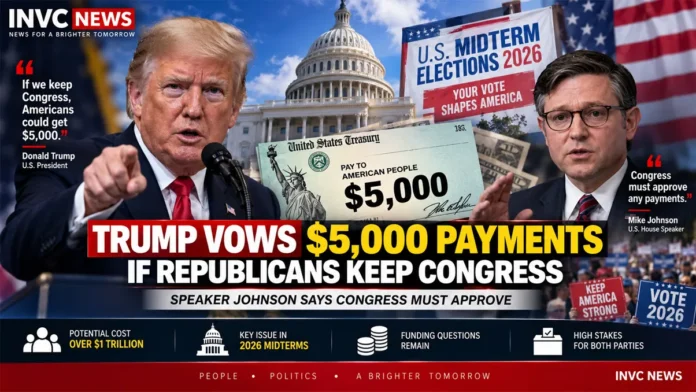
Trump $5,000 dividend proposal has quickly become one of the biggest issues in the U.S. midterm election campaign after President Donald Trump insisted that his administration could afford to send thousands of dollars to American adults if Republicans retain control of Congress in November.
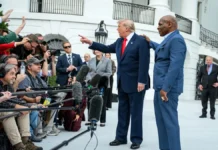
Trump reinforced the promise Sunday while speaking to reporters in Ireland, saying the payments would be financially manageable because the United States was bringing in substantial revenue.
However, House Speaker Mike Johnson immediately introduced an important political and legal complication: Congress would have to approve the money before any checks could be issued.
Trump Says $5,000 Payments Will Happen
Trump first unveiled what he has called a “Trump Dividend” during the Republican midterm convention in Dallas.
He tied the proposed payment directly to Republican victories in the House and Senate.
Speaking again Sunday, Trump said the government could “easily” handle the expense and later expressed absolute confidence that the payments would happen.
The proposal places Trump himself at the center of the Republican campaign to retain congressional control, turning the midterm election into a referendum not only on his presidency but also on a highly visible economic promise.
Mike Johnson Says Congress Must Act
House Speaker Mike Johnson said the proposal would require congressional authorization.
That matters because presidents generally cannot unilaterally spend more than $1 trillion without legislation approved by Congress.
Johnson nevertheless indicated that Republican lawmakers would examine ways to implement Trump’s proposal if the party retains power.
His response reflects the central political challenge facing Republicans: supporting Trump’s popular campaign message while confronting its enormous fiscal cost.
Plan Could Cost More Than $1 Trillion
The scale of the proposal is extraordinary.
With roughly 270 million adults living in the United States, a $5,000 payment to a very large share of them could push the overall cost above $1 trillion, depending on eligibility rules.
No detailed legislation has yet established income limits, citizenship requirements, payment dates or a funding mechanism.
Those unanswered questions will determine whether the proposal remains primarily a campaign pledge or develops into a serious legislative initiative.
Republicans Ask: How Will America Pay for It?
Not every Republican has immediately endorsed the plan.
Representative Mike Lawler of New York said he supports putting money back into Americans’ pockets but emphasized that lawmakers must determine how such a program would be financed.
That concern is significant because Washington is already dealing with a large federal budget deficit and rising national debt.
A payment program of this size could also become part of the broader debate over government spending, interest rates and inflation.
Democrats Attack Trump’s Election-Year Promise
Democratic leaders have dismissed the proposal as unrealistic.
House Minority Leader Hakeem Jeffries described it as not being a serious proposal, while Democratic Senator Mallory McMorrow questioned whether voters should expect the promised money to materialize.
The political battle is likely to intensify because Trump explicitly linked the payment to Republican control of Congress.
That connection gives Democrats an opening to portray the proposal as an election tactic, while Republicans can present it as a direct financial benefit for households.
Inflation Makes the Proposal Even More Politically Explosive
The timing adds another complication.
Americans continue to face pressure from inflation, elevated borrowing costs and expensive energy.
The Federal Reserve is also approaching another major policy decision, and Trump has publicly argued that the United States should have extremely low interest rates.
Economists and policymakers will therefore examine whether injecting more than $1 trillion into households could add further demand to an economy already struggling with persistent price pressures.
Midterm Elections Raise the Stakes
Republicans hold narrow congressional majorities, making the November election critical for Trump’s ability to advance his agenda during the remaining years of his presidency.
The president has urged Republican candidates to campaign as though he himself were on the ballot.
His $5,000 payment pledge gives the party an unusually simple economic message: retain Republican control and voters could receive a direct payment.
Whether that promise persuades undecided voters could become one of the defining questions of the 2026 campaign.
No Checks Are Approved Yet
For American households, one point is especially important: no $5,000 payment has been authorized yet.
There is currently no enacted legislation establishing such a federal payment program.
Congress would need to determine who qualifies, where the money comes from and how the government would distribute it.
Until that happens, the “Trump Dividend” remains a political proposal rather than an approved benefit.
Trump Turns Midterms Into an Economic Gamble
The proposal nevertheless changes the political conversation.
Trump has transformed a conventional congressional election argument into a direct financial promise carrying a potential price tag of more than $1 trillion.
Republicans now face the challenge of explaining how they would fund it.
Democrats must decide whether attacking the proposal will resonate with voters who may be attracted to the prospect of receiving $5,000.
With the November midterms approaching, the battle over the “Trump Dividend” could become one of the most consequential domestic political fights of the fall.