WASHINGTON, United States | September 10, 2026 —
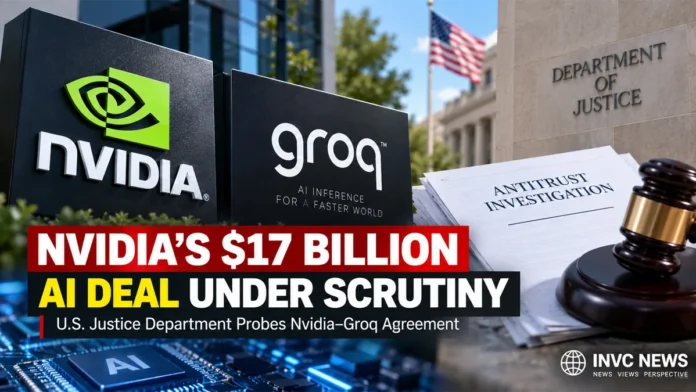
Nvidia Groq Antitrust Probe has put one of the artificial intelligence industry’s most unusual technology deals under fresh regulatory scrutiny as the U.S. Justice Department examines Nvidia’s roughly $17 billion licensing arrangement with AI chip startup Groq.
The investigation centers on a critical question: Did Nvidia structure the transaction as a licensing agreement rather than a conventional acquisition in order to avoid the level of antitrust review that a takeover could have triggered?
No violation has been established.
However, the investigation matters far beyond Nvidia and Groq. Regulators are increasingly examining whether powerful technology companies can gain access to valuable technology, intellectual property and key employees without formally buying the companies that developed them.
For Nvidia, already the dominant force in AI computing, the case could become an important test of how Washington approaches unconventional Big Tech transactions in the AI era.
What is the Nvidia-Groq deal?
Groq announced the agreement on December 24, 2025.
Rather than Nvidia buying Groq outright, the companies entered into what Groq described as a non-exclusive licensing agreement covering Groq’s inference technology.
The arrangement also resulted in several important Groq executives joining Nvidia, including founder Jonathan Ross and President Sunny Madra.
Groq itself remained an independent company.
Simon Edwards stepped into the CEO role, while GroqCloud continued operating.
That structure is now at the center of regulatory attention.
Why is the Justice Department investigating?
The Justice Department is examining whether Nvidia structured the transaction in a way that allowed it to sidestep antitrust scrutiny normally associated with a major corporate acquisition.
The investigation reportedly began shortly after the deal was announced in December.
Authorities subsequently sent Nvidia a formal request seeking information about the transaction.
That does not mean regulators have concluded Nvidia broke the law.
Investigators are trying to determine whether the structure and handling of the deal complied with applicable competition rules.
For Nvidia, the distinction is crucial.
A licensing agreement and an acquisition are legally different transactions. But regulators can still examine the economic substance of an arrangement when technology, personnel and competitive capabilities move between companies.
Why was the deal worth around $17 billion?
Groq developed specialized processors known as Language Processing Units, or LPUs, designed for high-speed AI inference.
Inference is the stage at which a trained AI model actually responds to users.
When someone asks an AI chatbot a question, generates an image, requests code or uses an AI agent, computing infrastructure must process that request and generate an answer.
Training powerful AI models requires enormous computing resources.
Running those models at scale also requires huge amounts of infrastructure.
As AI adoption expands, inference is becoming one of the industry’s most strategically important computing markets.
Groq built its technology around extremely low latency — essentially reducing the time users wait for AI-generated responses.
That made its technology highly valuable to Nvidia.
Why Groq matters to Nvidia
Nvidia built its AI empire primarily around GPUs.
Its chips became the foundation of the generative-AI boom because GPUs are highly effective at processing the parallel workloads required to train and run large AI models.
Groq approached the problem differently.
Its LPU architecture focuses heavily on predictable, fast inference.
The technologies can therefore complement each other.
Nvidia has since moved aggressively to integrate Groq-derived technology into its broader AI infrastructure.
In August 2026, Nvidia announced that NVIDIA Groq 3 LPX had entered full production as an inference accelerator designed to extend the Vera Rubin platform. Nvidia says the system targets ultrafast token generation for agentic AI workloads.
That development shows why the original licensing agreement has become strategically significant.
Nvidia Groq 3 LPX changes the picture
The technology is no longer merely an experimental asset sitting inside a licensing contract.
Nvidia is actively commercializing Groq-derived architecture.
Groq 3 LPX combines Nvidia’s broader computing ecosystem with Groq’s LPU technology to accelerate inference.
Each LPX rack contains 256 interconnected LPU accelerators, according to Nvidia.
The company is positioning the platform for AI agents and other applications where response time matters.
Nvidia says Groq 3 LPX complements its Rubin GPUs, with the two architectures addressing different aspects of AI workloads.
This commercial progress makes the regulatory question more consequential.
Did Nvidia acquire Groq?
No — not according to the structure publicly announced by the companies.
Groq said explicitly that it would continue operating as an independent company.
Nvidia obtained a non-exclusive license to Groq technology.
At the same time, founder Jonathan Ross, President Sunny Madra and other members of Groq’s team moved to Nvidia.
That combination — licensing valuable technology while recruiting key personnel — is precisely what makes the transaction unusual.
It resembles a broader phenomenon sometimes described as an acqui-hire-style licensing deal, where a major technology company gains intellectual property rights and important talent without completing a conventional acquisition.
The Nvidia investigation could therefore have consequences beyond this single transaction.
Why regulators care about AI licensing deals
Traditional antitrust enforcement has established procedures for reviewing mergers and acquisitions.
If a giant company attempts to purchase a major competitor or strategically important startup, regulators can examine whether the transaction would reduce competition.
AI has complicated that model.
Large technology companies can potentially form partnerships, license technology, invest in startups, secure commercial rights or hire key teams without buying the entire company.
Each individual transaction may look different from a conventional takeover.
Yet regulators can still ask whether the practical result reduces independent competition.
That question becomes particularly important when the buyer or licensee already holds enormous market power.
Nvidia’s AI dominance raises the stakes
Nvidia’s position in the AI chip market makes almost any major transaction involving the company worthy of attention.
Its GPUs power a large share of the infrastructure used to train and operate sophisticated AI systems.
Major cloud providers, AI laboratories, governments and enterprises depend on Nvidia hardware.
Groq represented a different approach to AI inference.
Therefore, regulators have an obvious competition question to examine: Does the arrangement preserve Groq as a meaningful independent competitive force, or does it strengthen Nvidia’s position in a way that deserves additional scrutiny?
The investigation will have to determine the answer.
Nvidia defends the arrangement
Nvidia has defended the transaction.
Responding to reports about the investigation, the company described the Groq arrangement as an example of the American innovation system functioning as intended to encourage innovation, reward entrepreneurs and benefit consumers.
Groq and the Justice Department had not immediately commented on the latest report.
That leaves the investigation at an important but preliminary stage.
There is no public finding that Nvidia deliberately violated antitrust law.
Could the $17 billion deal be cancelled?
That currently appears unlikely.
Reporting on the investigation indicates that the Justice Department could potentially seek financial penalties if it ultimately determines Nvidia mishandled the transaction.
However, regulators are reportedly unlikely to seek to unwind the arrangement.
That distinction matters for investors.
An investigation does not automatically mean the Groq technology will disappear from Nvidia products or that the transaction will be reversed.
Nvidia is already deploying Groq technology commercially through its AI infrastructure portfolio.
Still, regulatory findings could influence how similar transactions are structured in the future.
Could Nvidia face a fine?
Potentially.
If investigators conclude that Nvidia violated applicable requirements in the way it handled or reported the transaction, financial penalties could become possible.
But there is currently no announced fine.
There is also no final enforcement decision.
Readers should therefore be cautious with headlines suggesting Nvidia has already been penalized.
The current development is an investigation, not a conviction or completed enforcement action.
What happens to Groq?
Groq continues to operate independently.
Its GroqCloud business remained active following the licensing arrangement, and the company has continued announcing partnerships and fundraising.
In August, Groq said it would be among the early adopters bringing Nvidia Groq 3 LPX and Vera Rubin NVL72 to market.
The company has also continued expanding its inference-cloud business.
That independent activity could become relevant when regulators assess the competitive effects of the transaction.
Why this case matters for the entire AI industry
The biggest consequence may have little to do with a potential Nvidia fine.
The investigation could help define how regulators treat a new generation of AI transactions.
Big technology companies want access to scarce engineering talent and valuable AI intellectual property.
Startups need capital, distribution and computing infrastructure.
Traditional acquisitions are increasingly likely to attract regulatory attention.
That creates incentives for companies to explore licensing arrangements, strategic investments and talent agreements instead.
If regulators decide some of these arrangements effectively function like acquisitions, the rules surrounding AI deals could tighten considerably.
Microsoft, Google, Amazon, Meta and other major technology companies would have reason to watch the outcome closely.
AI inference is becoming the next battleground
The Nvidia-Groq story also highlights an important shift inside artificial intelligence.
The first phase of the generative-AI boom focused heavily on training ever-larger models.
The next phase increasingly focuses on inference.
Millions of people and businesses are now using AI systems continuously.
AI agents can require repeated model calls to complete complex tasks.
That means speed, latency, power consumption and inference costs are becoming critical competitive factors.
Groq’s technology was built specifically around that challenge.
Nvidia’s willingness to commit roughly $17 billion to licensing the technology demonstrates how valuable the inference market has become.
What investors should watch next
Three developments now matter.
First, watch whether the Justice Department expands its information requests or takes a formal enforcement step.
Second, Nvidia’s deployment of Groq 3 LPX will show how commercially important the licensed technology becomes inside its Vera Rubin ecosystem.
Third, regulators’ eventual interpretation of the transaction could influence future AI licensing deals across Silicon Valley.
A financial penalty would matter to Nvidia.
A new regulatory precedent governing how Big Tech can acquire technology and talent without formally acquiring a company could matter much more to the entire industry.
The bottom line
The Nvidia Groq Antitrust Probe does not mean Nvidia has been found guilty of breaking competition law.
It means the Justice Department is investigating whether Nvidia’s roughly $17 billion licensing arrangement with Groq was structured in a way that sidestepped antitrust scrutiny.
The unusual deal gave Nvidia a non-exclusive license to valuable Groq inference technology while several senior Groq executives moved to Nvidia. Groq remained an independent company.
Since then, the technology has become increasingly important to Nvidia’s AI strategy through Groq 3 LPX and the Vera Rubin platform.
That makes this much more than another regulatory investigation.
The outcome could help determine where U.S. regulators draw the line between a technology partnership and a transaction that deserves the same scrutiny as an acquisition.