By Team INVC | INVC NEWS
WASHINGTON, United States | September 9, 2026 —
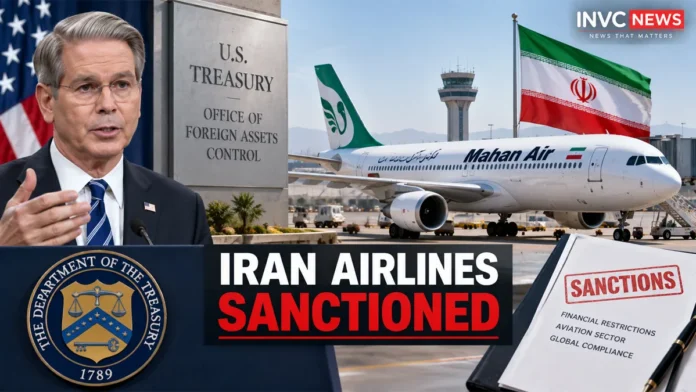
US Iran Aviation Sanctions have entered a sweeping new phase after the Trump administration targeted Iran’s remaining active airlines and foreign companies accused of supporting Mahan Air as part of its expanding “Operation Economic Outcast.”
The US Treasury Department said its Office of Foreign Assets Control, or OFAC, sanctioned 36 targets linked to Iran’s aviation sector.
The action includes 27 Iranian airlines and a network of companies and individuals operating outside Iran that Washington says helped Mahan Air obtain aircraft, move cargo or maintain international commercial operations.
Treasury Secretary Scott Bessent warned businesses around the world that dealing with newly sanctioned Iranian airlines could expose them to severe US financial restrictions.
The move represents one of Washington’s broadest attempts yet to isolate Iran’s commercial aviation sector from international finance, aircraft procurement and logistical support.
Scott Bessent Issues Warning to Companies Worldwide
Bessent said the latest action delivers on the administration’s earlier promise to impose serious consequences on businesses providing economic support to Tehran.
The Treasury Secretary specifically highlighted companies that continue to support Mahan Air.
He also warned anyone conducting business with Iran’s remaining airlines that they could face the risk of being cut off from the global financial system.
The warning is significant because US sanctions can affect companies far beyond American territory.
Foreign banks, logistics providers, aviation companies and intermediaries may reconsider dealings with designated Iranian entities if those transactions could threaten their access to the US financial system.
US Sanctions 27 Remaining Active Iranian Airlines
Treasury said OFAC designated 27 Iranian airlines under Executive Order 13902 for operating in Iran’s aviation sector.
The list includes major carriers such as Iran Aseman Airlines, Iran Air Tour, Kish Airlines, Qeshm Air, Taban Airlines, Zagros Airlines, Ata Airlines and Sepehran Airlines, among others.
Washington says Iran has used commercial aviation infrastructure to support activities involving the Islamic Revolutionary Guard Corps and to move personnel, equipment and other cargo.
The Iranian government has repeatedly rejected US accusations surrounding its military and sanctions-evasion networks.
The new designations could make it significantly harder for affected carriers to access international payments, aircraft components, insurance and other commercial services where US sanctions jurisdiction or exposure applies.
Mahan Air Was Already Under US Sanctions
One important distinction is that Mahan Air itself is not being sanctioned for the first time.
The United States designated Mahan Air in October 2011, accusing the airline of providing financial, material and technological support to the Islamic Revolutionary Guard Corps-Quds Force.
The US State Department later designated the carrier again in 2019 under a separate authority related to weapons proliferation.
The latest action instead targets companies and intermediaries that Washington says continue to support Mahan Air despite those longstanding restrictions.
That network extends across multiple countries.
US Targets Foreign Firms Supporting Mahan Air
Treasury says Mahan Air obtained at least three Boeing 777 aircraft during the summer of 2026 through arrangements involving companies outside Iran.
US officials allege that aircraft were routed through third countries to obscure their ultimate Iranian destination.
The latest sanctions target companies and individuals connected to those procurement arrangements.
They include entities based in the United Arab Emirates, Türkiye and the United Kingdom, as well as cargo and sales-service providers operating from Türkiye, Malaysia and Kazakhstan.
Treasury says some of those firms helped coordinate aircraft transfers, aviation services or shipments connected to Mahan Air.
The administration’s message is clear: Washington intends to pursue not only Iranian companies but also third-country businesses it believes are enabling sanctioned aviation networks.
Three Aviation Authorizations Suspended
The US government has also tightened rules governing aviation-related activity involving Iran.
OFAC suspended three Iran-related aviation authorizations as part of the new pressure campaign.
These included permissions that previously allowed certain overflights and enabled non-US airlines to operate US-origin or US-controlled commercial aircraft into Iran.
Treasury said requests involving genuine aviation-safety concerns may still be considered individually.
The change could complicate airline operations involving aircraft that contain US-controlled technology or components.
Given the global dominance of US-origin aviation equipment, such restrictions may have consequences beyond airlines based directly in Iran.
FinCEN Warns Banks About Aircraft Procurement Networks
The Treasury Department is also using the financial system to identify possible attempts to bypass the restrictions.
The Financial Crimes Enforcement Network, or FinCEN, issued an alert asking financial institutions to watch for transactions connected to Iranian aircraft and aviation-parts procurement.
US officials say Iranian entities sometimes use front companies in third countries to disguise the final destination of aircraft, spare parts and dual-use equipment.
Banks have been asked to watch for patterns that may suggest such transactions.
This adds a financial-surveillance layer to the aviation sanctions.
What Is Operation Economic Outcast?
The Trump administration launched Operation Economic Outcast on August 24, 2026.
Treasury has described the campaign as an effort to cut Iran off from remaining economic lifelines.
The strategy targets networks Washington says Tehran uses to sell oil, access international finance, obtain technology and fund the Islamic Revolutionary Guard Corps.
Iran’s aviation sector became one of the industries specifically covered under the sanctions framework in August.
Tuesday’s aviation action marks the first major wave of airline designations under that determination.
The campaign is also designed to increase the threat of secondary sanctions against foreign businesses that continue significant dealings with designated Iranian entities.
Foreign Banks Could Face Secondary Sanctions Risk
The consequences are not limited to airlines.
Treasury warned that foreign financial institutions could face secondary sanctions exposure if they knowingly facilitate certain significant transactions for sanctioned entities.
Potential measures can include severe restrictions on access to correspondent banking relationships in the United States.
That threat often gives US sanctions global reach even when the targeted transaction does not directly involve an American company.
For multinational businesses, losing access to dollar clearing or the US banking system can carry far greater consequences than losing business with Iran.
Trump Administration Steps Up Economic Pressure on Tehran
The sanctions come as the United States combines economic pressure with military action against Iran amid the continuing regional confrontation.
President Donald Trump’s administration has signaled that it no longer wants merely to contain Iran’s ability to access global finance.
Instead, Washington is attempting to systematically reduce Tehran’s international economic connections.
Bessent has repeatedly described the strategy as cutting economic lifelines supporting the Iranian government and the IRGC.
The aviation measures therefore fit into a broader effort targeting banking, trade, energy, shipping and sanctions-evasion networks.
Could Iran’s Civil Aviation Sector Face Serious Disruption?
The new restrictions could create major practical challenges for Iranian commercial aviation.
Modern aircraft require constant access to spare parts, maintenance services, insurance, financial transactions and international logistics networks.
When sanctions restrict those networks, carriers may find it harder and more expensive to keep aircraft operating.
However, aviation sanctions also raise concerns about civilian passengers and aircraft safety.
Treasury says it will continue to consider safety-related authorization requests on a case-by-case basis.
How extensively international airlines, suppliers and financial institutions withdraw from Iran following the latest action will determine the real-world impact.
What Happens Next?
Companies with exposure to Iran’s aviation sector will now need to examine whether their customers, transactions or business partners appear on US sanctions lists.
Banks are likely to increase compliance checks.
Aircraft suppliers, freight companies, sales agents and logistics providers could also reassess existing relationships.
For Tehran, the larger problem is that Washington is no longer focusing only on individual Iranian airlines.
The United States is now attempting to isolate the aviation ecosystem surrounding them.
That shift makes the latest US Iran Aviation Sanctions one of the most significant economic-pressure measures introduced under Operation Economic Outcast so far.