NEW DELHI, India | September 10, 2026 —
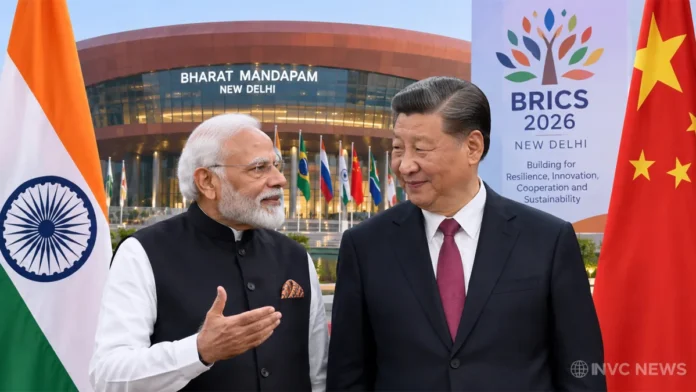
Xi Jinping India Visit 2026 is emerging as one of the biggest geopolitical stories surrounding the BRICS Summit as New Delhi prepares to host leaders of the expanded grouping on September 12 and 13.
Chinese President Xi Jinping’s expected presence will immediately turn attention toward the state of India-China relations and the possibility of high-level engagement with Prime Minister Narendra Modi.
The significance goes far beyond summit protocol. Relations between Asia’s two largest powers deteriorated sharply after the deadly 2020 border confrontation. Since then, however, India and China have gradually reopened diplomatic channels while continuing to manage unresolved strategic differences.
The BRICS Summit now gives both sides another major opportunity to test whether that cautious improvement can develop into a more stable relationship.
Modi-Xi engagement could become BRICS summit’s biggest story
Prime Minister Narendra Modi and Xi have already resumed high-level engagement after years of strained relations.
Their meeting in Kazan in October 2024 marked their first formal bilateral talks in roughly five years. They met again during the Shanghai Cooperation Organisation summit in Tianjin in August 2025, where both sides emphasized the importance of managing differences and preventing disputes from defining the entire relationship.
A meeting in New Delhi would carry even greater symbolism.
Xi’s arrival would place India-China relations at the center of a summit already dealing with some of the world’s most difficult questions, including trade fragmentation, energy security, financial cooperation and geopolitical instability.
However, New Delhi and Beijing still have substantial issues to resolve.
Border stability remains crucial for India-China relationship
The Line of Actual Control remains the most sensitive component of bilateral ties.
India has consistently linked the broader relationship with peace and stability along the border. Although military and diplomatic negotiations have reduced some areas of friction, restoring long-term confidence remains a much more difficult challenge.
Recent senior military engagement has nevertheless indicated that both governments want to prevent another confrontation.
For New Delhi, border stability will remain fundamental regardless of improvements in trade or summit diplomacy.
China, meanwhile, has repeatedly argued that the boundary dispute should not define the entire relationship.
That difference in emphasis means any Modi-Xi interaction will be closely analyzed for language concerning peace, disengagement, military confidence-building and future diplomatic mechanisms.
Trade relationship is booming despite political tensions
One of the most striking aspects of India-China relations is the continuing strength of bilateral trade.
Commercial ties have expanded even while political trust remains limited. China continues to play a major role in India’s supply chains, particularly in electronics, machinery, renewable energy components and industrial equipment.
India, however, remains concerned about its large trade deficit with China and dependence on Chinese imports in several strategic sectors.
Investment is another sensitive area.
New Delhi tightened scrutiny of investment from neighboring countries following the 2020 border crisis. While some restrictions have gradually eased, national-security considerations continue to influence policy toward Chinese capital and technology.
The BRICS summit could therefore create space for discussions about investment rules, technology access, manufacturing and supply-chain resilience.
BRICS 2026 gives India a much larger global stage
India is hosting the 18th BRICS Summit on September 12 and 13 at Bharat Mandapam in New Delhi.
The summit comes during India’s fourth BRICS chairship and during the grouping’s 20th anniversary year.
India has chosen the theme “Building for Resilience, Innovation, Cooperation and Sustainability.”
More than 350 meetings and high-level engagements have taken place across over 25 Indian cities during the country’s chairship.
The summit agenda is expected to cover economic cooperation, financial coordination, technology, energy security, healthcare, resilient supply chains and reforms to global governance institutions.
This year’s gathering also reflects how dramatically BRICS has changed.
What began as a grouping of major emerging economies has expanded to include additional members and partner countries, giving the organization considerably greater political and economic weight.
India faces a difficult balancing act inside BRICS
BRICS also contains major internal differences.
India maintains close strategic relations with the United States and participates in the Quad while simultaneously preserving longstanding ties with Russia and participating actively in BRICS.
China sees BRICS as an important platform for strengthening the influence of the Global South.
Russia has increasingly promoted alternative financial and trading mechanisms as Western sanctions have reshaped its economic relationships.
India takes a more cautious approach.
New Delhi supports reforms to international institutions and greater representation for developing economies but has resisted framing BRICS simply as an anti-Western coalition.
That strategic autonomy could become particularly important during the New Delhi summit.
Dollar debate could return to the spotlight
The future role of the U.S. dollar has become another major BRICS talking point.
Ahead of the summit, Kremlin spokesperson Dmitry Peskov said Russia was not pursuing “de-dollarisation” and remained open to acceptable payment mechanisms.
The statement highlights the complexity of the debate.
Some BRICS members favor expanding settlement in national currencies. India has also supported practical mechanisms that reduce transaction costs, but it has not endorsed creating a political confrontation around the dollar.
Digital payments could instead become one of India’s strongest contributions to the summit agenda.
India’s experience with digital public infrastructure and UPI gives New Delhi an opportunity to push practical financial connectivity rather than ideological monetary confrontation.
Xi Jinping visit could define the political optics
Xi’s expected India visit carries exceptional political symbolism because it would demonstrate how far bilateral relations have moved since the crisis following the 2020 border confrontation.
Yet symbolism alone will not resolve the deeper challenges.
India and China remain competitors across trade, technology, manufacturing, regional influence and the Indo-Pacific. Their border dispute has also not disappeared.
That is precisely why the BRICS Summit matters.
If Prime Minister Narendra Modi and Xi Jinping use New Delhi to strengthen communication, improve border stability and expand carefully managed economic cooperation, the summit could mark another meaningful step toward what both governments increasingly describe as a relationship that must manage competition without allowing confrontation to dominate.
For now, the world’s attention will be on New Delhi.