By Team INVC | INVC NEWS
NEW DELHI, India | September 9, 2026 —
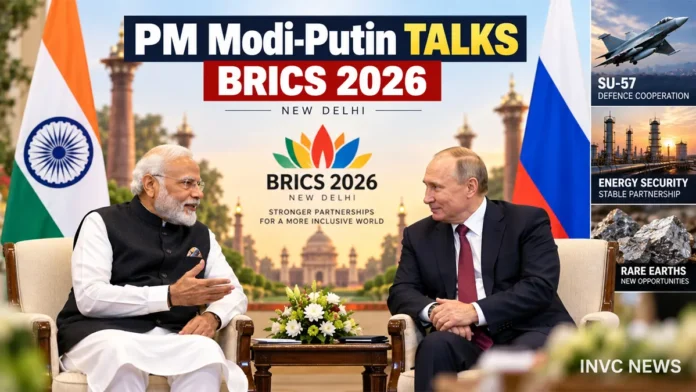
PM Modi Putin Meeting preparations have moved into focus as Prime Minister Narendra Modi and Russian President Vladimir Putin prepare for bilateral talks in New Delhi on Friday, September 11, just one day before India hosts the 18th BRICS Summit.
The meeting is expected to focus heavily on trade, energy, defence cooperation and emerging areas such as rare-earth exploration, while Russia has also confirmed that the possible sale of its Su-57 fifth-generation stealth fighter remains on the bilateral agenda.
The talks come at a particularly sensitive geopolitical moment, with the Russia-Ukraine war continuing, global energy markets under pressure and India balancing strategic partnerships across competing international blocs.
PM Modi and Putin to Meet on September 11
Kremlin spokesperson Dmitry Peskov has confirmed that President Putin will hold bilateral talks with Prime Minister Narendra Modi during his visit to India.
The meeting will take place on Friday, September 11.
India will then host the 18th BRICS Summit in New Delhi on September 12 and 13.
The bilateral engagement will be the second meeting between the two leaders in less than two weeks.
Prime Minister Narendra Modi and President Putin last met on August 31 on the sidelines of the Shanghai Cooperation Organisation Summit in Bishkek.
During that meeting, the two leaders reviewed defence, energy, economic, space and people-to-people cooperation.
Su-57 Fighter Jet Back on India-Russia Agenda
One of the most closely watched issues will be Russia’s Su-57 stealth fighter.
The Kremlin has acknowledged that the possible sale of the fifth-generation fighter aircraft to India remains part of the bilateral agenda.
The Su-57 represents Russia’s most advanced operational fighter platform and has repeatedly appeared in discussions surrounding India’s future combat-aircraft requirements.
However, no final deal has been announced.
Any agreement involving purchase, joint production, technology transfer or manufacturing would require detailed negotiations between the two governments.
Therefore, speculation about contract size, aircraft numbers or delivery schedules should not be treated as confirmed until an official announcement is made.
Defence Cooperation Remains a Key Pillar
India and Russia maintain one of the world’s longest-running defence partnerships.
Russian-origin platforms continue to form an important part of India’s military inventory.
The relationship has gradually evolved from direct purchases toward joint production, maintenance and technology cooperation.
Defence discussions during the September 11 meeting could therefore extend beyond individual weapons systems.
Both sides are likely to examine how future cooperation can fit India’s growing emphasis on domestic defence manufacturing and technology transfer.
Russian Oil and India’s Energy Security
Energy will remain another major component of the talks.
India has become a significant buyer of Russian crude oil in recent years, while Moscow has strengthened its position as an important energy supplier to the Indian market.
The relationship has attracted international attention because Western countries have continued imposing restrictions and pressure linked to Russia’s war in Ukraine.
Russia has criticized attempts to penalize countries for purchasing Russian energy.
For India, the central consideration remains energy security, pricing and supply stability.
With global crude markets already facing volatility from tensions in the Middle East, stable access to energy remains strategically important.
Rare Earth Cooperation Emerges as New Opportunity
A particularly important new area is rare-earth exploration.
The Kremlin has confirmed that India and Russia are discussing cooperation in this sector.
Rare earths and other critical minerals have become strategically important because they are used in electric vehicles, electronics, renewable-energy systems, advanced manufacturing and defence equipment.
Countries around the world are attempting to diversify critical-mineral supply chains.
India has also accelerated efforts to secure access to strategic minerals overseas.
Closer cooperation with Russia could therefore extend the India-Russia partnership beyond traditional areas such as defence and oil.
Trade and Payments Will Feature in Talks
Trade and economic cooperation will form a major part of the bilateral agenda.
India-Russia trade has expanded sharply in recent years, largely because of growing Indian purchases of Russian energy.
However, both sides are also trying to diversify commerce into sectors such as pharmaceuticals, machinery, agriculture, technology and industrial manufacturing.
Payment mechanisms remain another important issue.
Russia has increased the use of national currencies in trade with BRICS countries.
However, the Kremlin has said Moscow is not pursuing a formal campaign to eliminate the U.S. dollar.
Instead, Russia says it supports multiple acceptable payment mechanisms.
BRICS Currency Debate Returns
The broader question of dollar dependence is likely to attract attention during the BRICS Summit.
Peskov said roughly 90% of transactions between Russia and BRICS countries now take place in national currencies.
However, Moscow has stressed that this does not amount to a campaign against the dollar.
That distinction could prove important during the New Delhi summit because BRICS has expanded significantly in recent years and now includes countries with very different economic and political priorities.
India has consistently supported practical financial cooperation without presenting BRICS as an anti-Western bloc.
Ukraine War Will Remain in Background
The Russia-Ukraine war will inevitably remain part of the diplomatic backdrop.
Prime Minister Narendra Modi has repeatedly emphasized dialogue and diplomacy as the path toward resolving international conflicts.
During the August 31 meeting in Bishkek, the two leaders discussed global and regional issues, including the conflict around the Black Sea region.
India has maintained engagement with both Russia and Ukraine while continuing to call for peaceful resolution.
The September 11 meeting gives the two leaders another opportunity to review recent diplomatic developments.
West Asia Adds Another Layer to Talks
The worsening security situation in West Asia could also influence discussions.
India and Russia both have significant economic and strategic interests in the region.
Shipping disruption, higher oil prices and threats to maritime routes can affect both countries.
For India, the consequences include higher crude-import costs, inflation pressure and risks to Indian nationals working across the Gulf.
The two leaders discussed West Asia during their recent Bishkek meeting, making it likely that broader regional stability will remain relevant during their New Delhi talks.
Putin Arrives for BRICS Summit
President Putin is expected to participate in the BRICS Summit hosted by India.
The summit will bring together leaders from an expanded grouping that now includes Brazil, Russia, India, China, South Africa, Egypt, Ethiopia, Iran, Indonesia and the United Arab Emirates.
The agenda is expected to cover security, economics, finance, technology, artificial intelligence and development cooperation.
India’s chairship puts New Delhi at the center of discussions on how BRICS should evolve amid widening geopolitical divisions.
Second Modi-Putin Meeting in Less Than Two Weeks
The frequency of the meetings highlights the continuing strategic importance both sides attach to the relationship.
Prime Minister Narendra Modi and President Putin met in Bishkek on August 31.
Less than two weeks later, they will sit down again in New Delhi.
The September 11 talks will allow both governments to move from broad strategic discussions toward specific cooperation in defence, energy, trade and critical minerals.
What to Watch From the PM Modi-Putin Meeting
Five issues will dominate attention:
1. Su-57 discussions
Whether Russia offers new terms involving technology transfer or local production.
2. Russian oil
How India and Russia respond to international pressure surrounding energy trade.
3. Rare earths
Whether both sides announce concrete exploration or investment projects.
4. Trade and payments
Progress toward diversifying bilateral commerce and resolving payment challenges.
5. Ukraine and global conflicts
Whether the leaders announce any new diplomatic initiative.
PM Modi-Putin Meeting Could Shape BRICS Weekend
The PM Modi Putin Meeting will take place just before one of India’s most important diplomatic events of 2026.
Defence cooperation gives the talks strategic weight.
Russian energy gives them economic importance.
Rare-earth discussions add a new future-focused dimension.
Meanwhile, the Ukraine war, West Asia tensions and changing global financial system ensure that the meeting will carry implications beyond the bilateral relationship.
The clearest signals will come after Friday’s talks, when both governments reveal which discussions produced concrete outcomes.