By Team INVC | INVC NEWS
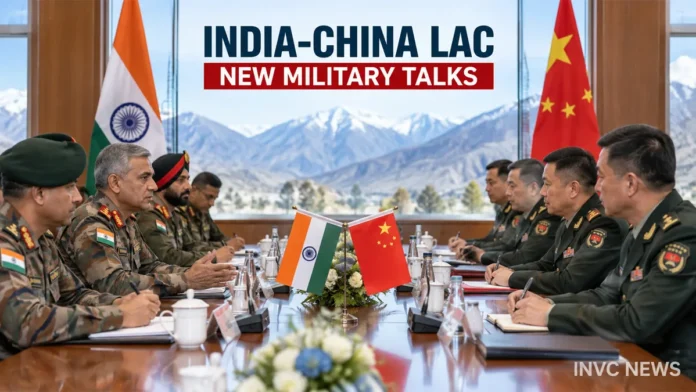
India China Border Talks have entered a significant new phase after the two countries held their first Corps Commander-level military meetings in the eastern sector of the Line of Actual Control, establishing a higher-level communication channel in Arunachal Pradesh as New Delhi and Beijing work to prevent fresh border tensions.
The Ministry of External Affairs confirmed that senior military commanders met on two consecutive days — first at Wacha on the Indian side on September 6 and then at Damai on the Chinese side on September 7.
The meetings mark the first time India and China have used a Corps Commander-level mechanism specifically in the eastern sector.
Until now, this level of sustained military dialogue had become primarily associated with the western sector, where the two armies held repeated talks following the 2020 military confrontation in eastern Ladakh.
Why the Eastern-Sector Talks Matter
The eastern sector covers some of the most sensitive portions of the India-China frontier.
Arunachal Pradesh remains central to the broader boundary dispute, making reliable communication between senior military commanders especially important when local tensions or differing patrol perceptions emerge.
By creating a higher-level military dialogue mechanism in this sector, both sides now have an additional channel through which they can discuss operational concerns before they develop into larger confrontations.
The move does not resolve the boundary dispute.
However, it can strengthen crisis management and reduce the risk of misunderstandings between troops deployed close to the LAC.
Meetings Held at Wacha and Damai
According to the Ministry of External Affairs, the first meeting took place at Wacha on the Indian side in Arunachal Pradesh on September 6.
A second engagement followed at Damai on the Chinese side on September 7.
The Wacha-Damai area has long functioned as one of the established Border Personnel Meeting points between the two countries.
What makes the latest discussions different is the seniority of the officers involved.
The engagement elevated communication in the eastern sector to the Corps Commander level, creating a mechanism similar to the one already used extensively in eastern Ladakh.
First Corps Commander-Level Mechanism in Eastern Sector
India and China have held multiple Corps Commander-level negotiations in the western sector since the 2020 Ladakh standoff.
Those discussions became one of the principal military channels for addressing friction points, troop deployments and disengagement arrangements.
The two sides have held 23 rounds of Corps Commander-level meetings at the Chushul-Moldo meeting point in eastern Ladakh.
The eastern sector had not previously operated the same type of formalized Corps Commander dialogue.
That makes the latest meetings an important structural change in India-China border management.
Talks Follow Diplomatic Engagement
The military meetings did not occur in isolation.
They followed a series of diplomatic and security discussions between New Delhi and Beijing.
India and China have used several mechanisms to manage their boundary dispute, including talks between their Special Representatives and meetings of the Working Mechanism for Consultation and Coordination on India-China Border Affairs.
The latest eastern-sector military engagement followed understandings reached through those diplomatic channels.
The objective is to connect political-level discussions with practical military communication on the ground.
Taksing Area Remains Under Close Watch
The talks also came amid reports of friction in the broader Taksing area of Arunachal Pradesh’s Upper Subansiri district.
That region has attracted attention because differing perceptions of the LAC can create situations in which troops from both sides operate in close proximity.
Neither side has announced a new disengagement agreement connected specifically to the latest meetings.
Therefore, the significance of the talks lies primarily in establishing communication and discussing ways to maintain peace rather than announcing a breakthrough on the boundary itself.
MEA Sees Positive Movement in India-China Ties
The Ministry of External Affairs has indicated that India-China relations have been moving gradually in a more positive direction.
Border peace remains central to that process.
India has repeatedly maintained that stable bilateral relations require peace and tranquility along the frontier.
The creation of an eastern-sector commander-level mechanism therefore carries implications beyond military operations.
If successful, it could support wider diplomatic engagement by reducing the risk that a localized border incident disrupts the broader relationship.
What Changed After the 2020 Ladakh Standoff
India-China relations deteriorated sharply after the 2020 military confrontation in eastern Ladakh.
The Galwan Valley clash resulted in the deaths of 20 Indian soldiers. China later acknowledged fatalities among its own troops.
The confrontation triggered large military deployments and fundamentally altered relations between the two countries.
Since then, military commanders and diplomats have held repeated rounds of negotiations.
Several friction points in the western sector have seen disengagement arrangements, while both militaries have continued to maintain substantial forces and infrastructure along the frontier.
The experience also reinforced the importance of direct communication between senior commanders.
Why Military Communication Can Prevent Escalation
The India-China border does not have a mutually agreed Line of Actual Control in all areas.
That creates differing perceptions over where each side believes the boundary runs.
Patrols can therefore encounter each other even when both sides believe they are operating within their own territory.
Higher-level communication mechanisms can help commanders rapidly address such situations.
They can clarify local developments, reduce misinterpretation and prevent tactical incidents from escalating politically.
The Wacha-Damai Corps Commander channel could become particularly important if similar meetings continue regularly.
No Final Boundary Settlement Yet
Despite improving communication, India and China remain far from resolving their decades-old boundary dispute.
The latest meetings should therefore not be interpreted as a settlement of competing territorial claims.
Instead, they represent an attempt to manage disagreement more effectively.
The distinction is important.
Border-management arrangements can maintain stability while political negotiations over the final boundary continue separately.
What Happens Next
Attention will now turn to whether Corps Commander-level meetings in the eastern sector become a regular mechanism.
Three developments will be especially important:
- Whether India and China schedule additional senior military meetings in Arunachal Pradesh
- Whether both sides establish new confidence-building or communication procedures
- Whether diplomatic talks produce further agreements on maintaining peace along the LAC
Any future announcement on patrol arrangements, disengagement or troop deployments would carry greater operational significance.
For now, the creation of the dialogue channel itself remains the central development.
India-China Border Talks Enter a New Phase
The India China Border Talks in Arunachal Pradesh represent a notable expansion of the mechanisms used by the two countries to manage one of the world’s most sensitive disputed frontiers.
India and China have not solved their boundary dispute.
Nor have the latest meetings produced a publicly announced territorial agreement.
However, bringing Corps Commander-level dialogue to the eastern sector gives both militaries a more direct route for addressing problems before they become crises.
After years in which border tensions repeatedly shaped the wider bilateral relationship, that communication channel could prove important in determining whether the recent diplomatic stabilization continues.