NEW DELHI, India | September 8, 2026 —
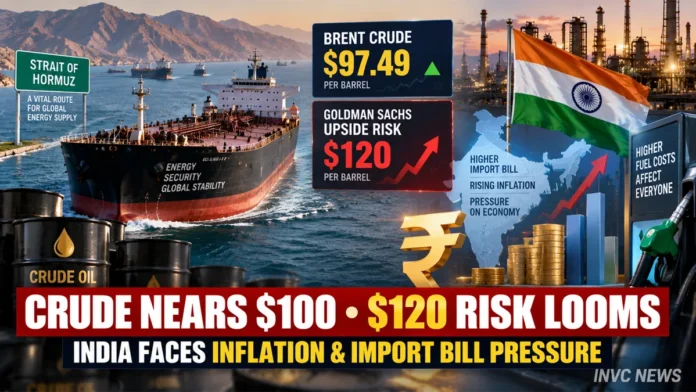
Crude Oil Price Today has returned to the center of India’s economic risk map as Brent crude moves closer to $100 a barrel amid renewed US-Iran tensions, disruptions around the Strait of Hormuz and growing concerns over attacks on Middle East shipping.
Brent crude traded around $97.5 a barrel on Tuesday, while US West Texas Intermediate hovered near $92.9.
The latest surge has revived fears that another sharp oil shock could push up India’s import bill, weaken the rupee, squeeze fuel-marketing margins and eventually add to inflation.
Goldman Sachs has warned that crude could rise as high as $120 a barrel if attacks on shipping in the Middle East intensify and disruptions broaden.
The investment bank has also outlined a lower scenario in which oil could fall toward $80 if regional exports return to normal.
For India, however, the current direction matters immediately.
The country depends on imports for nearly nine out of every 10 barrels of crude it consumes, leaving the economy highly exposed when global oil prices rise.
Brent Crude Climbs Toward $100
Oil prices extended gains Tuesday as investors priced in a higher geopolitical risk premium.
Iran has threatened retaliation if the United States launches further attacks on Iranian assets, while shipping through the Strait of Hormuz has remained disrupted.
The strait is one of the world’s most important energy routes and carries a large share of global oil and gas shipments.
Any serious disruption can quickly tighten global supply.
Brent crude rose to around $97.49 per barrel, while WTI climbed to approximately $92.92.
The move followed a strong Monday session in which Brent settled at about $97.31, its highest close since late July.
Goldman Sachs Warns Oil Could Reach $120
Goldman Sachs has now placed a $120-per-barrel upside scenario on the table if attacks on vessels and shipping routes in the Middle East intensify.
That is not the bank’s base-case forecast.
It is a geopolitical risk scenario.
The distinction matters because $120 crude would require a materially larger disruption in regional exports and shipping than the market is currently experiencing.
Goldman has also raised its December Brent forecast to around $85, reflecting expectations that Middle East supply disruptions could continue through the end of 2026.
If exports normalize, the bank sees scope for crude to fall toward $80.
That wide range shows how heavily oil prices now depend on security conditions rather than simply global demand.
What About the $150 Oil Warning?
Recent market commentary has also revived discussion of oil above $150.
However, the latest $150-plus risk was not issued by Goldman Sachs.
JPMorgan warned earlier in 2026 that crude could surge above $150 a barrel if major supply disruptions through the Strait of Hormuz persisted for an extended period.
That remains an extreme tail-risk scenario rather than the current consensus outlook.
For now, the more immediate risk highlighted by Goldman Sachs is $120 crude.
Even that level would represent a major economic shock for oil-importing countries such as India.
OPEC+ Keeps October Output Policy Unchanged
The oil market received no major supply relief from OPEC+ over the weekend.
The producer alliance decided to keep its production policy unchanged for October.
That effectively pauses further output increases for now.
The group has already completed the rollback of part of its earlier production cuts, but actual supply from several producers remains constrained.
The decision comes at a time when Middle East exports continue to face disruption and global buyers are drawing more heavily on alternative suppliers and inventories.
OPEC+ is now focused on negotiations over future production quotas.
Its next major meeting is scheduled for October 4.
India Imports Nearly 89% of Its Crude Oil
India remains particularly vulnerable to any prolonged oil rally.
Official data show that crude oil import dependence reached around 88.6% during April-January FY26.
That means changes in global crude prices have a direct impact on India’s external finances.
A higher oil price raises the number of dollars Indian refiners need to pay for imports.
That can widen the trade deficit and increase demand for the US dollar.
It can also put downward pressure on the rupee.
India has diversified its crude suppliers over recent years, but diversification does not completely shield the economy from a global price shock.
When benchmark crude prices rise sharply, almost every major source becomes more expensive.
Indian Crude Basket Already Near $100
The pressure is already visible in India’s own crude basket.
India’s crude import benchmark has recently moved close to the $100-per-barrel mark.
The Indian basket stood around $99.35 earlier this month, substantially higher than levels seen in July and August.
That increase is significant for refiners and oil marketing companies.
It also means the economic impact is already arriving before Brent actually crosses $100.
If crude remains elevated for several weeks, the pressure could become much harder to absorb.
How Higher Crude Can Raise Inflation in India
Oil affects inflation through several channels.
Petrol and diesel prices are the most obvious.
But fuel also affects freight, aviation, manufacturing, chemicals, plastics, fertilizers and logistics.
When transportation costs rise, companies often face higher costs moving food and goods across the country.
That can gradually feed into consumer prices.
The Reserve Bank of India has previously estimated that a 10% increase in crude oil prices above its baseline, assuming full domestic pass-through, could raise inflation by around 30 basis points.
That does not mean inflation will automatically rise by that amount.
The actual impact depends on fuel taxes, government intervention, company margins, currency movements and how much of the higher cost reaches consumers.
Rupee Faces Fresh Oil Pressure
The rupee has also started feeling the impact.
The Indian currency traded around 94.5-94.7 against the US dollar on Tuesday.
Market participants have reported continued intervention by the Reserve Bank of India through state-owned banks to prevent excessive currency volatility.
A weaker rupee makes imported crude even more expensive because oil is priced in dollars.
That creates a difficult cycle.
Higher oil increases dollar demand.
Higher dollar demand can weaken the rupee.
A weaker rupee then raises the rupee cost of imported oil further.
India’s Oil Import Bill Could Rise Sharply
India already spends tens of billions of dollars every year importing crude oil.
When oil prices rise by $10 or $20 a barrel, that additional cost can become substantial across hundreds of millions of imported barrels.
Higher crude can therefore widen the current account deficit and increase pressure on foreign-exchange reserves.
It can also reduce the fiscal room available to the government if authorities decide to cushion consumers through tax cuts, subsidies or support to oil marketing companies.
The problem becomes especially serious if high oil prices persist rather than spike briefly.
Oil Marketing Companies Face Margin Pressure
State-owned fuel retailers also face another challenge.
IndianOil, Bharat Petroleum and Hindustan Petroleum buy crude at international prices but sell petrol and diesel in a politically sensitive domestic market.
When crude rises quickly and retail fuel prices remain unchanged, marketing margins shrink.
Recent estimates already indicate negative marketing margins on some fuels.
A sustained move above $100 could therefore force oil marketing companies to absorb more losses unless retail prices, taxes or subsidy mechanisms change.
Indian Stock Market Also Feels the Heat
Rising oil prices are already affecting Dalal Street.
The Sensex and Nifty have faced pressure in recent sessions as investors worry about inflation, the rupee, company margins and interest rates.
Oil-intensive sectors such as aviation, paints, chemicals, logistics and some consumer businesses can face higher input costs.
On the other hand, upstream energy producers may benefit from stronger crude realizations.
That makes oil one of the most important global variables for Indian equities right now.
MCX Crude Jumps in India
Domestic commodity markets have reflected the global rally.
MCX crude oil futures climbed sharply on Monday.
The contract touched an intraday high of about ₹8,774 per barrel and traded around ₹8,715 later in the session, up roughly 1.6%.
Further gains in Brent could keep MCX crude volatile through the week.
Indian commodity traders will therefore closely track US-Iran developments, Strait of Hormuz shipping traffic and any change in OPEC+ policy expectations.
Why Oil Is Still Below $100
Despite serious supply disruption, Brent has so far remained below $100.
Several factors have helped contain the rally.
Some Middle East oil continues to move through the Strait of Hormuz.
Gulf producers have also expanded alternative shipping routes.
At the same time, higher output from the United States, Canada and Guyana has added supply.
China has also maintained large strategic and commercial stockpiles, reducing immediate pressure on global markets.
These factors have prevented a full-scale price shock so far.
But they may not be enough if shipping disruptions intensify sharply.
What Happens If Brent Hits $120?
For India, $120 Brent would represent a much more serious macroeconomic challenge.
The first impact would likely appear in the import bill and rupee.
Oil marketing companies would then face greater pressure.
Transportation and input costs could rise across the economy.
Inflation expectations could strengthen.
And the RBI could face a tougher policy trade-off between supporting growth and controlling prices.
Equity markets could also turn more volatile.
A move toward $120 would therefore matter well beyond petrol pumps.
It could influence everything from government finances and monetary policy to corporate profits and household budgets.
Is $150 Crude Possible?
It is possible only under a much more severe disruption scenario.
A sustained shutdown or major reduction in flows through the Strait of Hormuz could theoretically drive prices much higher.
But $150 is not the market’s central expectation today.
The current market is focused first on whether Brent crosses $100, and then whether regional shipping conditions become severe enough to push crude toward Goldman Sachs’ $120 upside scenario.
That is already a serious risk for India.
What India Should Watch Next
Three factors will determine the next move.
First, shipping traffic through the Strait of Hormuz.
Second, whether US-Iran military tensions escalate further.
Third, whether OPEC+ changes its supply strategy at its next meeting.
If shipping normalizes and tensions ease, oil could quickly lose its geopolitical premium.
If attacks intensify, however, the market could move rapidly toward triple-digit prices.
For India, Crude Oil Price Today has therefore become much more than a commodity-market story.
It is now a direct inflation, currency, import-bill and stock-market risk.
With Brent already close to $100 and Goldman Sachs warning of a possible $120 scenario, policymakers, companies and investors will be watching every development in the Gulf with increasing urgency.