
MUMBAI, India | September 7, 2026 —
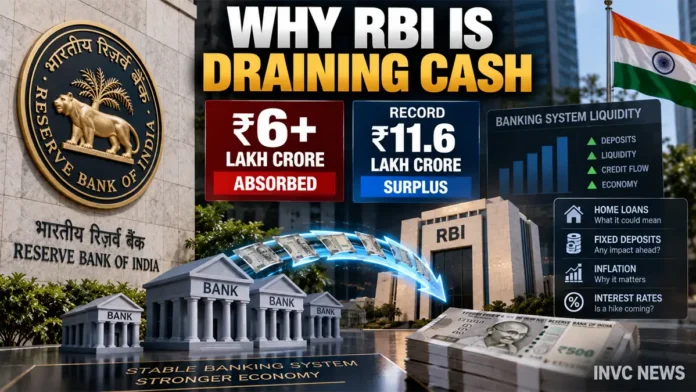
RBI liquidity withdrawal crossed ₹6 lakh crore on Monday as the Reserve Bank of India stepped up efforts to drain an extraordinary cash surplus from the banking system after excess liquidity climbed to a record ₹11.6 lakh crore.
The central bank absorbed about ₹2.59 lakh crore through a 30-day variable rate reverse repo auction and another ₹3.53 lakh crore through an overnight operation.
Together, the two auctions removed roughly ₹6.12 lakh crore of liquidity from banks.
The scale of the intervention has immediately raised questions among depositors, borrowers and investors.
Why does India suddenly have so much excess cash?
Why is the RBI taking money out of the banking system?
And does this mean home loans, personal loans or fixed-deposit rates are about to rise?
The short answer is that the RBI is trying to restore balance in money markets.
It is not the same thing as raising the repo rate.
Banking System Liquidity Hits Record ₹11.6 Lakh Crore
India’s banking system liquidity surplus surged to approximately ₹11.6 lakh crore on September 6, equivalent to nearly 4% of banking-system deposits.
That is an unusually large amount of excess cash.
Banks need liquidity to meet withdrawals, settle payments and provide loans. However, too much liquidity can also create problems.
When banks hold large quantities of surplus funds, short-term borrowing costs can fall below the level the central bank considers appropriate.
Banks may also become more aggressive in lending.
If excess money continues circulating through the economy, it can contribute to higher asset prices, stronger credit growth and, eventually, inflationary pressure.
The RBI therefore tries to keep liquidity conditions consistent with its monetary-policy stance.
Why Did So Much Money Enter Indian Banks?
A major part of the recent liquidity surge came from unusually large foreign-currency inflows.
India received roughly $136 billion through special one-off measures aimed at strengthening the country’s external balances.
Those inflows exceeded earlier expectations and injected a large amount of rupee liquidity into the banking system.
When foreign currency enters India and is converted into rupees, domestic banks can end up holding substantially more cash.
The central bank then has to decide how much of that liquidity should remain available and how much should be temporarily absorbed.
That is exactly what the RBI is doing now.
What Is a Variable Rate Reverse Repo?
The RBI is using a tool known as the Variable Rate Reverse Repo, or VRRR, to absorb excess money.
The mechanism is relatively straightforward.
Banks with surplus cash temporarily park money with the RBI.
In return, the RBI pays them interest at a rate determined through an auction.
During that period, the money is effectively removed from active circulation in the banking system.
When the VRRR matures, the funds return to the banks.
This means the RBI is not permanently taking away ₹6 lakh crore.
It is temporarily locking up excess liquidity.
RBI Wanted to Drain ₹7 Lakh Crore for 30 Days
The central bank initially offered banks the opportunity to park as much as ₹7 lakh crore for 30 days.
However, banks submitted offers worth only around ₹2.59 lakh crore.
Participation was therefore much weaker than the amount the RBI had targeted.
The RBI subsequently conducted an overnight VRRR operation with a notified amount of ₹5 lakh crore.
Banks offered approximately ₹3.53 lakh crore.
The two operations together allowed the RBI to absorb more than ₹6 lakh crore.
The central bank could use additional liquidity-management measures if large surpluses persist.
Why Were Banks Reluctant to Lock Away Cash for 30 Days?
Banks generally prefer flexibility when managing short-term liquidity.
Parking money with the RBI overnight is very different from locking it away for an entire month.
A bank may expect to need those funds for credit demand, withdrawals, bond purchases or other obligations.
That makes longer-duration reverse repo operations less attractive, especially when institutions are uncertain about future cash requirements.
There were also differing accounts about whether technical issues affected participation in the 30-day auction.
Some market participants cited problems during bidding, while another person familiar with the system disputed that explanation.
Regardless of the cause, participation in the longer auction fell well short of the RBI’s announced ₹7 lakh crore amount.
Does This Mean RBI Will Raise the Repo Rate?
Not necessarily.
This is one of the most important distinctions for consumers.
Liquidity withdrawal and an interest-rate hike are two different monetary-policy actions.
The RBI’s policy repo rate currently stands at 5.25%.
A repo-rate change requires a monetary-policy decision.
A VRRR auction, by contrast, allows the central bank to manage the amount of cash available in the financial system without changing the benchmark policy rate.
Removing surplus liquidity can help short-term market rates remain aligned with the RBI’s monetary-policy framework.
It may also reduce the risk that excessive liquidity fuels inflation or speculative asset prices.
But Monday’s action does not automatically mean the RBI has raised rates or has guaranteed a future rate increase.
Will Home Loans and Personal Loans Become More Expensive?
There should not be an automatic immediate change in retail loan rates simply because the RBI conducted these liquidity operations.
Home-loan and personal-loan rates depend on several factors, including the repo rate, banks’ funding costs, credit demand and individual lending benchmarks.
If the RBI eventually changes the repo rate, borrowers with linked floating-rate loans could see an impact.
But liquidity absorption alone does not directly translate into an equivalent increase in EMIs.
Consumers should therefore avoid interpreting the ₹6 lakh crore withdrawal as an immediate loan-rate hike.
What Could It Mean for Fixed Deposits?
The impact on fixed-deposit rates is also indirect.
Banks typically raise deposit rates when they need more funds.
At present, the banking system is facing the opposite problem: it has a large liquidity surplus.
That does not create an obvious reason for banks to compete aggressively for additional deposits.
However, individual banks can still change FD rates depending on their own funding needs, credit growth and balance-sheet strategy.
The RBI operation itself does not set retail fixed-deposit rates.
Why Excess Liquidity Can Become an Inflation Risk
The RBI has another reason to act: inflation.
If banks have too much money available, borrowing can become cheaper and credit expansion can accelerate.
More lending can boost consumption, investment and asset prices.
That can be positive when an economy requires support.
But when growth is already firm and inflation risks are increasing, too much liquidity can work against the central bank’s objectives.
The RBI therefore needs to ensure that the amount of cash in the financial system does not undermine its broader monetary-policy stance.
RBI Has Already Absorbed More Than ₹8.5 Lakh Crore
The latest auctions are part of a much broader liquidity-management effort.
The RBI’s total liquidity withdrawals have already exceeded ₹8.5 lakh crore through a series of operations.
Because much of that money has been absorbed through temporary instruments, funds will return to the banking system as individual operations mature.
That means the RBI may need to keep conducting fresh auctions if the underlying liquidity surplus remains unusually high.
Economists are also watching whether the central bank turns to additional tools.
Possible options include longer-duration reverse repos, market-stabilization securities and foreign-exchange sell-buy swaps.
What Market Investors Should Watch Next
The scale of excess liquidity now makes RBI operations an important indicator for stock, bond and currency markets.
Bond traders will watch whether liquidity conditions push short-term interest rates closer to the policy rate.
Equity investors will monitor whether tighter liquidity affects financial stocks or overall risk appetite.
Currency traders will also watch the RBI’s foreign-exchange operations, especially after the enormous recent inflows into India.
Most importantly, investors will monitor inflation and the RBI’s next monetary-policy meeting for evidence of whether the broader interest-rate outlook is changing.
For now, however, Monday’s action should be viewed primarily as a liquidity-management operation.
The RBI is not signaling that Indian banks have run out of cash.
It is dealing with precisely the opposite problem.
India’s banking system has more cash than the central bank currently wants circulating freely — and the RBI has begun pulling a significant portion of it back.