MADRID, Spain | September 7, 2026 —
Spain Ceuta migration crisis has turned into a major political headache for Prime Minister Pedro Sánchez after a new opinion poll showed overwhelming public anger over the mass border crossings from Morocco and a sharp rise in support for Spain’s conservative opposition.
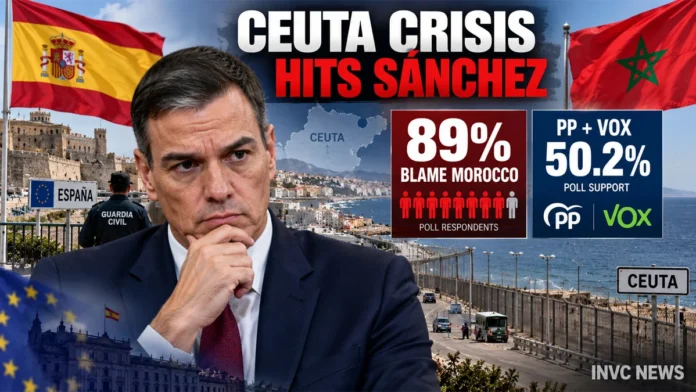
The latest 40dB survey found that 89% of respondents believe Morocco bears major responsibility for the crisis that erupted in late July at Ceuta, Spain’s North African enclave.
At the same time, only 14.2% of those surveyed gave Sánchez a positive rating for his handling of the emergency.
The political damage could prove even more significant.
Combined voting intention for the conservative People’s Party and Vox has climbed to 50.2%, pushing Spain’s right-wing parties above the 50% mark in this poll for the first time during the current legislature.
The result gives opposition leaders fresh ammunition as they intensify pressure on Sánchez over migration, border security and Madrid’s relationship with Morocco.
Ceuta Crisis Becomes a Political Test for Pedro Sánchez
The crisis began in late July when tens of thousands of people crossed from Morocco into Ceuta by land and sea.
The sudden movement overwhelmed local authorities and forced Madrid to deploy additional police and military personnel.
The incident quickly developed into one of the most serious border emergencies Spain has faced in years.
Authorities later returned tens of thousands of people to Morocco, while Madrid strengthened surveillance and emergency measures around the enclave.
However, the political fallout has continued long after the largest crossings stopped.
Opposition parties argue that the government reacted too slowly and failed to anticipate the crisis.
Sánchez rejects that criticism and says authorities prioritized both border control and the protection of human life during the emergency.
89% of Spaniards Point to Morocco
The latest poll shows just how strongly public opinion has shifted.
According to the survey, 89% of respondents attributed significant responsibility to Morocco.
Human-trafficking groups came next at 75%, while 74% blamed disinformation circulating on social media.
Another 73% placed responsibility on people who chose to cross the border.
The Spanish government itself was blamed by 72% of respondents.
Those numbers present Sánchez with a difficult political challenge.
His government has resisted claims that Moroccan authorities deliberately organized the border surge.
Sánchez has said Spain has not found evidence proving that Rabat orchestrated the mass crossing.
That position increasingly places him at odds with voters who believe Morocco played a central role.
Only 14.2% Approve Sánchez’s Handling of Crisis
Public dissatisfaction extends beyond Morocco.
Only 14.2% of respondents rated Sánchez’s handling of the crisis positively.
Around two-thirds said the government responded too slowly.
That level of dissatisfaction gives the opposition an opening on an issue that has become increasingly important across Europe: immigration and border security.
Sánchez has defended the response by highlighting the speed at which Spain returned people who had no right to remain.
The government says roughly 63,000 people returned to Morocco within 72 hours during the initial phase of the crisis.
Madrid also declared the situation a matter of national security interest in August, allowing stronger coordination between different levels of government.
However, political perceptions can prove as important as operational statistics.
And the latest survey suggests many Spaniards remain unconvinced.
PP and Vox Surge Above 50%
The biggest electoral warning for Sánchez comes from voting-intention figures.
The conservative People’s Party, or PP, reached 32.4%, up from 32% in the previous 40dB survey.
Vox climbed to 17.8%, up from 17.2%.
Together, the two parties reached 50.2%.
Meanwhile, Sánchez’s Socialist Party fell to 27.6%, down from 28%.
The wider centre-left bloc stood at just 36.1%.
These numbers do not predict an election result, and Spain is not voting today.
However, they show how dramatically the Ceuta crisis has altered the political debate.
Migration has moved rapidly toward the top of the national agenda, giving both PP and Vox an issue on which they can directly attack the government.
Vox Gains Ground on Immigration
Vox appears particularly well positioned to capitalize on the crisis.
Around 27% of respondents said they considered Vox the party most capable of dealing with immigration.
The Socialists followed at 18.4%, while PP received 13.9%.
That finding matters because immigration has long formed a central part of Vox’s political platform.
The party advocates tougher border enforcement and stricter migration policies.
The Ceuta emergency has therefore created conditions in which one of Vox’s strongest campaign themes now dominates national discussion.
PP faces a strategic choice of its own.
It must attack Sánchez strongly enough to benefit from public dissatisfaction without allowing Vox to monopolize the immigration issue.
That competition on the right could shape Spain’s political landscape in the months ahead.
Seven in 10 Want Tougher Border Controls
The poll also indicates a broader shift in public attitudes toward border enforcement.
Seven out of 10 respondents preferred tighter border controls over prioritizing protection for vulnerable migrants.
Meanwhile, 82% supported increasing border fences and surveillance.
That represents a potentially important change in Spain’s migration debate.
For years, Sánchez’s government has tried to balance humanitarian obligations with border enforcement and cooperation with Morocco.
Ceuta has made that balancing act much harder.
A tougher public mood could force the government to adjust its policies or risk allowing opposition parties to dominate the issue.
Why Morocco Matters So Much to Spain
Spain and Morocco share an unusually complicated relationship.
The two countries cooperate on trade, counterterrorism, migration management and security.
At the same time, they disagree over sensitive territorial and diplomatic issues.
Ceuta and Melilla, Spain’s two enclaves on the North African coast, sit directly on Morocco’s borders.
Morocco claims the territories, while Spain considers them integral parts of the country.
That geography makes Rabat an essential partner in controlling migration routes toward Spanish territory.
When cooperation works, border crossings can fall sharply.
When relations deteriorate, migration can quickly become a diplomatic and political weapon—or at least be perceived as one.
That explains why the latest poll is so politically sensitive.
If nearly nine in 10 Spaniards believe Morocco bears responsibility, Sánchez may find it increasingly difficult to defend a cautious approach toward Rabat.
Sánchez Says There Is No Proof Morocco Organized the Surge
The prime minister has tried to draw an important distinction.
He has acknowledged serious failures around the border but says Spanish authorities do not possess evidence proving that Morocco deliberately organized the mass crossings.
Sánchez has also defended security personnel who faced the initial surge.
During a parliamentary appearance, he said officers had been forced to choose between maintaining complete border control and protecting human life.
He backed their decision to prioritize lives.
The government has also sought more European Union support for border security and humanitarian services in Ceuta.
Madrid argues that Ceuta represents not only Spain’s external border but also an external frontier of the European Union.
Ceuta Could Reshape Spain’s Next Election
The immediate border emergency may have eased, but its political consequences are growing.
PP leader Alberto Núñez Feijóo and Vox now have a powerful issue with which to challenge Sánchez.
Migration.
Border control.
Morocco.
Government competence.
All four themes converge in Ceuta.
If the latest polling trend continues, the crisis could become one of the defining political issues ahead of Spain’s next national election.
Sánchez still has time to recover.
Polls can change, especially when voters are reacting to an unusually dramatic event.
However, crossing the symbolic 50% level gives Spain’s right-wing opposition a psychological boost and creates a new narrative around the government’s vulnerability.
The battle over Ceuta is therefore no longer confined to a small Spanish enclave on the African coast.
It has moved directly into the heart of Madrid’s political struggle.
And for Pedro Sánchez, the next challenge may be convincing voters that his government can control Spain’s border without destroying one of Madrid’s most important relationships in North Africa.