ATHENS, Greece | September 6, 2026 —
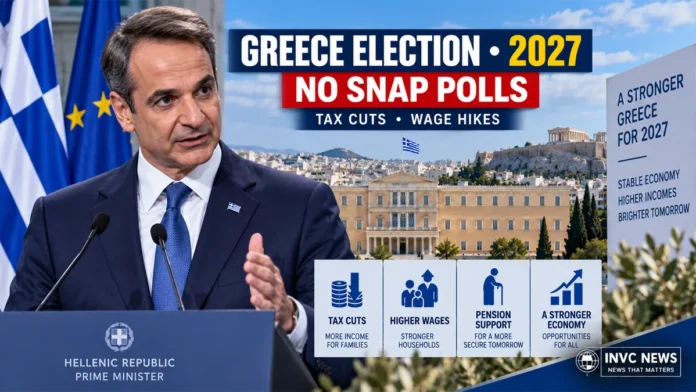
Greece Election 2027 will take place in the spring as Prime Minister Kyriakos Mitsotakis moved Sunday to shut down months of speculation over an early national vote, declaring that his government intends to complete its term while pushing a sweeping package of tax cuts, wage increases and income support measures.
Mitsotakis ruled out a snap election after presenting an economic programme whose total fiscal impact is expected to reach about €3.5 billion by 2030.
The package will initially cost around €2.2 billion in 2027 and includes tax relief for families and farmers, bonuses for pensioners and public-sector employees, reductions in business taxes and further increases in Greece’s minimum wage.
The prime minister said elections would be held in spring 2027 and expressed confidence that his center-right New Democracy party could secure a third consecutive term.
His declaration turns Greece’s political focus from speculation over election timing toward a year-long contest over household incomes, the cost of living, economic reform and public trust.
Mitsotakis Ends Snap Election Speculation
Rumors of an early election had intensified as the government faced declining public support and continuing political pressure.
Mitsotakis rejected that scenario on Sunday.
He said the general election would take place in spring 2027, sticking to the timetable he has repeatedly defended.
The declaration matters because uncertainty over an early election can affect government decision-making, financial markets and party strategy.
By publicly committing to the spring timetable, Mitsotakis is signaling that his government intends to use the remaining months of its mandate to implement economic measures and rebuild voter support.
€3.5 Billion Programme Targets Household Incomes
The government’s new economic programme represents the political centerpiece of that strategy.
Its immediate fiscal cost will be around €2.2 billion in 2027.
As additional measures phase in, the total annualized impact is expected to approach €3.5 billion by 2030.
The measures target several groups that have faced persistent pressure from Greece’s cost-of-living crisis.
They include workers, pensioners, farmers, families with children, public servants, self-employed professionals and small businesses.
The government is presenting the package as evidence that Greece’s improving fiscal position can now translate into higher household incomes and lower taxes.
Pensioners and Public Servants to Receive Bonuses
The programme includes an annual bonus of €400 for pensioners and €500 for public-sector employees.
These measures are designed to provide direct income support as households continue to face elevated living costs.
Greece’s economy has improved dramatically compared with the debt-crisis years, but purchasing power remains a major political concern.
Higher food, housing and energy expenses have weakened the impact of nominal wage gains for many households.
Mitsotakis is therefore trying to shift the government’s economic message from macroeconomic recovery toward tangible benefits for families.
Tax Relief Targets Farmers and Larger Families
The government also plans significant income-tax relief.
Farmers and families with three children earning up to specified income thresholds will benefit from zero or reduced income-tax treatment under the new measures.
The prime minister highlighted a family with three children and annual income of €20,000 as an example of households that could see their income-tax burden fall to zero.
The government also plans additional financial support for larger families.
The measures form part of a broader attempt to address Greece’s demographic challenges while reducing pressure on household budgets.
Minimum Wage Heading Toward €1,000
Mitsotakis also strengthened his government’s wage commitments.
He said Greece’s minimum wage would exceed the previously announced €950 target in 2027.
The government now aims to raise it to €1,000 per month in January 2028.
That represents a politically significant promise in a country where wage growth and purchasing power remain major voter concerns.
Higher wages could boost household consumption, but policymakers will also need to watch whether businesses can absorb rising labour costs without pushing prices higher.
The government argues that continued economic growth gives employers and the state more room to support higher incomes.
Greece Economy Growing Faster Than Eurozone Average
Mitsotakis is basing his political strategy partly on Greece’s improving economic position.
The economy is growing at roughly 2% annually, above the eurozone average.
Athens also expects a strong primary budget surplus this year.
That fiscal performance has created room for tax reductions and income-support measures that would have been difficult during Greece’s debt crisis.
For years, the country operated under severe austerity, international bailout programmes and intense pressure to cut public spending.
The government now wants voters to see the latest package as evidence that the era of emergency fiscal management has given way to more conventional economic policymaking.
Public Debt Target Falls Below 110% of GDP
Mitsotakis has also set longer-term fiscal targets.
The government wants to reduce public debt to below 110% of GDP by 2030.
It also aims to bring unemployment down to around 6%.
Those targets are central to New Democracy’s argument that Greece can combine fiscal discipline with rising incomes.
The prime minister is trying to convince voters that tax cuts and wage increases do not require a return to the excessive borrowing that contributed to Greece’s earlier financial crisis.
That credibility will become increasingly important as election campaigning intensifies.
New Democracy Support Has Fallen From 2023 High
Despite the improving macroeconomic picture, Mitsotakis faces a tougher political environment than he did during the last national election.
New Democracy won around 40.5% of the vote in 2023.
Recent opinion polls have placed support below 30%.
The decline reflects several political pressures, including household frustration over living costs and allegations involving government conduct.
Mitsotakis remains ahead of his rivals in many polls, but maintaining the largest party is different from securing enough parliamentary seats to govern alone.
That distinction explains why the prime minister is already talking openly about winning an outright majority.
Mitsotakis Seeks Third Consecutive Term
The Greek prime minister said he believes New Democracy can win a third consecutive four-year mandate.
That would extend a period of political dominance that began when Mitsotakis first came to power in 2019.
The government’s campaign is likely to emphasize economic stability, investment, lower unemployment, fiscal credibility and tax relief.
Opposition parties are expected to focus on household purchasing power, public services, government accountability and allegations of corruption.
The 2027 election could therefore become a referendum on whether Greece’s economic recovery has improved daily life quickly enough for ordinary voters.
Cost of Living Remains Political Weakness
That question is particularly important because headline economic growth does not always translate immediately into higher living standards.
Greece continues to face a substantial gap in household purchasing power compared with wealthier European Union economies.
Rising prices have put additional pressure on wages.
Public frustration was visible during demonstrations in Thessaloniki around the government’s annual economic programme.
Thousands of workers, farmers and other protesters demanded stronger action on wages and affordability.
For Mitsotakis, the challenge is to convince those voters that the new package will produce meaningful improvements before election day.
Tax Cuts Also Target Businesses and Self-Employed
The package extends beyond households.
The government plans to gradually reduce advance tax payments for self-employed workers and businesses.
It is also moving to eliminate certain business levies outside the Athens region before later extending the reductions more broadly.
Such measures aim to improve cash flow for smaller firms and encourage investment.
The government argues that reducing the tax burden can help economic growth continue while supporting employment.
Critics will likely examine whether the benefits reach smaller businesses and middle-income households rather than concentrating among higher earners.
Spring 2027 Vote Now Becomes Political Deadline
By ruling out a snap election, Mitsotakis has created a clearer political timetable.
The government now has several months to demonstrate that the economic measures can deliver results.
Voters will watch inflation.
They will watch wages.
They will watch employment.
And they will assess whether the promised tax relief reaches household budgets.
New Democracy’s ability to convert Greece’s stronger macroeconomic position into improved voter sentiment could determine whether Mitsotakis secures the third term he wants.
Greece Election 2027 Will Test Economic Recovery
The coming election therefore carries significance beyond party politics.
Greece has travelled a long distance from the sovereign-debt crisis that once raised questions about whether it could remain inside the eurozone.
Its economy is expanding.
Its fiscal position has improved.
Its government now has room to cut taxes and raise wages.
But voters will ultimately judge that recovery through their own household finances.
Mitsotakis has now removed one major uncertainty by confirming that elections will take place in spring 2027.
The next question is much harder.
Can a €3.5 billion tax-and-income programme restore enough public support to give New Democracy another governing majority?
That battle will define Greek politics over the months ahead.