WASHINGTON, D.C., United States | September 6, 2026 —
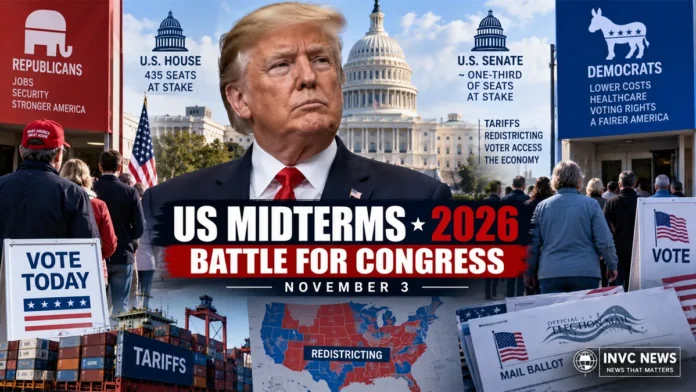
US Midterms 2026 have entered their decisive final stretch with President Donald Trump again dominating America’s political conversation as Republicans fight to retain congressional power and Democrats try to turn voter frustration over the economy, tariffs, foreign policy and election rules into gains on November 3.
Less than two months remain before American voters decide all 435 seats in the House of Representatives and roughly one-third of the U.S. Senate.
The elections will determine whether Republicans can preserve their ability to advance Trump’s agenda through Congress or whether Democrats gain control of one or both chambers and dramatically constrain the White House during the remainder of his term.
Trump is not on the ballot.
Politically, however, he is everywhere.
Republican candidates increasingly campaign on his record, while Democrats are trying to make the election a referendum on his presidency.
That dynamic gives the 2026 midterms the character of a national election even though voters will technically choose hundreds of individual House, Senate, gubernatorial and state-level candidates.
Trump Becomes Central Figure in Midterm Battle
Donald Trump’s influence over the Republican Party remains one of the defining forces of the 2026 campaign.
The president has promised to campaign aggressively for Republican candidates in competitive races and has urged lawmakers to sell voters on his administration’s record.
For Republicans, that strategy carries both opportunity and risk.
Trump can energize the party’s most committed voters and drive turnout in close contests.
However, Democrats believe dissatisfaction with his administration could motivate opposition voters at the same time.
That means many congressional races will ultimately revolve around a simple question:
Are voters satisfied with the direction of the country under Trump?
Control of House Could Turn on Small Number of Districts
The battle for the House of Representatives remains particularly intense.
All 435 House seats will be contested on November 3.
However, only a relatively small group of competitive districts may ultimately determine which party controls the chamber.
Democrats are targeting Republican-held seats in suburban districts, rapidly changing communities and areas where economic concerns have weakened support for the governing party.
Republicans, meanwhile, hope to defend their vulnerable incumbents while challenging Democrats in districts where Trump’s coalition has expanded.
Because the majority margin is narrow, even a modest national swing could change control of the House.
That makes individual races in California, Texas, Nevada, Nebraska and other competitive states nationally significant.
Senate Map Adds Another Layer of Uncertainty
The Senate presents a different political challenge.
Only about one-third of the 100 Senate seats come up for election in each two-year cycle.
That means control depends heavily on which states have races in a particular year.
Competitive Senate contests in states including Texas, Georgia and others have attracted growing national attention.
Republicans are seeking to protect their position while Democrats look for opportunities to expand the battlefield into states that previously appeared difficult to win.
A change in Senate control would have consequences extending far beyond legislation.
The Senate confirms federal judges, Cabinet nominees and many senior government officials.
That makes every close Senate race important to the balance of power in Washington.
Tariffs Become Major Economic Election Issue
Trump’s tariff policy has become one of the most significant economic questions in the campaign.
The president argues that tariffs protect American industry, strengthen domestic manufacturing and force trading partners to negotiate better terms with the United States.
Democrats and some businesses counter that tariffs can increase costs for companies and consumers.
The political impact varies by state and industry.
Manufacturing communities may respond differently from agricultural regions.
Businesses dependent on imported materials can face different pressures from companies that compete directly with foreign producers.
Voters will ultimately judge whether Trump’s trade strategy has improved their economic position or raised the cost of living.
That makes tariffs much more than a foreign-trade policy.
They have become a household economic issue.
Economy Remains Critical for Voters
As in most American elections, the economy could ultimately outweigh many political controversies.
Voters are watching prices, wages, housing affordability, interest rates, employment and healthcare costs.
Republicans are highlighting investment, economic growth, lower border crossings and other achievements of the Trump administration.
Democrats argue that many households still face significant cost pressures.
That contrast will dominate advertising through November.
The political party that persuades voters it can better manage their everyday economic concerns could gain a decisive advantage in close congressional districts.
Redistricting Reshapes Fight for House
The 2026 election has also been shaped by an extraordinary mid-decade redistricting battle.
Normally, states redraw congressional districts after the once-a-decade U.S. census.
This cycle, however, several states have pursued new maps during the middle of the decade.
Trump encouraged Republican officials in Texas to seek additional favorable congressional districts.
Democratic-led California responded with its own redistricting moves.
Other states then entered the battle.
The result has been a nationwide legal and political struggle over congressional maps.
Courts, legislatures and voters are now deciding boundaries that could influence control of the House.
Courts Become Major Players in Election Map Battles
Redistricting fights have moved rapidly through state and federal courts.
Missouri’s Supreme Court recently blocked a Trump-backed congressional map from automatically governing the November election and ordered that the issue go before voters.
Maryland has also seen major legal disputes over congressional redistricting.
These battles demonstrate how control of Congress can depend not only on candidates and campaigns but also on which district maps voters use.
Both parties accuse the other of manipulating boundaries for political advantage.
Redistricting will therefore remain one of the most consequential but complex issues of the 2026 election.
Voting Rules and Mail Ballots Face New Legal Battles
Voting access has also moved to the center of the campaign.
The Trump administration has pushed changes involving mail ballots and election procedures.
Courts have blocked or questioned some of those measures, while the administration continues to seek legal approval.
Supporters argue tighter procedures can strengthen election integrity.
Critics say last-minute changes could make voting more difficult and create confusion.
Because U.S. elections are primarily administered by states, federal attempts to influence election procedures frequently generate constitutional and legal disputes.
Those disputes are becoming increasingly urgent as states begin preparing and distributing ballots.
Trump Administration Takes Mail Voting Fight to Supreme Court
The administration has again asked the U.S. Supreme Court to allow restrictions involving mail ballots to take effect before November.
The legal battle comes as election officials across the country are already preparing voting systems.
Mail voting remains important because a substantial share of American voters use absentee or postal ballots.
Changing procedures close to Election Day can therefore affect millions of voters and create significant logistical challenges for state election offices.
The Supreme Court’s handling of these disputes could become one of the most important election-law developments of the campaign.
Iran Conflict Adds Foreign Policy to Campaign
Foreign policy is also shaping voter attitudes.
The United States remains deeply involved in military confrontation with Iran, while the Trump administration simultaneously pursues diplomatic efforts involving Russia and Ukraine.
Republicans can argue that Trump is defending American interests aggressively abroad.
Democrats can counter by questioning the financial, military and economic costs of prolonged international confrontation.
Energy prices add another political dimension.
Conflict involving Iran and the Strait of Hormuz can influence global oil markets.
If international instability increases fuel or transportation costs inside the United States, foreign policy could quickly become a domestic election issue.
Trump Deploys Political Money
Trump-aligned political organizations are also beginning to deploy significant campaign resources.
MAGA Inc. has launched a major advertising push in the Texas Senate race, illustrating how Trump intends to use his political network to influence competitive contests.
Texas has traditionally leaned Republican in statewide elections.
However, increased Democratic investment and changing political dynamics have turned some races into potentially important tests of national momentum.
Large spending decisions can signal which races Republican strategists consider vulnerable.
They can also force Democrats to redirect resources toward states they once viewed as difficult opportunities.
Democrats Try to Expand Electoral Map
Democrats are not limiting their strategy to traditional battleground districts.
They are also targeting Republican-held seats that would normally sit outside the core competitive map.
Such “reach” races can become important when national voter sentiment turns strongly against the governing party.
Democrats are watching contests in states including Nebraska, Kentucky, Nevada, South Carolina and Texas.
Winning several such races would indicate a substantial national shift.
Republicans insist many of those districts remain fundamentally favorable to their candidates.
The results will reveal whether voter frustration has become strong enough to overcome traditional partisan patterns.
Latino Voters Could Decide Critical Districts
Both parties are also watching Latino voters closely.
Trump made important gains among Hispanic voters in previous elections, challenging assumptions about long-term Democratic dominance among that electorate.
However, some recent political indicators suggest parts of that support may be shifting again.
Economic pressures, healthcare policy, immigration enforcement and local concerns could influence Latino voters differently across the country.
California’s Central Valley provides one important test.
Republican candidates who previously survived in Democratic-leaning districts may now face stronger challenges if Latino voters move away from the GOP.
That makes demographic voting patterns another major national storyline.
Every Midterm Becomes Referendum on President
Historically, the president’s party often faces difficulties during midterm elections.
Voters sometimes use the midterms to place a check on the White House, particularly when one party controls multiple branches of government.
Trump and Republican strategists know that history.
The president has acknowledged the traditional challenges facing governing parties while insisting Republicans can defy the pattern.
Democrats are counting on the opposite.
They want voters who oppose Trump’s administration to treat November 3 as their first major opportunity to change Washington’s balance of power since his return to office.
November 3 Could Reshape Washington
The stakes extend well beyond election-night victories.
If Republicans retain control of Congress, Trump would have a stronger opportunity to continue advancing his domestic and foreign-policy agenda.
If Democrats capture the House, they would gain control of committees, investigations, legislative priorities and spending negotiations.
A Democratic Senate victory would carry even larger consequences for presidential nominations and the federal judiciary.
Split control could produce legislative gridlock.
Unified opposition control would fundamentally change the remaining years of Trump’s presidency.
Five Issues to Watch Before Election Day
As November 3 approaches, five developments could change the race quickly.
The economy: Any major shift in inflation, employment, interest rates or consumer confidence could move voters.
Iran and global conflict: Further escalation could affect national security sentiment and energy prices.
Redistricting rulings: Court decisions could change the boundaries of competitive House districts.
Voting rules: Supreme Court action involving mail ballots could alter election procedures.
Trump himself: The president’s speeches, endorsements, campaign spending and policy decisions will continue to shape Republican fortunes.
That last factor may ultimately overshadow everything else.
US Midterms 2026 Are Becoming a Trump Referendum
American voters will choose hundreds of candidates on November 3.
But the national campaign increasingly revolves around one political figure.
Donald Trump.
Republicans want voters to reward his record.
Democrats want voters to restrain his power.
Court battles over voting, disputes over district maps, tariffs, economic anxiety and foreign wars have all become part of that larger confrontation.
That is why the 2026 midterms are becoming much more than routine congressional elections.
They will determine who controls Capitol Hill.
They will shape the final phase of Trump’s current presidency.
And they will provide America’s clearest political signal yet about where voters want the country to go before the 2028 presidential race begins in earnest.