By Team INVC | INVC NEWS
Published: September 1, 2026 | 07 : 23 PM IST
NEW DELHI, India | September 1, 2026 —
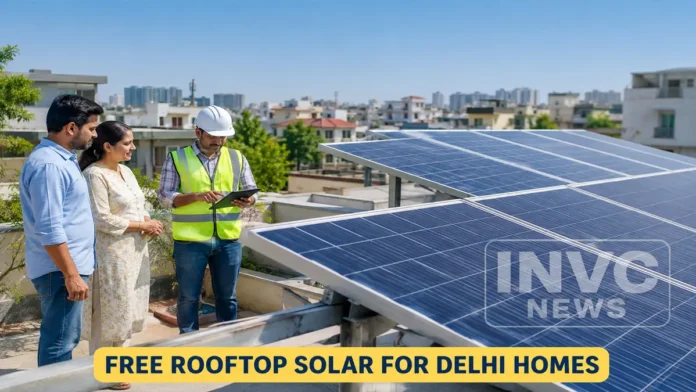
Delhi Free Solar Panel Scheme is set to dramatically expand rooftop solar access across the national capital after the Delhi Cabinet approved a revised policy aimed at removing one of the biggest barriers for households — the upfront cost of installing solar panels.
Under the Cabinet-approved framework announced Tuesday, eligible residential consumers using up to 400 units of electricity a month can receive rooftop solar systems with effectively zero upfront installation cost, subject to technical feasibility and the final implementation conditions.
The Delhi government has set an ambitious target to install rooftop solar systems in around 230,000 households by March 2027, potentially making the initiative one of the capital’s biggest residential clean-energy drives.
The plan combines central and Delhi government financial support to make rooftop solar significantly more affordable while also allowing households to reduce their dependence on grid electricity.
What Changes Under the Revised Delhi Solar Policy?
The biggest change is the government’s attempt to eliminate the initial financial burden that often discourages families from installing rooftop solar systems.
A standard 3-kW rooftop solar system can cost around ₹1.75 lakh. Under the revised framework, a household in the eligible category could receive financial assistance from both the central government and the Delhi government.
For a 3-kW system, the Centre’s support under the PM Surya Ghar program can reach ₹78,000. The revised Delhi framework proposes matching state support of up to ₹78,000, while an additional government top-up can bridge the remaining installation cost for qualifying households.
For households consuming up to 400 units a month, the additional support is designed to make the installation effectively zero-cost upfront.
That distinction is important because households consuming more than 400 units may still qualify for substantial solar subsidies, but they may have to contribute part of the installation cost depending on their consumption category and system size.
How Much Support Could a 3-kW System Get?
For eligible households consuming between 201 and 400 units a month, the government’s announced structure envisages a 3-kW rooftop solar system supported through combined central and Delhi subsidies.
The central subsidy can provide up to ₹78,000, while the Delhi government’s revised support can provide another ₹78,000. An additional state top-up of around ₹19,000 for qualifying consumers could cover the remaining amount on a system estimated to cost approximately ₹1.75 lakh.
This structure is intended to solve a longstanding problem in rooftop solar adoption: many households want lower electricity bills but cannot or do not want to pay a large installation cost at the beginning.
What About Homes Using 200 Units or Less?
Households with lower electricity consumption are also part of the revised solar push.
For a household consuming up to 200 units a month, a 2-kW rooftop solar system may be more appropriate depending on roof space, electricity demand and technical assessment.
Under the announced structure, the combined central subsidy, Delhi government assistance and additional support could effectively cover the estimated cost of an eligible 2-kW installation.
The government’s broader objective is therefore not limited to subsidizing electricity consumption. It wants more homes to begin generating electricity themselves.
Solar Panels Could Cut Bills and Generate Surplus Power
The financial benefit does not necessarily end with installation.
A rooftop solar system can generate electricity during daylight hours, reducing the amount of power a household needs to draw from the grid. Depending on system generation, household consumption and applicable net-metering rules, surplus electricity can also be exported to the grid.
The revised policy retains the importance of net metering, which allows eligible consumers to receive credit or benefits for surplus solar power supplied to the electricity network under prevailing regulations.
A 3-kW system can generate roughly 300 units a month under suitable conditions, although actual output will vary with sunlight, roof orientation, weather, shading, maintenance and equipment efficiency.
For households whose solar systems generate more electricity than they immediately consume, net metering could further improve the economics of installing rooftop panels.
Five-Year Maintenance Support Could Remove Another Barrier
Installation cost is not the only concern homeowners have when considering solar.
Maintenance, repairs and system performance can also discourage consumers unfamiliar with rooftop power systems.
Under the revised framework, the Delhi government plans to arrange operation and maintenance support for five years through designated vendors.
That could make the scheme more attractive to households that have avoided solar because of concerns about maintaining panels, inverters and related equipment after installation.
Existing Electricity Subsidy to Continue
Another significant element of the announcement is that Delhi’s existing electricity subsidy benefits are expected to continue for eligible consumers.
The rooftop solar program is being positioned as an additional route toward lower household energy costs rather than an immediate replacement for the existing subsidy structure.
The government wants consumers to gradually move from being solely electricity users to becoming small-scale electricity generators.
Target: 2.3 Lakh Delhi Homes by March 2027
The scale of the plan is substantial.
The Delhi government aims to bring rooftop solar systems to approximately 2.3 lakh households by March 2027.
Chief Minister Rekha Gupta has linked the initiative to the government’s wider Green Delhi push, which seeks to expand clean-energy use and reduce dependence on conventional sources of electricity.
The government has also said that only around 10,000 buildings in Delhi currently have solar generation capability, with government buildings accounting for a significant share.
If the residential target is achieved, rooftop solar penetration in the capital could therefore increase sharply.
Why the Delhi Free Solar Panel Scheme Matters
Delhi has long struggled with severe air pollution, heavy electricity demand and the environmental cost associated with conventional energy generation.
Rooftop solar alone cannot solve the capital’s pollution problem. However, expanding distributed renewable energy can reduce demand for conventionally generated electricity, increase clean-energy capacity and give households greater control over their power expenses.
More importantly for consumers, the revised Delhi Free Solar Panel Scheme shifts the solar proposition from a long-term investment requiring significant upfront spending to a government-supported household energy program.
Its success will now depend on implementation — including vendor capacity, rooftop suitability, DISCOM approvals, net-metering procedures and how quickly applications and installations are processed.
Residents should check the final notified eligibility rules and application process before making financial commitments, as operational conditions can be refined during implementation.