
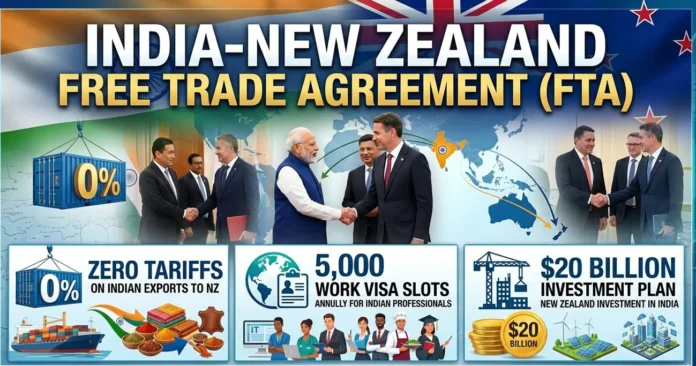
NEW DELHI, October 20, 2026 — India’s free trade agreement (FTA) with New Zealand came into force on Tuesday, opening a new chapter in bilateral economic ties. The agreement gives Indian exports duty-free access across New Zealand’s tariff lines, creates new pathways for Indian professionals and students, and includes a commitment by New Zealand to facilitate $20 billion in investment in India over 15 years.
The deal also opens India’s large consumer market to more New Zealand products, with tariff reductions covering 95% of New Zealand’s current exports to India. However, New Delhi has kept sensitive sectors—including dairy and several agricultural products—outside key market-access concessions to protect domestic farmers and industries.
The central question is whether the agreement can turn these commitments into higher exports, jobs and investment while maintaining a balance between the two economies.
India-New Zealand FTA: The key numbers
- Effective date: October 20, 2026
- Indian exports: Zero-duty access across 100% of New Zealand’s tariff lines
- New Zealand exports: Tariff reductions covering 95% of its current exports to India
- Investment: New Zealand has committed to facilitating $20 billion in investment in India over 15 years
- Professional mobility: A dedicated quota of up to 5,000 Temporary Employment Entry visa holders in New Zealand at any one time
- Working-holiday visas: Up to 1,000 places annually for eligible young Indians
- Trade ambition: The two countries aim to increase two-way trade in goods and services to NZ$7 billion by 2030
These are commitments and targets under the agreement, not guarantees that trade, investment or employment will automatically rise by the stated amounts.
How much do India and New Zealand trade today?
India and New Zealand already exchange goods and services, but the relationship remains relatively small compared with India’s trade with its largest partners.
According to India’s Department of Commerce, bilateral merchandise trade reached approximately $1.3 billion in fiscal year 2024-25, up from about $873 million in 2023-24. India exported roughly $711 million worth of goods to New Zealand in 2024-25, while imports from New Zealand stood at approximately $587 million.
The broader goods-and-services relationship is larger. New Zealand’s official trade figures put two-way trade at NZ$3.9 billion for the year ended June 2026.
New Zealand’s exports to India include travel and other services, forestry products, fruit, aluminium, iron and steel, and wool. India’s exports include pharmaceuticals, machinery, textiles and other manufactured products, along with business and information technology services.
The FTA is intended to make this trade easier and more competitive by reducing import duties and providing clearer rules for businesses operating across the two markets.
What changes for Indian exporters?
1. Textiles, clothing and leather could become more competitive
New Zealand has removed tariffs across all its tariff lines for Indian exports under the agreement. That matters because even relatively modest import duties can make a product more expensive in a competitive market.
Potential beneficiaries include textiles, apparel, leather goods, footwear, carpets, engineering products, pharmaceuticals, chemicals, processed foods and marine products.
For Indian manufacturers, the benefit could be particularly important for labour-intensive industries and small and medium-sized enterprises that need access to overseas buyers. Lower tariffs may help them compete with suppliers from countries that already enjoy preferential trade arrangements.
However, zero tariffs do not automatically translate into new orders. Exporters will still need to meet product standards, delivery requirements, rules of origin and other regulatory conditions.
2. Pharmaceuticals and engineering goods gain an opening
Indian pharmaceutical companies and engineering manufacturers could find it easier to compete on price as applicable customs duties are removed.
The opportunity extends beyond large businesses. Smaller suppliers that manufacture components, specialised equipment, textiles and other products could also benefit if they can establish reliable distribution and customer relationships in New Zealand.
The scale of the eventual gains will depend on demand, regulatory approvals, logistics costs and how effectively Indian companies use the new access.
3. Services and professional opportunities expand
The agreement covers a broad range of services, including information technology, professional services, education, finance, telecommunications, construction, tourism and other business services.
India has long sought better access for its service providers and skilled professionals. The agreement creates new routes for eligible Indian workers in sectors where New Zealand needs skills, including information technology, engineering, healthcare, education and construction.
It also includes provisions for certain Indian occupations such as AYUSH practitioners, yoga instructors, Indian chefs and music teachers.
These arrangements could help Indian professionals access opportunities abroad while allowing New Zealand employers to recruit eligible workers in fields facing shortages. Applicants must still meet the relevant visa, qualification, job-offer and other immigration requirements.
What do the 5,000 work visa places mean?
The FTA establishes a dedicated Temporary Employment Entry visa pathway with a quota of up to 5,000 visa holders in New Zealand at any one time. Eligible professionals may be permitted to stay for up to three years, depending on the applicable visa conditions.
This is not an automatic work permit for every Indian applicant. Eligibility depends on the occupation and immigration rules, including qualifying employment and other requirements.
The agreement also provides for up to 1,000 working-holiday visa places annually for eligible young Indians. The scheme is designed to support travel, cultural exchange and work experience.
For students, the deal includes commitments relating to work while studying and expanded post-study work opportunities. Eligible STEM bachelor’s and master’s graduates may qualify for post-study work rights of up to three years, while doctoral graduates may qualify for up to four years, subject to the applicable rules.
Students should check New Zealand’s official immigration guidance before making education or employment plans.
Why has New Zealand agreed to invest $20 billion in India?
New Zealand is seeking stronger access to one of the world’s largest consumer markets. India’s expanding economy and demand for goods, services, technology and investment make it an important long-term destination for New Zealand businesses.
Under the FTA, New Zealand has committed to facilitating $20 billion in investment in India over 15 years. The stated ambition is to support areas such as manufacturing, infrastructure, innovation, agriculture and job creation.
The commitment is significant, but it should not be interpreted as $20 billion already invested or as an unconditional transfer of funds. Actual investment will depend on projects, commercial decisions and implementation of the agreement.
For India, the potential benefit lies not only in attracting capital but also in encouraging technology partnerships, improving productivity and supporting employment.
What does New Zealand gain from India?
New Zealand receives preferential access to the Indian market for a wide range of its exports. The agreement reduces or removes tariffs on products that can include selected fruit, wool, forestry products and other goods, with the terms varying by product and implementation schedule.
For some products, tariff cuts will be phased in over time or linked to quotas and other safeguards. The agreement also contains provisions affecting services and business mobility.
New Zealand wants to diversify its export markets and expand sales in India. Its government has set a goal of increasing two-way trade in goods and services to NZ$7 billion by 2030.
For New Zealand exporters, lower duties may improve competitiveness. For Indian consumers and businesses, some imports could become less expensive, although the final retail price will also depend on freight, exchange rates, distribution margins and taxes.
Why has India kept dairy and sensitive farm products out?
Dairy has been one of the most sensitive issues in India-New Zealand trade negotiations. New Zealand is a major dairy exporter, while India’s dairy economy supports millions of farmers, including small and marginal producers.
India has therefore excluded key dairy products—including milk, cream, cheese, yoghurt and whey—as well as several other sensitive products from important market-access concessions. Coffee, onions, sugar, spices, edible oils and rubber are among the categories also identified for protection under the agreement.
The exclusions are intended to reduce the risk that increased imports will place additional pressure on domestic producers.
At the same time, the agreement provides for agricultural cooperation and productivity partnerships, including work related to apples, kiwifruit and honey. The aim is to support better farming practices, technology exchange and productivity while retaining safeguards for Indian producers.
The balance will depend on how the agreement is implemented and how effectively domestic farmers and businesses can improve their competitiveness.
What are India’s main demands and priorities?
India’s key objectives include:
- Better access for goods: Removing tariffs that can make Indian products less competitive overseas.
- Services exports: Expanding opportunities for IT, professional, financial, education and other service providers.
- Professional mobility: Creating more structured routes for qualified Indian workers.
- Investment and technology: Encouraging long-term capital, innovation and cooperation in manufacturing and infrastructure.
- Protection for sensitive sectors: Keeping important agricultural and dairy products outside major concessions.
- Support for smaller exporters: Helping MSMEs and labour-intensive businesses enter overseas markets.
The challenge is to ensure that the gains reach a broad range of businesses and workers, rather than being concentrated among a small number of large exporters.
Which countries has India signed trade agreements with?
India has expanded its network of trade agreements over the past two decades. Important arrangements include agreements with Japan, South Korea, Australia, the United Arab Emirates, Mauritius and the United Kingdom, as well as agreements with Singapore, Malaysia, Sri Lanka, Thailand and Bhutan.
India also has trade arrangements with the ASEAN group of Southeast Asian nations and with the European Free Trade Association (EFTA), which comprises Iceland, Liechtenstein, Norway and Switzerland.
The status and scope of these agreements differ: some are comprehensive free trade agreements, while others are narrower or cover particular categories of trade. India has also pursued negotiations with additional partners, including the European Union and the United States. Any deal under negotiation or political announcement should not be described as an agreement in force until the relevant legal and implementation steps are completed.
The New Zealand agreement adds another developed-market partner to India’s trade network and comes as businesses look for more predictable access to overseas markets.
What happens next?
With the FTA now in force, businesses on both sides must begin using its provisions. Exporters and importers will need to check the applicable tariff schedules, product-specific rules of origin, documentation and any quotas or safeguards.
The next test will be measurable: whether Indian exports increase, whether more companies enter the New Zealand market, whether the investment commitment produces real projects and whether eligible professionals can use the new mobility pathways.
Consumers may see changes in the cost or availability of selected imports over time, but the size and speed of any price impact will vary by product.
The bottom line
The India-New Zealand FTA is more than a tariff-cutting agreement. It combines market access with services, professional mobility, agricultural cooperation and a long-term investment commitment.
Indian exporters in textiles, leather, pharmaceuticals, engineering and other sectors have a new opportunity to compete in New Zealand, while New Zealand gains improved access to selected segments of India’s large market.
The agreement’s success will ultimately depend on execution: companies must convert preferential access into sales, investment commitments must translate into projects, and India’s safeguards for farmers and sensitive industries must remain effective.