By Team INVC | INVC NEWS
Published: September 1, 2026 |11 : 32 AM IST
BENGALURU, India | September 1, 2026 —
India’s factories have delivered an unexpected warning just after the economy posted blockbuster growth.
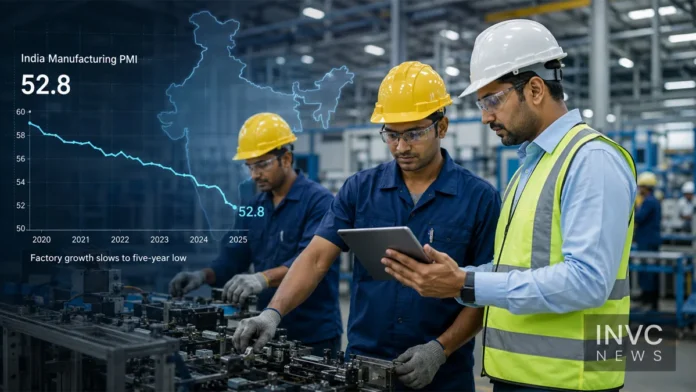
The India Manufacturing PMI fell to 52.8 in August 2026, marking the weakest expansion in factory activity in five years as softer domestic demand, slower export momentum and cautious hiring weighed on manufacturers.
The HSBC India Manufacturing Purchasing Managers’ Index, compiled by S&P Global, slipped sharply from 53.5 in July and also came in slightly below the preliminary August estimate of 52.9.
A PMI reading above 50 still signals expansion. Therefore, Indian manufacturing has not entered contraction. However, the sharp loss of momentum is significant because it comes immediately after official GDP data showed India’s economy expanding 7.8% in the April-June quarter, comfortably beating expectations.
The contrast creates an important question for the months ahead: can India maintain its strong headline economic growth if factory demand continues to cool?
India Manufacturing PMI Drops to 52.8
The August manufacturing survey showed weakness across several closely watched indicators.
Key August PMI signals:
- Manufacturing PMI: 52.8
- July PMI: 53.5
- Factory growth: Slowest in five years
- New-order growth: Weakest since August 2021
- Employment: Fell for the first time in 30 months
- Output growth: Slowest in five years
- Input-price inflation: Six-month low
- Business confidence: Improved modestly
The headline PMI remains above the crucial 50 level, meaning manufacturing activity continued to grow during August.
However, the pace of that expansion weakened noticeably.
New Orders Send the Biggest Warning
Perhaps the most important signal came from new business.
New orders received by Indian manufacturers increased at the slowest pace since August 2021, indicating that demand conditions have become more challenging.
Manufacturers reported weakness for some products, while growth in international orders also lost momentum compared with July.
For factories, new orders act as an early indicator of future production.
If order books continue to weaken, businesses may eventually respond by slowing production, reducing purchases, delaying investment or becoming more cautious about hiring.
That makes the August reading particularly important for investors, policymakers and companies tracking the strength of India’s industrial economy.
Factory Jobs Fall for First Time in 30 Months
The employment data delivered another notable signal.
Indian manufacturers reduced their workforce marginally during August, marking the first decline in factory employment in 30 months.
The fall was limited, but the direction matters.
Manufacturing has been positioned as one of the crucial engines for India’s future employment growth, particularly as the country pushes Make in India, semiconductor manufacturing, electronics production, industrial corridors and global supply-chain diversification.
Any sustained weakening in factory hiring would therefore attract attention far beyond the PMI headline.
The Big Contrast: GDP Growth Was 7.8%
The factory slowdown looks especially striking because it arrives immediately after India reported 7.8% real GDP growth in Q1 FY27.
The April-June GDP performance exceeded expectations, with manufacturing itself expanding by about 9.2% during the quarter.
Financial, real-estate and professional services also recorded strong growth, while investment helped support the broader economy.
That means the latest PMI does not erase India’s strong GDP performance.
Instead, it offers a more forward-looking warning that conditions during the current quarter may be less powerful than those seen in April-June.
Also Read – : PM Modi Hails India’s 7.8% GDP Growth, Says Global Crises Could Not Stop Economy; Pushes Swadeshi and Self-Reliance
Why GDP and PMI Can Tell Different Stories
GDP and PMI measure different things and cover different periods.
The 7.8% GDP number reflects economic activity during the April-June quarter.
The latest PMI, meanwhile, captures business conditions among manufacturers during August.
Therefore, both can be true at the same time: India may have delivered powerful economic growth in the previous quarter while manufacturing momentum weakened later in the year.
PMI data is closely watched precisely because it can provide a faster indication of changes in business conditions before broader official economic data becomes available.
There Is Some Good News for Inflation
The August survey was not entirely negative.
Cost pressures eased notably.
Input-price inflation fell to a six-month low, suggesting that manufacturers faced less intense increases in raw-material and other production costs.
Companies consequently raised their selling prices more slowly.
Output-price inflation eased to its weakest level in 45 months.
For consumers and the Reserve Bank of India, softer factory price pressures could become helpful if the trend continues.
India remains vulnerable to global energy prices, currency movements and geopolitical disruptions, particularly because the country imports a large share of its crude-oil requirements.
Lower manufacturing cost inflation could provide at least some cushion against those external risks.
Business Confidence Improves Despite Slowdown
Interestingly, manufacturers did not become dramatically more pessimistic.
Business confidence improved slightly and reached its highest level since May.
That suggests many companies still expect production to rise over the coming year despite the immediate slowdown in orders and output.
However, confidence remains subdued compared with historical levels.
Manufacturers are navigating a complicated environment shaped by uncertain global demand, volatile energy markets, geopolitical conflicts and shifts in international supply chains.
Also Read – : India’s New FDI Rules Attract $511 Million as AI, Manufacturing and Data Centers Draw Investors
What the PMI Slowdown Means for India
One weak month does not establish a long-term manufacturing downturn.
The index remains above 50, factories are still expanding and India continues to benefit from large infrastructure spending, domestic consumption, manufacturing incentives and investment in emerging sectors.
However, August has produced three signals worth watching closely:
Demand is weakening.
Factory output growth has slowed.
Employment has fallen for the first time in two-and-a-half years.
If those trends reverse in September, August may prove to be a temporary loss of momentum.
If they continue, however, the manufacturing slowdown could become an important test of whether India can maintain growth near the levels recorded in the first quarter.
For now, India has an unusual economic picture: GDP is growing at 7.8%, but its factories have just recorded their weakest expansion in five years.
That tension could become one of the most closely watched economic stories of the coming months.