By Team INVC | INVC NEWS
Published: August 31, 2026 |04 : 49 PM IST
TEL AVIV, Israel | August 31, 2026 —
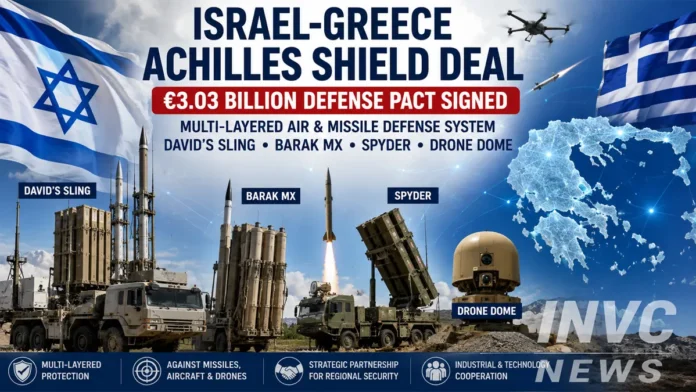
Israel and Greece have signed a landmark €3.035 billion Achilles Shield defence deal, under which Israeli technology will form the backbone of a new multi-layered Greek air and missile defence network capable of countering ballistic missiles, aircraft and hostile drones.
The agreement, signed in Tel Aviv on Monday, is the largest defence export deal in the history of Israel-Greece relations and one of the biggest ever signed by Israel.
At the centre of the programme are three major Israeli air-defence systems — David’s Sling, BARAK MX and SPYDER — supported by advanced MMR radars and a new nationwide command-and-control architecture.
A separate €26 million agreement was also signed for Rafael’s Drone Dome systems to strengthen protection of strategic sites against unmanned aerial vehicles.
What Is Greece’s Achilles Shield?
Achilles Shield is Greece’s ambitious new integrated air-defence architecture.
Rather than relying on one interceptor or radar system, Greece will combine several layers of defence so different weapons can respond to different threats.
The network is designed to counter:
- Ballistic missiles
- Aircraft and other aerial threats
- Cruise-type threats
- Unmanned aerial vehicles
- Drones attacking strategic sites
The entire architecture will be connected through a national command-and-control system so Greek defence authorities can coordinate detection, tracking and interception from one integrated network.
David’s Sling Becomes a Key Layer
One of the most important components is David’s Sling, developed through Israel’s missile-defence programme with Rafael as prime developer.
The system occupies an important layer between shorter-range air defence and higher-altitude ballistic missile interception.
Greece becomes only the second European country to acquire David’s Sling, further expanding the system’s international footprint.
Its inclusion gives Achilles Shield a capability designed for more sophisticated missile and aerial threats rather than relying only on conventional short-range air defence.
BARAK MX Adds Ballistic Missile Defence
Israel Aerospace Industries will supply the BARAK MX system.
BARAK MX is a modular, multi-layered air-defence system capable of engaging a wide spectrum of aerial threats.
It is designed to integrate sensors, command systems and different interceptor ranges according to operational requirements.
IAI will also provide MMR multi-mission radars through its ELTA division.
These radars will play a central role in identifying and tracking incoming aerial threats before the command network assigns an interceptor.
SPYDER Will Strengthen Shorter-Range Protection
Rafael’s SPYDER system forms another layer of the Greek network.
SPYDER is designed for rapid-response air defence and can protect military forces and strategic assets against aircraft, helicopters, drones and other aerial threats.
Combining SPYDER with David’s Sling and BARAK MX will allow Greece to create overlapping defensive layers rather than depending on a single weapons platform.
That is the core idea behind Achilles Shield.
€26 Million Drone Dome Deal Signed Separately
Drones have become one of the fastest-changing threats in modern warfare.
Alongside the €3.035 billion Achilles Shield programme, Israel and Greece signed another deal valued at approximately €26 million.
Under that agreement, Greece will receive Drone Dome systems manufactured by Rafael.
The systems will be used to protect strategic sites from hostile drones and reinforce existing anti-UAV defences.
The additional purchase highlights how heavily modern military planning is now focused on relatively inexpensive unmanned systems that can threaten infrastructure, military bases and other sensitive installations.
Israel Says Systems Draw on Real Combat Experience
Israeli officials are presenting operational experience as one of the biggest advantages behind the deal.
Israeli air-defence systems have been used against missiles and drones during recent regional conflicts, giving manufacturers substantial real-world data on interception and battlefield performance.
That combat experience has become an increasingly important part of Israel’s defence-export pitch.
Also Read – : Trump-Iran Conflict Escalates Again as Strait of Hormuz Oil Risk Returns
For Greece, the decision provides access not simply to individual weapons but to an integrated architecture built around systems that have already been operated against multiple categories of aerial threats.
19 Greek Companies Already Involved
Achilles Shield will not be an exclusively imported turnkey programme.
The Greek Ministry of National Defence says 19 Greek companies are already participating in processes connected with implementation.
The agreement provides for broader involvement of Greece’s defence and technology ecosystem.
Israel has also committed to expanding industrial cooperation, including the transfer of knowledge and technology to local industry.
That could give Greek companies opportunities in maintenance, integration, support and potentially other areas of the programme over its operational life.
Why Greece Is Spending Billions on Air Defence
Greece is undertaking a wider modernisation of its armed forces under its Agenda 2030 strategy.
Athens is investing in aircraft, naval platforms, missiles, drones and integrated air defence as it adapts to changing military technology and regional security risks.
The Eastern Mediterranean remains strategically sensitive, while drones and ballistic missiles have dramatically altered the threat environment witnessed in conflicts across Europe and the Middle East.
Achilles Shield is intended to create a modern national protective umbrella capable of dealing with these emerging threats.
The programme is expected to be introduced in stages rather than becoming operational all at once.
Israel and Greece Deepen Strategic Partnership
The deal is also about more than weapons.
Israel describes Greece as a key strategic partner in the Eastern Mediterranean, and military cooperation between the two countries has expanded significantly in recent years.
In April, Israel and Greece signed another major agreement worth approximately €650 million for Israeli-made PULS rocket artillery systems.
Achilles Shield takes that relationship to another level.
Israel’s Defence Minister Israel Katz said the two countries share strategic interests and face common regional challenges, arguing that defence and strategic cooperation will continue to deepen.
Neither side has formally described Achilles Shield as a system directed at one specific country.
That distinction is important even as Greece’s wider defence modernisation unfolds against longstanding geopolitical tensions in the Eastern Mediterranean.
Greece Is Building a Much Bigger Military Technology Network
Achilles Shield fits into a broader transformation of Greek military capability.
The country is also modernising its fighter fleet, naval forces and long-range strike capabilities.
The objective is increasingly to connect sensors, aircraft, missiles, radars, drones and command systems into one digital defence network.
An integrated system can potentially detect a threat through one sensor and engage it through another weapons platform.
That type of interoperability is becoming increasingly important as missile and drone attacks grow faster, more complex and more coordinated.
Why This Deal Matters for Israel’s Defence Industry
The agreement represents a major commercial victory for some of Israel’s biggest defence manufacturers.
Rafael will play a central role through:
- David’s Sling
- SPYDER
- Drone Dome
- National command-and-control infrastructure
Israel Aerospace Industries will contribute:
- BARAK MX
- ELTA MMR radars
Large government-to-government agreements also provide manufacturers with longer production runs and stronger export pipelines.
For Israel, defence exports have become increasingly important economically as well as strategically.
Achilles Shield Changes the Scale of Israel-Greece Defence Ties
The significance of Monday’s agreement lies in its scale.
Israel is not simply supplying Greece with individual missiles or radars.
For the first time, the Israeli Defence Ministry is exporting an entire integrated defence architecture designed to confront threats ranging from ballistic missiles to hostile drones.
Greece, meanwhile, is making Israeli systems a core component of one of its most important military modernisation programmes in decades.
The €3.035 billion deal, plus the separate Drone Dome purchase and growing industrial cooperation, shows how rapidly the Israel-Greece security relationship is moving from conventional defence procurement toward a deeper strategic and technological partnership.