By Team INVC | INVC NEWS
Published: August 31, 2026 | 09 : 25 AM IST
WASHINGTON/TEHRAN | August 31, 2026 —
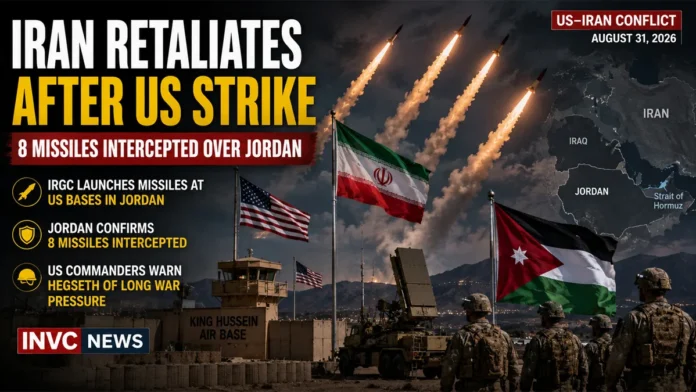
The US-Iran conflict August 31 2026 intensified sharply on Monday after Iran’s Islamic Revolutionary Guard Corps said it launched ballistic missiles at two military bases hosting US forces in Jordan in retaliation for an American strike on Iran’s Larak Island near the Strait of Hormuz.
Jordan’s armed forces confirmed that its air-defence systems intercepted eight missiles that entered Jordanian airspace early Monday, saying the missiles were destroyed before they could pose a threat to civilians or property.
The IRGC identified its targets as the King Hussein and Al Azraq bases and claimed the attack caused damage. Those damage claims have not been independently confirmed.
No casualties were immediately reported by Jordan.
Iran Says Missile Attack Was Retaliation for Larak Island Strike
The Iranian operation followed a US military strike on Larak Island, a strategically located Iranian island near the Strait of Hormuz.
US Central Command described the action as a limited strike against IRGC forces it said posed an imminent threat to maritime activity in the strait.
Iran responded by accusing Washington of aggression and warning that attacks on Iranian territory would draw further retaliation.
The exchange represents one of the clearest renewed episodes of direct US-Iran military confrontation after several weeks of comparatively reduced hostilities.
Jordan Says Eight Missiles Were Intercepted
The Jordanian Armed Forces said its air-defence systems detected missiles entering the country’s airspace at dawn on Monday.
According to the official statement, eight missiles were successfully intercepted and destroyed.
Jordan said its military acted to protect the country’s sovereignty, citizens and property.
The statement did not identify the missiles’ origin, but it came shortly after the IRGC announced its operation against US-linked military facilities inside Jordan.
King Hussein and Al Azraq Bases Named by IRGC
Iran said its retaliatory attack targeted the King Hussein Air Base and Al Azraq base.
The IRGC claimed the operation involved ballistic missiles and was launched in response to US military action on Larak Island.
Iranian authorities described the attack as a warning that further strikes would receive an increasingly severe response.
The situation remains fluid, and assessments of damage at the targeted installations may change as more information emerges.
US Military Leaders Warn of Pressure From Long Iran War
The renewed fighting comes as senior American military commanders have reportedly raised concerns over the sustainability of a prolonged Iran campaign.
A classified US military assessment reviewed by The Washington Post reportedly showed that several senior commanders warned Defense Secretary Pete Hegseth that maintaining large-scale deployments around Iran for an extended period could weaken America’s ability to respond to threats elsewhere.
More than 50,000 US personnel have been committed to or placed on alert for operations connected with the Iran conflict.
Some commanders responsible for operations in Europe, the Pacific and Latin America reportedly objected to continued transfers of ships, surveillance aircraft and other military assets to the Middle East.
The Pentagon has said decisions on troop deployments reflect current threats and strategic priorities and has pushed back against suggestions that US military readiness is being compromised.
US Navy Faces Growing Strain
The US Navy appears to be facing particularly heavy pressure from the extended conflict.
Warships, destroyers and other naval assets have been deployed for combat operations, air defence and maritime security around the Persian Gulf.
Long deployments also create maintenance and readiness challenges.
The concern for Washington is that keeping substantial naval and air-defence resources concentrated around Iran for months could reduce flexibility if another major crisis develops elsewhere.
Strait of Hormuz Again at Heart of Conflict
The latest confrontation once again centres attention on the Strait of Hormuz, one of the world’s most important energy corridors.
Larak Island lies close to the waterway.
Washington says its latest action was intended to prevent Iranian forces from threatening maritime traffic, while Tehran continues to challenge US claims about control and security in the region.
Any serious disruption to commercial shipping through Hormuz could quickly affect global crude oil and LNG prices.
Also Read – : India Buys Costliest LNG Since 2022 as Iran War Chokes Supplies Through Strait of Hormuz
Oil Prices Rise After Renewed Fighting
Global crude prices moved higher as traders reacted to the renewed confrontation.
The market’s immediate concern is not only the exchange of missiles and air strikes but the possibility that fighting spreads closer to oil terminals, shipping routes or other critical energy infrastructure.
For India, prolonged instability around Hormuz carries direct economic consequences.
India imports most of the crude oil it consumes and is also a major buyer of liquefied natural gas.
Higher crude and shipping costs can increase India’s import bill and add pressure to inflation and the rupee.
Also Read – : Trump Labels Strait of Hormuz ‘New US Territory’ as Iran Says Key Oil Route Will Stay Shut
What Happens Next?
Attention is now focused on whether Iran launches additional strikes and whether the United States responds militarily.
Jordan’s interception of eight missiles also highlights a wider regional risk: military confrontation between Washington and Tehran can quickly affect countries hosting US troops even if those governments are not directly seeking escalation.
Shipping conditions in the Strait of Hormuz, movements of American forces and any further Iranian missile launches will remain critical indicators of whether the conflict is entering another sustained phase.