By Team INVC | INVC NEWS
Published: August 31, 2026 | 09 : 18 AM IST
KATHMANDU, Nepal | August 31, 2026 —
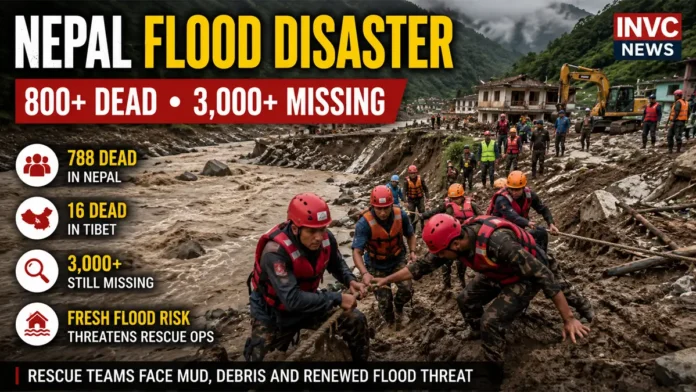
The Nepal-Tibet flood 2026 disaster has now killed more than 800 people across Nepal and China’s Tibet region, while over 3,000 remain missing as rescuers battle mud, damaged roads, unstable slopes and the renewed threat of flooding in the devastated Himalayan border region.
Latest figures from authorities put Nepal’s death toll at 788, with 2,502 people still missing. On the Tibetan side of the border, Chinese authorities have reported 16 deaths and 546 missing, taking the combined confirmed toll to at least 804 deaths and 3,048 missing people.
The disaster began on August 26 after a massive glacial and rock collapse high in the Himalayas sent water, ice, rock and mud crashing into river valleys below.
The resulting torrent swept through the Bhote Koshi and Trishuli river systems, destroying settlements, roads, bridges and hydropower infrastructure.
Fresh Flood Threat Complicates Rescue Operations
The crisis is far from over.
Authorities have warned communities downstream to remain alert after water levels again rose in the Bhote Koshi River.
Chinese officials have also been monitoring a large crater reservoir upstream that contains an estimated 1.4 million cubic metres of water.
Although the immediate risk is being monitored, another sudden surge could threaten already devastated settlements and rescue teams working close to river channels.
Warnings have been sent to residents in vulnerable areas as authorities continue monitoring flows coming from the Tibetan side of the border.
Rescue Teams Race to Find Thousands
Search-and-rescue operations are continuing across difficult mountain terrain.
Thousands of Nepali security personnel have been deployed, while specialist teams and assistance from neighbouring countries are supporting rescue efforts.
One of the most difficult operations is centred on hydropower projects damaged by the flood.
Hundreds of workers have been reported missing from project sites, and rescuers have been trying to reach people feared trapped inside flooded or debris-filled tunnels.
At the Upper Trishuli hydropower complex, teams have been working to clear tunnel entrances and create access for rescuers carrying oxygen equipment and cameras.
Every passing hour is increasing pressure on the operation.
Foreign Tourists and Pilgrims Among Missing
The disaster struck an area used by workers, tourists and pilgrims travelling through the Nepal-Tibet border region.
Hundreds of foreign nationals have been reported missing across Nepal and Tibet.
Chinese authorities said 261 foreigners were among those missing on the Tibetan side, including people from several countries.
Indian nationals have also been caught in the disaster, including travellers using routes connected with pilgrimage and tourism in the Himalayan region.
Also Read – : Kailash Mukti Yatra Calls for Easier Access to Mount Kailash and Mansarovar
Indian authorities have been working with Nepal and China to locate and assist affected citizens.
Entire Villages, Roads and Bridges Destroyed
The scale of physical destruction is enormous.
The torrent swept away homes and settlements along river valleys and destroyed or damaged numerous bridges, cutting communities off from road access.
Hydropower infrastructure has suffered particularly severe damage.
The disaster has disrupted a significant share of Nepal’s electricity-generation capacity, adding an economic and infrastructure crisis to the humanitarian emergency.
Rescue teams have had to airlift equipment into some locations because normal road access has disappeared.
What Caused the Nepal-Tibet Flood?
Scientists examining satellite imagery believe the catastrophe began when bedrock beneath part of a glacier collapsed high in the Himalayas.
A huge mass of rock and ice then crashed into the valley below.
The event was so powerful that seismic instruments registered it as an earthquake-like signal.
Water, melted ice, rock and debris subsequently surged into downstream river systems, creating the devastating flood.
Experts say the exact sequence continues to be studied, but the disaster has renewed concern over the growing vulnerability of Himalayan communities to glacier instability and extreme weather.
Nepal Had Sought Better Cross-Border Warning Data
The catastrophe has also intensified discussion over early-warning cooperation between Nepal and China.
Nepali officials had previously sought deeper sharing of information on glacier movement, water levels and other Himalayan hazards.
Officials from the two countries had met months before the disaster to discuss better monitoring and information exchange.
Experts have cautioned that limited data sharing should not be presented as the cause of the August 26 disaster.
However, improved real-time monitoring could provide communities with more time to respond to future cross-border flood threats.
More Than 800 Dead, But Toll May Still Rise
The casualty figures remain fluid because rescue teams are still reaching areas that were previously inaccessible.
Bodies have been recovered far downstream from the main disaster zone, while thousands of families continue waiting for news of missing relatives.
Identification has also become a major challenge.
Authorities have been recording photographs, DNA samples and other identifying information where necessary as Nepal deals with the scale of casualties.
The number of confirmed deaths could therefore change further as search teams continue working through destroyed settlements, riverbanks and hydropower facilities.
Nepal Faces a Long Recovery
Even after the immediate rescue operation ends, Nepal faces a massive reconstruction challenge.
Homes, highways, bridges, electricity infrastructure and local businesses have been destroyed across affected districts.
The disaster also highlights the wider vulnerability of the Himalayan region, where warming temperatures, unstable glaciers, steep terrain and increasingly extreme weather can combine to create sudden catastrophic events.
For families still searching for more than 3,000 missing people, however, reconstruction remains a distant concern.
The priority on August 31 remains finding survivors while protecting rescue teams and communities from the possibility of another flood.