By Team INVC | INVC NEWS
Published: August 31, 2026 | 09 : 02 AM IST
TORONTO, Canada | August 31, 2026 —
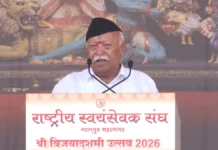
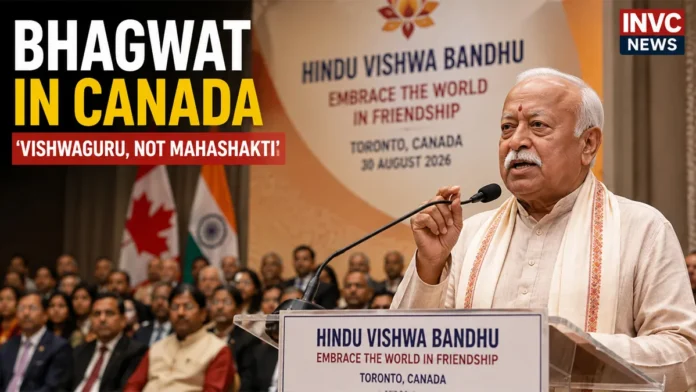
Mohan Bhagwat Canada speech has put India’s civilisational idea of service, diversity and global friendship at the centre of discussion as the Rashtriya Swayamsevak Sangh chief told an Indian-origin audience in Toronto that India’s rise should not be measured merely by how powerful it becomes.
Addressing the “Hindu Vishwa Bandhu – Embrace the World in Friendship” gathering, Bhagwat argued that India’s traditional strength lies in helping others rather than seeking domination.
He said India had emerged as a “Vishwaguru” through service and character, not by setting out to become a “Mahashakti” or superpower.
His Toronto remarks came immediately after his high-profile visit to New York, where his comments on Hindu identity, Muslims, diversity and social harmony had triggered a wider political debate.
‘If Hindus Awaken, the World Awakens’
One of the most striking lines from the Toronto address was Bhagwat’s assertion:
“If Hindus awaken, the world awakens.”
He linked the statement to what he described as the civilisational “DNA of Bharat” — a tradition of extending help to people in need and seeing humanity beyond differences of nationality, appearance, faith or background.
Bhagwat said India had not historically refused assistance when help was sought and argued that service to others should remain central to the country’s global role.
Rather than presenting India’s future only through economic, military or political power, he framed the country’s rise as a responsibility towards humanity.
India Is ‘Vishwaguru’, Not ‘Mahashakti’, Says Bhagwat
Bhagwat drew a distinction between becoming powerful and becoming influential through knowledge and service.
According to his remarks, India may at different points have possessed the ability to act like a major power, but its historical role was not based on conquering other societies.
He referred to ancient Indian travellers reaching regions from Central and East Asia to Southeast Asia and argued that they carried knowledge, astronomy, Ayurveda and cultural ideas rather than pursuing territorial control.
His larger message was that India’s global standing should be judged not simply by the power it accumulates, but by what it contributes to a more peaceful and connected world.
That “Vishwaguru rather than Mahashakti” formulation gives the Toronto speech a distinctly different theme from Bhagwat’s address in New York.
Also Read – : Zohran Mamdani, Mohan Bhagwat and the RSS New York Event: What Sparked the Debate
Bhagwat Invokes Vasudhaiva Kutumbakam
The RSS chief also used the traditional Indian concept of “Vasudhaiva Kutumbakam” — the world is one family — to explain his view of human unity.
Bhagwat said differences in physical appearance, language, customs or methods of worship should not prevent people from recognising their shared humanity.
He argued that diversity should not necessarily be treated as an obstacle to unity.
Instead, diversity itself can form part of a larger unity when communities respect one another.
This theme broadly continued the message Bhagwat delivered during his United States visit, where he had also stressed coexistence and the acceptance of different traditions.
‘Hindu’ Cannot Be Limited to One Form of Worship
Bhagwat also presented a broad interpretation of Hindu identity during the Toronto event.
He said it should not be confined to a single language, method of worship or lifestyle.
According to his argument, different traditions and ways of life represent natural variations in human society and should be respected.
He referred to India’s history of providing refuge to communities facing persecution elsewhere and said people from different religious backgrounds have lived in India while retaining their distinct traditions.
The comments continue a recurring theme in Bhagwat’s overseas speeches: presenting Hindu thought through pluralism, service and civilisational coexistence.
Toronto Event Draws Hindu Canadians From Across the Country
The Toronto gathering was organised by Canadian Hindus for Outreach, Relations and Dialogue (CHORD), a national organisation that describes its mission as strengthening outreach, relationships and constructive dialogue across Canadian society.
Organisers said more than 2,500 people representing eight Canadian provinces attended the event.
Former Canadian defence minister and former Alberta premier Jason Kenney was also among those present.
The gathering combined Bhagwat’s address with cultural performances and discussions around the Hindu Canadian community, global harmony and relations between India and Canada.
Canada-India Relations Form an Important Backdrop
The location of Bhagwat’s latest speech is significant.
India-Canada relations went through a prolonged period of diplomatic strain before the two countries began moving towards renewed engagement.
Against that backdrop, an event bringing together Hindu Canadians, community representatives and a prominent former Canadian political leader inevitably carries diplomatic and diaspora significance beyond the speech itself.
Bhagwat, however, concentrated his remarks primarily on culture, service, diversity and India’s civilisational outlook rather than offering a detailed foreign-policy agenda.
From New York Controversy to Toronto Message
The Canada event follows an unusually high-profile stop in New York.
Bhagwat’s appearance at Madison Square Garden had attracted both supporters and protesters, while New York Mayor Zohran Mamdani had publicly criticised the RSS ahead of the gathering.
During that New York speech, Bhagwat argued that a person seeking an India without Muslims could not represent his understanding of Hindu thought.
The Toronto speech shifted the emphasis.
Instead of the Muslim-Hindu debate dominating the address, Bhagwat focused more heavily on India’s global role, service to humanity, Vasudhaiva Kutumbakam and the distinction between a Vishwaguru and a conventional superpower.
That makes the Canada event a separate substantive development rather than merely a repeat of the New York address.
Also Read – : Hindu Americans Press Lawmakers on Anti-Hindu Hate at Fifth Hindu Day of Advocacy on Capitol Hill
Why Mohan Bhagwat’s Canada Speech Matters
The RSS is marking its centenary period while Bhagwat’s overseas engagements are drawing attention well beyond the organisation’s traditional Indian audience.
His speeches in New York and Toronto are therefore being watched not only for what they say about Hindu philosophy but also for how the RSS presents its worldview internationally.
In Toronto, Bhagwat’s message was built around one central distinction:
India’s success should not simply mean becoming more powerful. It should mean becoming more useful to humanity.
By describing India as a Vishwaguru rather than a Mahashakti, Bhagwat has given that argument a phrase likely to remain at the centre of discussion around his Canada visit.