By Team INVC | INVC NEWS
Published: August 29, 2026 | 9 : 40 AM IST
NEW DELHI, INDIA | August 29, 2026 —
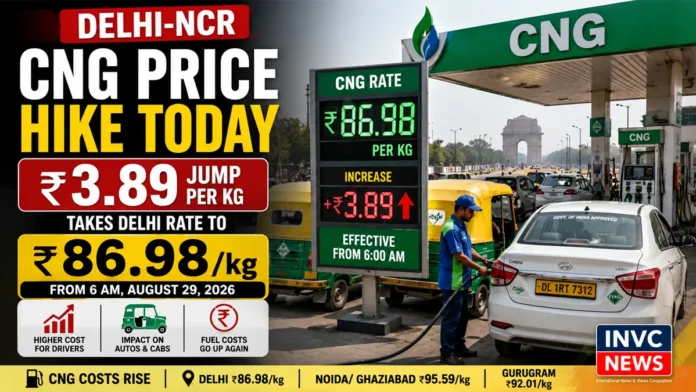
The Delhi CNG price hike today has hit motorists across the National Capital Region after Indraprastha Gas Limited raised compressed natural gas prices by ₹3.89 per kg, pushing the retail rate in Delhi to ₹86.98 per kg from 6 AM on Saturday.
The increase is immediately relevant to thousands of private CNG-car owners, auto-rickshaw drivers, taxi operators and goods carriers who depend on the fuel every day.
Delhi’s previous CNG price was ₹83.09 per kg.
That means the latest revision is not a future proposal or expected increase.
The higher price is already in effect.
IGL has linked the hike to elevated international LNG prices as the continuing West Asia crisis raises the cost of imported gas.
New CNG Prices Across Delhi-NCR
The revised rates are:
| City | New CNG Price |
|---|---|
| Delhi | ₹86.98/kg |
| Noida | ₹95.59/kg |
| Ghaziabad | ₹95.59/kg |
| Gurugram | ₹92.01/kg |
| Meerut | ₹95.47/kg |
| Muzaffarnagar | ₹95.47/kg |
| Rewari | ₹91.59/kg |
| Karnal | ₹91.32/kg |
| Kaithal | ₹92.32/kg |
The revision applies across IGL’s geographical areas and represents one of the most noticeable fuel-cost increases for NCR motorists this year.
How Much Extra Will a CNG Refill Cost?
The ₹3.89-per-kg increase may look small in isolation, but it adds up quickly for regular users.
A refill of:
- 5 kg now costs about ₹19.45 extra
- 8 kg costs about ₹31.12 extra
- 10 kg costs about ₹38.90 extra
- 15 kg costs about ₹58.35 extra
For a private car owner filling occasionally, that may still be manageable.
For commercial drivers refuelling almost every day, however, the cumulative monthly impact can become much larger.
Auto and Cab Drivers Feel the Pressure First
The biggest immediate pressure is likely to fall on:
- Auto-rickshaw operators
- App-based cab drivers
- Traditional taxi operators
- Delivery fleets
- Small goods carriers
- School and staff transport operators
These vehicles often cover long distances daily and therefore consume much more CNG than an average private car.
If fuel costs stay elevated, drivers may increasingly push for higher fares or revised platform incentives.
That does not mean an automatic fare hike has already been approved.
But the economics of every CNG-powered trip changed at 6 AM today.
Why Has IGL Raised CNG Prices?
IGL says the problem originates in the global gas market.
A significant share of gas used for CNG supply is being sourced through imported LNG.
International LNG prices have remained elevated since the escalation of the West Asia conflict, forcing Indian buyers to pay more for spot cargoes.
IGL said the ₹3.89 revision became necessary to partially offset the increase in input gas costs.
That word—“partially”—is important.
It suggests city-gas distributors are still dealing with higher underlying procurement costs even after raising retail prices.
Also Read – : India Buys Costliest LNG Since 2022 as Iran War Chokes Supplies Through Strait of Hormuz
West Asia Crisis Reaches Delhi’s Fuel Pumps
This is where a distant geopolitical conflict becomes a household-expense story.
Disruptions around the Strait of Hormuz and the broader West Asian energy market have already pushed Indian companies toward expensive spot LNG purchases.
Now part of that pressure has reached CNG consumers in Delhi-NCR.
The chain is straightforward:
West Asia disruption → expensive LNG → higher city-gas input cost → CNG price hike.
For consumers, this is a reminder that CNG is not completely insulated from international energy-market shocks.
Fifth CNG Hike This Year
The latest revision is reported to be the fifth CNG price increase in Delhi-NCR during 2026.
Earlier increases were implemented in stages during May.
That cumulative trend matters because CNG has traditionally attracted buyers partly through its running-cost advantage over petrol.
Repeated price increases narrow that gap.
For prospective car buyers comparing petrol, CNG and electric vehicles, running cost could therefore become an even more important calculation.
Could Cab and Auto Fares Rise?
There has been no across-the-board official fare increase announced simply because of today’s CNG revision.
However, commercial transport operators will now face higher fuel expenditure.
Whether passengers ultimately pay more will depend on several factors:
- Government-regulated auto and taxi fares
- App-based cab pricing
- Driver incentives
- Distance travelled
- Vehicle efficiency
- Whether CNG prices remain elevated
Goods transport costs are another area to watch because sustained fuel increases can eventually feed into logistics expenses.
Noida and Ghaziabad Motorists Now Pay ₹95.59/kg
Delhi remains cheaper than several surrounding NCR markets.
Noida and Ghaziabad motorists now pay ₹95.59 per kg, while Gurugram’s rate stands at ₹92.01 per kg.
The variation reflects differences including local taxes and supply economics.
For frequent inter-city commuters, these differences can influence where they choose to refuel.
Could CNG Prices Rise Again?
That depends heavily on international LNG prices and the West Asia situation.
If global gas prices ease and supply routes normalize, pressure on city-gas distributors could reduce.
But if LNG remains expensive for an extended period, the risk of further cost pressure remains.
Also Read – : Iran-America War Sends Crude Oil Higher: Will Petrol-Diesel Get Costlier in India?
What Delhi-NCR Drivers Should Know Today
The most important facts are simple:
CNG is ₹3.89/kg costlier from 6 AM today.
Delhi’s new rate is ₹86.98/kg.
Noida and Ghaziabad are at ₹95.59/kg.
Gurugram is at ₹92.01/kg.
For occasional users, this means a somewhat more expensive refill.
For drivers who earn their living behind the wheel, it means something much bigger:
Another increase in the daily cost of doing business.
And if West Asia’s energy crisis continues, the pressure may not stop with CNG.