WASHINGTON, D.C., United States | August 27, 2026 —
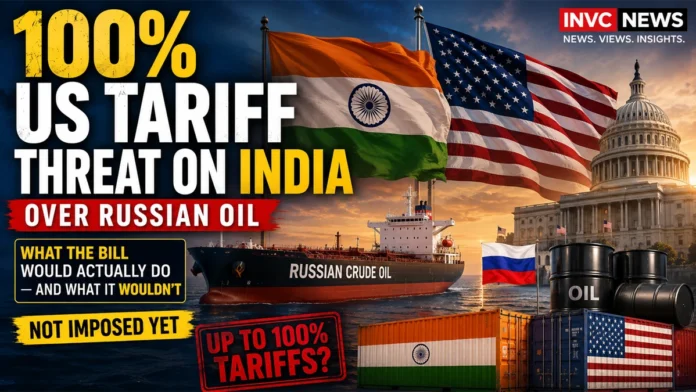
US tariff threat on India has returned to the spotlight after a sweeping Russia sanctions package cleared the U.S. Senate and opened the possibility of tariffs of up to 100% on goods imported from major buyers of Russian oil and gas, including India.
The legislation is designed to pressure countries that continue providing Moscow with energy revenue during the Russia-Ukraine war.
But one point needs to be clear from the beginning:
The United States has not imposed a new 100% tariff on India under this legislation.
The Senate has passed the sanctions package, but further action is still required in the House of Representatives before the measure can become law.
U.S. Senator Richard Blumenthal, one of the leading sponsors, said on August 26 that he hopes the House will approve the legislation next month.
For India, however, the potential consequences are substantial because the tariff authority in the Senate-passed framework could reach far beyond crude oil.
What Is the New US Russia Sanctions Bill?
The legislation is known as the Lindsey O. Graham Sanctioning Russia and Iran Act of 2026.
The U.S. Senate passed the amended legislative package on August 7 by an 86–11 vote, demonstrating unusually strong bipartisan support.
The measure targets several parts of Russia’s economy and the international networks supporting it.
Its provisions include sanctions involving:
- Russian officials and financial institutions
- Russia’s energy sector
- vessels used to move sanctioned Russian oil
- companies and individuals facilitating sanctions evasion
- major countries purchasing Russian oil or natural gas
The most important provision for India is the proposed tariff authority covering major purchasers of Russian energy.
Official Senate information:
Could India Really Face a 100% US Tariff?
Potentially, yes—but 100% is the ceiling, not an automatic tariff rate.
Under the Senate-passed framework, the U.S. President would have authority to increase duties on goods imported from a qualifying country to a rate of up to 100% ad valorem.
The legislation specifically focuses on countries that continue making new purchases of Russian crude oil or natural gas and rank among the five largest importers by volume.
India is among the major purchasers of Russian crude and is therefore directly relevant to the provision.
However, the wording “up to 100%” matters.
It means the rate could potentially be lower than 100%, depending on the administration’s determination and how a country’s Russian energy purchases change.
The Biggest Misunderstanding: This Is Not a 100% Tax on Russian Oil
This is where the story becomes particularly important for Indian businesses.
The proposed tariff is not simply a tax on Russian crude entering India.
Under the Senate text, qualifying duties could apply to goods imported into the United States from the targeted country.
In India’s case, that means the exposure could potentially extend to Indian products exported to the American market.
Depending on how the measure is implemented, that could make Indian products substantially more expensive for U.S. buyers.
The legislation also states that these duties would be in addition to other applicable tariffs, fees or charges.
That means products already facing U.S. duties could potentially face an even higher combined tariff burden.
Which Indian Industries Could Be Most Sensitive?
The final impact would depend on the tariff rate, exemptions and implementation rules.
However, any broad tariff on Indian goods could create concern across export-oriented sectors such as:
- Textiles and apparel
- Gems and jewelry
- Engineering goods
- Auto components
- Chemicals
- Seafood
- Leather products
- Machinery
- Consumer goods
- Selected electronics and manufactured products
Some sectors could be more vulnerable than others depending on existing tariff exemptions and U.S. trade policy.
The immediate risk would be competitiveness.
A product from India facing a much higher tariff could become significantly more expensive than a comparable product supplied by a country not covered by the measure.
Why Russian Oil Matters So Much to India
Russia has become a critical source of crude oil for Indian refiners.
India’s energy strategy has become even more complicated during the 2026 Middle East crisis because disruptions around the Strait of Hormuz have affected access to traditional Gulf supplies.
That has increased the strategic importance of alternative crude sources.
Also Read – : Qatar Steps In as US-Iran Tensions Rise: Can a Hormuz Deal Bring Oil Prices Down for India?
India therefore faces a difficult equation.
Reducing Russian crude purchases could ease pressure from Washington.
But replacing those barrels could become expensive or difficult if Middle Eastern supply routes remain disrupted.
Energy security and trade access are pulling India in different directions.
India-Russia Trade Goes Far Beyond Oil
Russian energy has also become a major component of the broader India-Russia economic relationship.
New Delhi and Moscow have set a target of raising bilateral trade to $100 billion by 2030.
Energy, fertilizers, coal and other commodities remain central to that relationship, while India is simultaneously trying to increase exports to Russia and reduce the large bilateral trade imbalance.
Also Read – : Jaishankar Russia Visit: $100 Billion Trade Goal, Energy Security and Lavrov Talks Take Center Stage
Any U.S. measure that forces India to choose between Russian energy and access to the American market would therefore create a major economic and diplomatic challenge.
When Could the Tariffs Actually Start?
They cannot start under this bill today because the legislation has not yet completed the U.S. legislative process.
The House must still act on the Senate-approved package.
If the House passes different language, the two chambers would need to resolve those differences before a final bill could be sent to President Donald Trump.
Only after enactment would the tariff provisions become operational.
The Senate text provides for determinations involving Russian energy purchases after enactment and gives the administration mechanisms to identify qualifying countries.
So there is no basis to tell Indian exporters that a new 100% tariff begins immediately.
Would Every Country Buying Russian Oil Be Hit?
No.
The Senate framework does not simply target every country purchasing any quantity of Russian energy.
The provision focuses on countries meeting specific criteria, including the five largest importers of Russian crude oil or natural gas by volume, as well as certain countries facilitating sanctions evasion.
The U.S. Trade Representative would also make subsequent assessments based on recent import patterns.
For natural gas, the legislation includes a limited exception for certain countries whose Russian gas imports represent less than 15% of Russia’s total annual gas exports and that are taking significant steps to reduce those purchases.
Could Trump Waive the Tariff?
Yes.
The legislation includes presidential waiver authority.
The President could waive duties or sanctions if he certifies to Congress that doing so is in the national interest of the United States and explains the basis for that decision.
That provision gives the White House significant flexibility.
It also means the bill should not be interpreted as a mechanical system in which every qualifying country automatically receives the maximum tariff with no possibility of adjustment.
Could India Reduce the Risk by Buying Less Russian Oil?
Potentially.
The legislation allows the tariff rate to be adjusted based on whether a country significantly increases or decreases purchases of Russian crude oil or natural gas.
That creates a powerful negotiating tool for Washington.
The U.S. administration could effectively tell a major buyer:
Reduce Russian energy purchases and tariff pressure could ease. Increase them and the pressure could rise.
For India, however, sourcing decisions cannot be made in isolation.
Indian refiners must consider price, shipping availability, refinery configuration, supply reliability and geopolitical risks.
Would Cutting Russian Oil Automatically Be Good for Indian Consumers?
Not necessarily.
Russian crude has often helped India diversify its supply sources.
If Indian refiners suddenly reduced purchases and had to compete more aggressively for barrels from other exporters, replacement costs could increase.
That becomes particularly important when West Asian supply routes are already under stress.
More expensive crude can affect:
- India’s import bill
- The rupee
- Inflation
- Refining costs
- Transportation expenses
- Petrol and diesel pricing pressure
Also Read – : Iran-America War Sends Crude Higher: Will Petrol-Diesel Get Costlier in India?
So India could potentially face pressure from both directions: expensive replacement energy on one side and U.S. trade risk on the other.
What the 100% Tariff Bill Would Do
If enacted in its current Senate-approved form and applied to India, the legislation could:
- Give the U.S. administration authority to impose tariffs of up to 100%
- Target goods India exports to the United States
- Add those tariffs on top of other applicable duties
- Use India’s continued Russian oil purchases as a key criterion
- Allow rates to change as Russian energy purchases rise or fall
- Give Washington significant leverage in negotiations with major Russian energy buyers
What the Bill Would Not Do
It would not:
- Impose a new 100% tariff on India today
- Guarantee that the maximum 100% rate will be used
- Apply merely because India purchased a single Russian cargo
- Function solely as a tariff on Russian oil
- Become law without completing the U.S. legislative process
- Eliminate presidential waiver authority
- Automatically determine petrol or diesel prices in India
These distinctions are crucial because headlines describing the proposal as a completed “100% tariff on India” would be misleading.
Why September Could Be Critical
Senator Richard Blumenthal is now pushing for House approval in September.
That makes the next few weeks potentially important for India-U.S. relations.
If the House advances the Senate framework without major changes, attention will shift toward the White House and how President Trump plans to use the tariff powers.
If the House modifies the measure, implementation could take longer.
And if negotiations involving Russia and Ukraine produce a meaningful diplomatic breakthrough, the political environment surrounding the sanctions legislation could also change.
For Indian policymakers, exporters and refiners, the safest conclusion right now is clear:
The 100% tariff is a serious potential risk—but it is not an imposed tariff today.
What happens next depends on Congress, the White House, Russia’s war in Ukraine and India’s future Russian energy purchases.
That makes this much more than another sanctions story.
It is potentially a test of how India balances energy security, its relationship with Russia and access to its most important international export markets.
Official US Sources
U.S. Senate Foreign Relations Committee — Senate Passage:
https://www.foreign.senate.gov/press/rep/release/chairman-risch-statement-on-passage-of-the-lindsey-o-graham-sanctioning-russia-and-iran-act
Senator Richard Blumenthal — Sanctions Legislation:
https://www.blumenthal.senate.gov/newsroom/press/release/video-blumenthal-celebrates-senate-passage-of-landmark-sanctions-bill-to-hold-purchasers-of-russian-oil-and-gas-accountable
This article explains pending U.S. legislation and its potential economic implications. The proposed tariff provisions are not currently a new 100% tariff imposed on Indian goods.