WASHINGTON, D.C., UNITED STATES | AUGUST 25, 2026 —
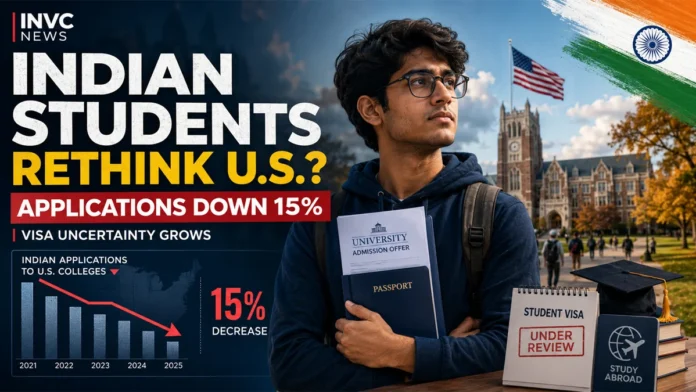
Indian students appear to be rethinking the United States as a study destination, with first-year applications from India through Common App falling about 15% in the 2025-26 cycle.
The decline comes at a sensitive time for American universities as students weigh not only tuition and rankings, but also F-1 visa rules, post-study work opportunities and the path from OPT to an H-1B visa.
The number does not mean overall Indian enrollment in the United States has fallen 15%. It specifically covers first-year undergraduate applicants using Common App. Still, the drop is notable because India has become one of the most important international-student markets for U.S. colleges.
Why Are Indian Students Pulling Back?
Cost remains a major concern, but immigration uncertainty is increasingly becoming part of the decision.
For many Indian families, studying in America involves four major questions:
Will the student visa remain predictable?
Will the student be able to work after graduation?
Will OPT remain useful?
Will there be a realistic route to an H-1B job?
That matters because a U.S. degree can involve years of tuition, housing, insurance and living expenses.
For students borrowing heavily to study abroad, career prospects after graduation are part of the return-on-investment calculation.
Also Read – : H-1B Visa Rule Change: US Introduces Salary-Based Selection System, New Form I-129 From April 2026
New F-1 Rules Add to the Uncertainty
A major U.S. immigration rule scheduled to take effect on September 15, 2026 will replace the traditional “duration of status” system with a fixed admission period for many F and J visa holders.
Students will generally be admitted for the length of their academic program, subject to a maximum period of four years before additional immigration action may be required.
That does not mean every degree must be completed within four years.
Students in longer programs may be able to seek an extension or another authorized period of stay.
But the additional immigration process adds another layer of uncertainty for students considering long degrees, research programs or academic changes.
OPT Has Not Been Cancelled
One point needs to be clear.
Optional Practical Training, or OPT, remains available to eligible F-1 students.
There has been no blanket cancellation of OPT.
But students are watching the wider immigration environment closely because the traditional pathway for many Indian graduates is:
US Degree → OPT → Employer Sponsorship → H-1B
Any uncertainty around that chain can influence whether a family is willing to spend heavily on an American education.
Also Read – : H-1B Visa Crackdown Proposed: What a New US Bill Could Mean for Indian Workers
India’s Drop Is Sharper Than China’s
Earlier Common App data also showed an interesting India-China difference.
Indian applicants were down about 14% at the March stage, while Chinese applicants had fallen only around 3%.
That does not mean Indian students are switching to China.
But it does show that U.S. education demand is weakening much more sharply in India than in one of America’s other major international-student markets.
For U.S. universities, that is significant because India has recently been one of their strongest sources of enrollment growth.
Why US Universities Should Care
International students bring substantial tuition revenue and support local economies.
If fewer Indian students apply and eventually enroll, the impact could be felt beyond admissions offices.
It could affect:
- University revenue
- Housing
- Research programs
- Campus employment
- Local businesses
- Graduate talent pipelines
Universities that depend heavily on international tuition may feel the pressure first.
Is America Still Worth It for Indian Students?
For many students, yes.
The United States still offers some of the world’s strongest universities, research institutions and technology employers.
But choosing a U.S. university now requires a more careful calculation.
Students should compare:
Total cost → scholarship → course quality → OPT eligibility → job prospects → immigration risk
A famous university name alone may not justify a very large education loan.
Could Lower Applications Improve Admission Chances?
At some universities, possibly.
If international applications continue falling, colleges seeking foreign students may offer stronger recruitment, scholarships or financial incentives.
But the country’s most selective universities are unlikely to suddenly become easy to enter.
A 15% decline in applications does not translate into a 15% improvement in admission chances.
Bottom Line
The fall in Indian applications to US colleges does not mean Indian students have abandoned America.
But it does show that the decision is becoming more complicated.
For years, families mainly asked:
“Which US university should I choose?”
Now another question is becoming equally important:
“What happens after I graduate?”
Visa stability, OPT, H-1B prospects and the total cost of education are increasingly influencing that answer.