
ANANTAPUR, ANDHRA PRADESH, INDIA | AUGUST 25, 2026 —
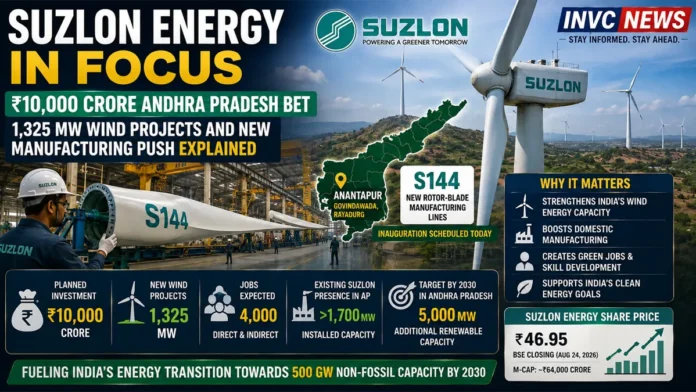
Suzlon Energy Andhra Pradesh investment is putting the renewable-energy company firmly in market focus after the group outlined plans to invest around ₹10,000 crore in new wind-power projects with a combined capacity of 1,325 MW in Anantapur district.
The expansion will deepen Suzlon’s already significant presence in Andhra Pradesh and comes alongside a fresh manufacturing push centered on its S144 wind-turbine platform.
Andhra Pradesh Education, IT and Electronics Minister Nara Lokesh is scheduled to inaugurate Suzlon’s new S144 rotor-blade manufacturing lines at Hulikera village in Kanekal mandal on Tuesday.
The new wind projects are planned around Govindawada in the Rayadurg constituency, while the wider expansion is expected to create approximately 4,000 direct and indirect employment opportunities.
For investors watching Suzlon Energy shares, however, the key question is bigger than one ₹10,000 crore announcement.
The story connects wind-power demand, manufacturing capacity, a growing project pipeline, Andhra Pradesh’s clean-energy ambitions and India’s push toward 500 GW of non-fossil electricity capacity by 2030.
Suzlon Andhra Pradesh Investment: Key Numbers
| Metric | Details |
|---|---|
| Planned investment | Around ₹10,000 crore |
| New wind projects | 1,325 MW |
| Location | Anantapur district |
| Project area | Govindawada, Rayadurg |
| Expected employment | Around 4,000 direct and indirect jobs |
| Existing Suzlon AP wind base | More than 1,700 MW |
| Additional AP renewable target by 2030 | 5,000 MW |
| Existing investment in Andhra Pradesh | Around ₹12,000 crore |
| Existing employment generated | Around 2,200 |
| Existing blade-production capacity | Equivalent to roughly 1,260 MW annually |
The numbers demonstrate that Andhra Pradesh is not a new market for Suzlon. It is becoming one of the company’s most strategically important manufacturing and project-development bases.
Where Will Suzlon Build the 1,325 MW Wind Projects?
The proposed wind projects are planned in the Rayadurg constituency of Anantapur district, including the Govindawada region.
Anantapur has favorable conditions for utility-scale wind development and already hosts significant Suzlon operations.
The company began working in Andhra Pradesh in 2004 and has since developed both project and manufacturing infrastructure in the state.
Suzlon already has more than 1.7 GW of installed wind capacity in Andhra Pradesh, making it one of the major wind-energy participants in the state.
The fresh 1,325 MW plan would materially expand that footprint.
Why the ₹10,000 Crore Investment Matters
A wind project requires far more than turbines.
Large-scale wind deployment can create demand for:
- Land development
- Towers
- Rotor blades
- Electrical equipment
- Substations
- Transmission infrastructure
- Roads
- Civil construction
- Engineering services
- Operations and maintenance
- Skilled technical workers
That means the ₹10,000 crore proposal potentially creates economic activity across an entire industrial ecosystem rather than simply adding electricity-generation capacity.
It also strengthens Andhra Pradesh’s position as a manufacturing and renewable-energy investment destination.
Also Read – : India’s Industrial Corridor Push Enters New Phase as Government Focuses on Factories, Investment and Production
Suzlon’s New S144 Manufacturing Lines Take Center Stage
The manufacturing side of today’s development is particularly significant.
Suzlon has established new production lines for its S144 wind-turbine blades at Hulikera village.
The S144 belongs to Suzlon’s newer 3.x MW wind-turbine platform.
Depending on site conditions, the S144 platform can extend to approximately 3.15 MW per turbine.
Its rotor diameter is 144 meters, and the platform has been designed in part to improve electricity generation at locations where wind resources are relatively lower.
Suzlon says the S144 can deliver 40%–43% higher generation than its older S120 platform, depending on operating conditions and project configuration.
That matters commercially because improving output from moderate or low-wind locations can increase the number of sites where wind projects become economically viable.
Why Bigger Wind Turbines Matter
Wind-energy economics increasingly depend on extracting more electricity from every viable location.
Larger rotors sweep a larger area.
Taller towers can reach stronger and more consistent winds.
Higher-capacity turbines can reduce the number of individual machines required for a given project capacity.
The result can potentially mean:
more electricity from the same project area + better capacity utilization + lower levelized cost of energy.
That is why companies are moving steadily toward larger wind platforms.
Anantapur Already Produces a Major Share of Suzlon’s Blades
Suzlon’s Anantapur manufacturing presence is already strategically important.
Its existing rotor-blade facility in the district accounts for approximately 40% of the company’s overall blade production, with annual output capability equivalent to around 1,260 MW.
The company says it has already invested approximately ₹12,000 crore in Andhra Pradesh over the years and generated around 2,200 jobs.
Today’s manufacturing expansion builds on that existing base rather than starting from scratch.
Tata Power Relationship Strengthens the Andhra Pradesh Story
Suzlon’s growing Andhra Pradesh presence is also connected to major customer projects.
In June 2026, the company secured a 400 MW EPC wind order from Tata Power Renewable Energy.
That project involves 127 S144 wind turbine generators rated at 3.15 MW and is scheduled for execution in Anantapur district.
The order took Suzlon’s order book in Andhra Pradesh close to 1 GW at the time.
Suzlon then announced another 201.6 MW Andhra Pradesh wind order from Waaree Forever Energies in July involving 64 S144 turbines.
Together, these orders show why additional manufacturing capacity in the state has strategic value.
Suzlon Wants Another 5 GW in Andhra Pradesh by 2030
The company’s ambitions extend well beyond the newly announced 1,325 MW.
Suzlon is targeting around 5,000 MW of additional renewable-energy projects in Andhra Pradesh by 2030.
That is a substantial pipeline.
For investors, however, a target should never be confused with completed capacity.
The important factors will be:
- Project awards
- Power-purchase arrangements
- Land availability
- Transmission connectivity
- Financing
- Regulatory approvals
- Execution timelines
A large announced pipeline becomes financially meaningful only when projects convert into executable orders and revenue.
Why India’s Wind Market Is Becoming More Important
India’s energy transition has historically attracted enormous attention to solar power.
Wind is now again becoming increasingly important.
Official government data shows India’s installed wind-power capacity reached approximately 58.14 GW by July 31, 2026.
That compares with 164.59 GW of solar capacity.
Wind has several advantages in a diversified renewable-energy system.
Generation patterns can differ from solar, meaning the two technologies can complement each other.
Wind also plays a major role in hybrid renewable projects combining:
wind + solar + storage + grid connectivity.
Those hybrid structures can provide more consistent renewable-electricity supply than standalone projects.
Also Read – : Renewable Energy Stocks 2026: Adani Green, Tata Power and Suzlon Lead India’s Clean-Energy Push
India Has Crossed 300 GW of Non-Fossil Power Capacity
The wider policy backdrop is extremely favorable.
India crossed 300 GW of installed non-fossil electricity capacity as of July 31, 2026, according to government data.
The breakdown included:
- Solar: 164.59 GW
- Wind: 58.14 GW
- Hydro: 57.24 GW
- Bio-power: 11.75 GW
- Nuclear: 8.78 GW
Total non-fossil capacity reached approximately 300.5 GW.
That represents more than 60% of India’s 500 GW non-fossil capacity target for 2030.
For turbine manufacturers such as Suzlon, this is a structural demand driver rather than a single-quarter catalyst.
Renewable Investment Is Becoming an Industrial Policy
India’s clean-energy expansion is increasingly connected to manufacturing policy.
The country does not want only to install renewable projects.
It also wants more of the equipment, technology and components to be manufactured domestically.
This creates opportunities across:
- Wind turbines
- Rotor blades
- Towers
- Solar modules
- Inverters
- Batteries
- Grid equipment
- Power electronics
- Green hydrogen equipment
Suzlon’s Anantapur expansion fits directly into that industrial strategy.
India is simultaneously attracting investment into manufacturing, AI infrastructure and data centers under a broader push to expand domestic industrial capacity.
Also Read – : India’s New FDI Rules Attract $511 Million as Manufacturing, AI and Data Centers Draw Investors
What About Suzlon Energy Shares?
The investment announcement makes Suzlon a stock to watch, but investors should separate business development from short-term share-price behavior.
Suzlon Energy closed Monday, August 24, at around ₹46.95 on the BSE, with its market capitalization near ₹64,000 crore.
The stock remains below its 52-week high.
That means a major project announcement does not automatically guarantee a sustained share-price rally.
Markets will focus on whether the investment translates into:
- New orders
- Revenue visibility
- Stronger margins
- Cash generation
- Execution
- Higher manufacturing utilization
₹10,000 Crore Investment Does Not Mean ₹10,000 Crore Immediate Revenue
This distinction is crucial.
Suzlon’s proposed investment program and the company’s recognized revenue are not the same thing.
Large wind projects are developed over time.
Capital is deployed across different phases.
Revenue recognition depends on order structure, turbine deliveries, construction progress and contractual milestones.
Therefore:
₹10,000 crore investment ≠ ₹10,000 crore immediate Suzlon sales.
Investors should avoid treating the headline investment number as instant revenue or profit.
Green Jobs Are Another Important Part of the Expansion
The planned projects could generate approximately 4,000 direct and indirect jobs.
Suzlon and the Andhra Pradesh government are also collaborating on renewable-energy skill development.
Wind Energy Learning Centres in Uravakonda and Vijayawada are targeting training for roughly 12,000 young professionals.
About one-quarter of participants are expected to be women.
This is important because India’s renewable transition will require a much larger technical workforce.
Future demand will include:
- Wind technicians
- Electrical engineers
- Blade specialists
- Project managers
- Grid engineers
- Safety professionals
- Operations teams
- Maintenance technicians
Clean energy is therefore becoming an employment story as well as an electricity story.
What Could Go Wrong?
Renewable energy has strong structural growth drivers, but Suzlon still faces business risks.
Execution Risk
Large projects can face delays involving land, transmission and approvals.
Working Capital
Manufacturing and EPC businesses can require substantial working capital.
Commodity Costs
Steel, copper and other materials can influence turbine manufacturing economics.
Competition
India’s renewable-equipment market attracts both domestic and global competitors.
Customer Concentration
Large contracts can make individual project execution important to quarterly performance.
Stock Valuation
A strong business outlook does not automatically make a stock attractive at every valuation.
Investors should therefore evaluate financial performance rather than rely solely on large investment announcements.
Why Andhra Pradesh Could Become a Renewable Manufacturing Hub
Andhra Pradesh combines several characteristics attractive to renewable investors:
- Land availability
- Wind resources
- Solar potential
- Industrial infrastructure
- Long coastline
- Transmission development
- Manufacturing ecosystem
- Government investment promotion
Large projects can also encourage component suppliers and service businesses to locate closer to major manufacturing facilities.
That creates the possibility of a broader clean-energy cluster rather than isolated wind farms.
Suzlon Energy FAQ
How much is Suzlon planning to invest in Andhra Pradesh?
Suzlon plans approximately ₹10,000 crore of investment linked to its latest wind-energy expansion.
How much new wind capacity is planned?
The company plans 1,325 MW of new wind projects in Anantapur district.
Where are the projects located?
The projects are planned around Govindawada in the Rayadurg constituency.
How many jobs could be created?
Around 4,000 direct and indirect employment opportunities are expected.
What is Suzlon’s S144 turbine?
S144 is Suzlon’s 3.x MW wind platform with a 144-meter rotor and capacity extending to approximately 3.15 MW depending on configuration and site conditions.
How much wind capacity does Suzlon already have in Andhra Pradesh?
Its installed base in the state is above 1,700 MW.
What is Suzlon targeting by 2030 in Andhra Pradesh?
The company is targeting roughly 5 GW of additional renewable-energy capacity.
Does the ₹10,000 crore investment guarantee Suzlon share-price gains?
No. Share prices depend on earnings, valuation, execution, order conversion, market conditions and many other factors.
Bottom Line
Suzlon Energy’s Andhra Pradesh investment is more significant than a single ₹10,000 crore headline.
It connects three major elements of India’s clean-energy transition:
Renewable generation + domestic manufacturing + green jobs.
The company plans 1,325 MW of new wind projects in Anantapur, is expanding S144 blade manufacturing and is targeting another 5 GW of renewable capacity in the state by 2030.
Suzlon already has more than 1.7 GW installed in Andhra Pradesh and a significant manufacturing footprint there.
For the company, the opportunity is clear.
India’s wind fleet is expanding, larger turbines are becoming more commercially attractive, and the country has now crossed 300 GW of non-fossil electricity capacity.
For investors, however, the real test will be execution.
The numbers that ultimately matter will not simply be investment announcements.
They will be:
orders, manufacturing utilization, revenue, margins, cash flow and project delivery.
That is what will determine whether Andhra Pradesh becomes merely another major Suzlon announcement—or a meaningful new phase in the company’s growth story.
Financial Disclaimer: This article is for informational purposes only and does not constitute investment advice. Stock prices can fluctuate and investors should assess financial performance, valuation and personal risk tolerance before investing.











Comments are closed.