MUMBAI, INDIA | AUGUST 25, 2026 —
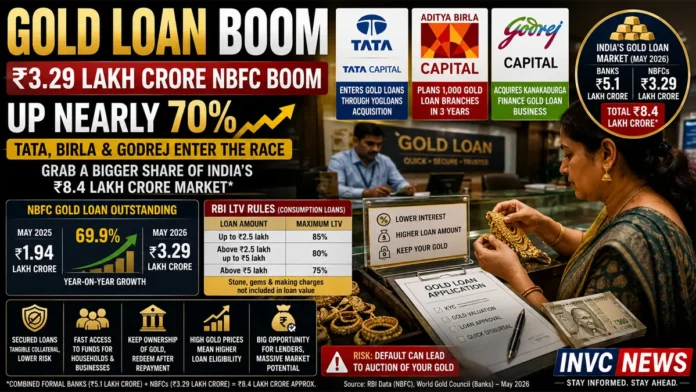
Gold loan market India 2026 is witnessing an extraordinary expansion, with outstanding loans against gold jewellery at non-banking financial companies rising 69.9% year over year to ₹3.29 lakh crore in May, up from ₹1.94 lakh crore a year earlier.
The surge has turned a lending category once associated mainly with specialist regional financiers into one of India’s hottest consumer-finance battlegrounds.
Tata Capital has entered the sector through its acquisition of Yogloans. Godrej Capital has bought the gold-loan business of Kanakadurga Finance. Aditya Birla Capital has announced plans to build around 1,000 dedicated gold-loan branches within three years.
And the opportunity is even larger than the headline ₹3.29 lakh crore figure suggests.
World Gold Council data indicates that banks had approximately ₹5.1 lakh crore of outstanding gold-backed loans at the end of May, up around 105% year over year, while NBFC exposure stood near ₹3.3 lakh crore.
Together, that puts formal bank and NBFC gold-backed lending at roughly ₹8.4 lakh crore.
Gold Loans Are Growing Faster Than Other NBFC Lending Segments
The latest RBI-linked data shows just how exceptional the growth has become.
Outstanding NBFC loans against gold jewellery stood at:
May 2025: ₹1.94 lakh crore
May 2026: ₹3.29 lakh crore
Year-on-year growth: 69.9%
That was among the fastest-growing major lending categories in the NBFC sector.
The trend reflects a combination of rising gold prices, greater acceptance of formal borrowing, demand from small businesses and households, and lenders’ growing preference for secured loans over unsecured credit.
Why High Gold Prices Are Fueling the Gold Loan Boom
One of the biggest drivers is simple:
The same jewellery can now support a larger loan.
If the market value of pledged gold rises significantly, a borrower may qualify for more credit against the same quantity of jewellery, subject to the lender’s valuation and RBI loan-to-value rules.
Gold prices have risen sharply during 2026 amid geopolitical uncertainty, global fiscal concerns and strong safe-haven demand.
That has increased the rupee value of gold sitting inside millions of Indian households.
Instead of selling family jewellery, borrowers can temporarily pledge it to raise cash.
The World Gold Council says high prices have contributed to households choosing to monetize gold through collateralized borrowing rather than sell it outright.
That behavioral shift is extremely important for lenders.
India’s Household Gold Is a Massive Financial Asset
Indian households collectively hold one of the world’s largest private stocks of gold.
Much of that wealth traditionally sits outside the formal financial system as jewellery stored at home or in lockers.
Gold loans effectively convert part of that dormant asset into credit.
For a borrower, the proposition can be attractive:
Keep ownership of the jewellery + pledge it temporarily + access cash + recover the gold after repayment.
For lenders, the appeal is equally clear.
Unlike an unsecured personal loan, a gold loan has tangible collateral that can be valued and, subject to regulatory procedures, liquidated if the borrower defaults.
That makes the product potentially less risky than unsecured consumer credit.
Why Tata Capital Entered Gold Loans
Tata Capital entered the gold-loan business in July through the acquisition of Yogakshemam Loans, or Yogloans, a Kerala-based lender with experience in secured gold financing.
The company described gold loans as a secured lending segment with significant growth potential.
The acquisition gives Tata Capital something particularly valuable: an existing operating platform and domain expertise.
Building a gold-loan franchise involves more than adding another button to a mobile app.
Lenders need expertise in:
- Gold purity assessment
- Valuation
- Secure storage
- Branch operations
- Customer verification
- Auction procedures
- Fraud prevention
- Collateral management
Buying an established operation can accelerate entry considerably.
Aditya Birla Capital Plans 1,000 Gold Loan Branches
Aditya Birla Capital is taking an even more aggressive approach.
The company formally announced its entry into gold loans on August 20.
It plans to establish 200–300 dedicated gold-loan branches by March 2027.
Over the next three years, it wants a network of around:
1,000 Gold Loan Branches
The company plans to target both urban and semi-urban customers while combining physical branches with digital capabilities.
That scale shows how seriously large financial groups now view the category.
Gold lending is no longer being treated as a small niche product.
It is becoming a major component of secured retail finance.
Godrej Capital Also Wants a Piece of the Market
Godrej Capital entered the segment through its acquisition of the gold-loan business of Andhra Pradesh-based Kanakadurga Finance.
The acquired operation included roughly:
- ₹280 crore of gold-loan assets under management
- Around 12,000 customers
- 54 operating branches
- Approximately 250 employees
Godrej has indicated that the acquisition is about much more than simply purchasing ₹280 crore of loans.
It gives the company experienced employees, operating systems and expertise in a specialized category.
Godrej Capital has set an ambition to build its gold-loan portfolio substantially over the coming years as part of its wider expansion in retail finance.
Why Big Companies Prefer Gold Loans to Some Unsecured Loans
India’s lending industry has spent years aggressively expanding unsecured personal loans and consumer credit.
But unsecured lending carries obvious risk.
If a borrower stops paying a personal loan, the lender does not hold a specific physical asset that can easily be sold to recover the debt.
A gold loan is different.
The jewellery itself provides security.
This does not make gold loans risk-free, but it changes the risk equation considerably.
For large NBFCs, gold loans can offer:
- Secured lending
- Shorter loan tenures
- Strong collateral coverage
- Faster processing
- Large potential customer base
- Cross-selling opportunities
- Lower dependence on credit scores in some cases
That combination helps explain why Tata, Birla and Godrej are entering aggressively.
RBI’s New Gold Loan Rules Matter
The regulatory environment has also become more standardized.
The Reserve Bank of India’s harmonized framework for lending against gold and silver collateral had to be adopted by regulated lenders no later than April 1, 2026.
For consumption loans, RBI has established maximum loan-to-value ratios based on loan size.
| Consumption Loan Amount | Maximum LTV |
|---|---|
| Up to ₹2.5 lakh | 85% |
| Above ₹2.5 lakh and up to ₹5 lakh | 80% |
| Above ₹5 lakh | 75% |
LTV means the percentage of the assessed value of eligible gold collateral that can support the loan.
So an 85% LTV does not mean a borrower automatically receives 85% of the retail purchase price of jewellery.
Stones and Making Charges Do Not Increase Your Loan Value
This is one of the most important consumer points.
When lenders assess jewellery for a gold loan, RBI rules require them to consider the intrinsic value of the eligible gold content.
The value of:
- Precious stones
- Gems
- Decorative components
- Making charges
does not simply get added to the collateral value.
That means jewellery purchased for ₹3 lakh at a store may not support a loan calculated on the full ₹3 lakh retail bill.
The lender values the actual eligible gold content based on purity and weight.
Borrowers Must Understand the Valuation Process
The standardized framework requires lenders to establish clear procedures for assaying and valuing pledged gold.
Borrowers should understand:
- Gross jewellery weight
- Net gold weight
- Purity
- Valuation rate
- Eligible loan amount
- Interest rate
- Processing charges
- Repayment structure
- Auction conditions
A gold loan can be straightforward, but borrowers should never pledge jewellery without understanding how the lender arrived at its valuation.
Gold Loans Can Be Cheaper Than Unsecured Personal Loans — But Compare Carefully
Because gold loans are secured, interest rates can sometimes be lower than unsecured personal-loan rates.
But there is no universal rule that every gold loan will always be cheaper.
Borrowers must compare the total cost, including:
- Interest
- Processing fee
- Valuation charges
- Penal charges
- Renewal charges
- Documentation costs
- Auction-related terms
A low advertised headline rate may not represent the final effective borrowing cost.
The Biggest Risk: Your Gold Can Be Auctioned
This is the part borrowers should never ignore.
A gold loan is not free liquidity.
The borrower is pledging a valuable asset.
If repayments are not made according to the agreed terms, the lender can eventually initiate an auction process subject to applicable rules and notice requirements.
For many Indian families, pledged jewellery also carries emotional value far beyond its market price.
Borrowers should therefore avoid taking the maximum possible loan merely because higher gold prices make more credit available.
The key question should be:
Can I comfortably repay this loan within the agreed period?
Rising Gold Prices Help Borrowers — Falling Prices Can Change the Equation
High gold prices support higher collateral values.
But gold does not move only upward.
If prices decline sharply, the loan-to-value ratio can rise because the value of the pledged collateral has fallen relative to the outstanding loan.
RBI requires applicable LTV limits to be maintained through the loan tenor.
Borrowers should therefore understand how their lender handles changes in collateral value.
Currency movements can also influence domestic gold prices because international bullion is dollar-denominated.
Also Read – : RBI Forex Swap Explained: Why $72.85 Billion Inflows Failed to Strengthen the Indian Rupee
Gold Loans Are Moving Beyond South India
Historically, specialist gold-loan companies built particularly strong networks in southern India.
That remains an important market.
But demand is becoming more geographically diverse.
Large national financial groups now see opportunities across urban, semi-urban and emerging markets.
Aditya Birla Capital’s plan for a nationwide branch network is a clear example of that shift.
The entry of large brands could also increase competition on:
- Interest rates
- Processing speed
- Customer experience
- Branch accessibility
- Digital servicing
- Transparency
For borrowers, more competition could be beneficial—but only if lending remains responsible.
Can You Take a Gold Loan Completely Online?
Technology is becoming more important, but gold loans still have a physical component.
Unlike an unsecured digital loan, the lender must actually assess and securely hold the pledged jewellery.
Digital systems can simplify:
- Applications
- Eligibility checks
- Repayment
- Statements
- Customer communication
- Loan management
But borrowers should be extremely cautious about unknown apps or websites claiming they can provide instant gold loans without proper collateral verification.
Financial fraudsters increasingly imitate trusted banking brands.
Also Read – : Fake SBI, ICICI and Axis Bank Apps Target Android Users: How to Check Your Phone and Protect Your Money
Never share OTPs, UPI PINs or banking passwords with anyone claiming they are required merely to inspect or approve a gold loan.
Bank Holidays Can Matter When Pledging or Releasing Gold
Even as lenders digitize parts of the process, gold loans remain more branch-dependent than many other retail-credit products because physical jewellery must be handled securely.
Customers planning urgent branch visits should therefore check local banking schedules.
Also Read – : Bank Holidays August 25–30, 2026: Full City-Wise List and Digital Banking Guide
This can become particularly relevant when borrowers need collateral release after full repayment or have time-sensitive documentation.
What Does the Boom Mean for Muthoot and Manappuram?
Specialist lenders such as Muthoot Finance and Manappuram Finance have spent decades building gold-loan expertise and large branch networks.
The arrival of Tata Capital, Aditya Birla Capital, Godrej Capital and other diversified lenders increases competitive pressure.
But incumbent specialists have significant advantages:
- Established brand recognition
- Gold-loan operating expertise
- Large branch networks
- Experienced valuers
- Existing customer relationships
- Deep presence in core markets
The next phase of competition may therefore center on price, technology and customer convenience rather than simply branch count.
Why the Gold Loan Boom Could Continue
Several structural factors remain supportive.
Gold Prices Remain Elevated
Higher collateral values allow households to unlock more liquidity from existing jewellery.
Credit Demand Is Strong
Small businesses and households continue to need relatively fast access to short-term finance.
Secured Lending Appeals to Lenders
After rapid expansion in unsecured lending, lenders increasingly value businesses backed by tangible collateral.
Formalization Is Increasing
Borrowers who once relied on informal moneylenders increasingly have access to banks and regulated NBFCs.
Big Brands Are Expanding Distribution
Tata, Birla, Godrej and others can use existing customer relationships and technology to grow quickly.
Gold Loan FAQ
How big is India’s NBFC gold-loan market?
Outstanding NBFC loans against gold jewellery reached approximately ₹3.29 lakh crore in May 2026, up 69.9% year over year.
Is the entire gold-loan market only ₹3.29 lakh crore?
No. That figure refers to NBFC lending. Banks separately held approximately ₹5.1 lakh crore in gold-backed loans at the end of May.
Why are gold loans growing so quickly?
Higher gold prices, strong credit demand, increased formal lending and lenders’ preference for secured credit are major factors.
Which big companies are entering gold loans?
Recent entrants include Tata Capital, Aditya Birla Capital and Godrej Capital.
How much can I borrow against gold?
The amount depends on eligible gold value, loan purpose and applicable regulations. For consumption loans, maximum RBI LTV ceilings range from 85% for loans up to ₹2.5 lakh to 75% for loans above ₹5 lakh.
Can I lose my jewellery?
Yes. Failure to repay can eventually lead to auction of pledged jewellery under the loan agreement and applicable regulatory procedures.
Should I take a gold loan because gold prices are high?
Higher gold prices may increase borrowing capacity, but that does not mean borrowing the maximum amount is advisable. Repayment capacity and total loan cost should come first.
Bottom Line
India’s gold-loan boom has moved into a new phase.
NBFC gold loans climbed 69.9% year over year to ₹3.29 lakh crore in May 2026, while banks separately held roughly ₹5.1 lakh crore of gold-backed loans.
That scale explains why some of India’s biggest corporate names are moving in.
Tata Capital has acquired its way into the sector.
Godrej Capital has bought an established gold-loan operation.
Aditya Birla Capital plans around 1,000 dedicated branches.
For lenders, gold offers valuable collateral and access to a vast retail-credit market.
For borrowers, it can provide fast liquidity without permanently selling family jewellery.
But the fundamental rule remains unchanged:
A gold loan turns jewellery into collateral—and collateral is at risk if the debt cannot be repaid.