NEW DELHI, INDIA | AUGUST 25, 2026 —
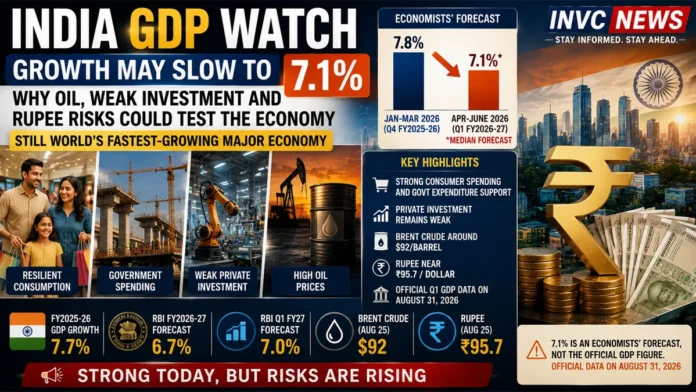
India GDP growth 2026 is likely to have slowed to around 7.1% in the April-June quarter, according to a survey of 58 economists, as resilient consumer demand and government spending helped offset softer private investment and growing pressure from expensive crude oil and a weaker rupee.
The projected expansion would represent a moderation from the 7.8% growth recorded in the January-March 2026 quarter, but would still leave India among the fastest-growing major economies in the world.
Importantly, the 7.1% figure is an economists’ forecast, not the official GDP estimate.
The Ministry of Statistics and Programme Implementation is scheduled to release India’s official GDP estimates for the first quarter of FY2026-27 on August 31, 2026.
Until then, the central question is not whether India’s economy has stopped growing strongly—it has not—but whether domestic demand can remain resilient as oil prices, currency weakness, inflation risks and subdued private investment begin to exert greater pressure.
India GDP Growth 2026: Key Numbers to Watch
| Indicator | Current Picture |
|---|---|
| Q1 FY2026-27 GDP forecast | 7.1% |
| Previous quarter GDP growth | 7.8% |
| FY2025-26 GDP growth | 7.7% |
| RBI FY2026-27 forecast | 6.7% |
| RBI Q1 FY27 forecast | 7.0% |
| RBI repo rate | 5.25% |
| Brent crude, August 25 | Around $92/barrel |
| Rupee | Around ₹95.7/$ |
| Official Q1 GDP release | August 31, 2026 |
Even if the 7.1% estimate proves accurate, the economy would still be expanding at a pace that many large economies currently cannot match.
The more important issue is what is driving that growth—and whether those drivers are sustainable.
Consumer Spending Is Keeping India’s Economy Moving
Household consumption remains one of the strongest supports for economic activity.
Changes to personal taxation introduced earlier have left more disposable income with parts of the middle class, while credit availability and continued urban demand have supported spending.
Consumption matters enormously because household spending accounts for more than half of India’s economy.
When consumers buy cars, smartphones, clothing, food, travel, housing services and other goods, the effect spreads across manufacturing, retail, logistics, banking and employment.
Official FY2025-26 data showed private final consumption expenditure growing 7.7% for the year.
That provides an important foundation entering the new financial year.
Also Read – : India GDP Growth Hits 7.7%, Highlighting Economic Resilience Amid Global Uncertainty
Government Spending Is Providing Another Cushion
Public expenditure is another important support.
Government spending on infrastructure can create demand directly through construction, roads, railways, energy and other capital projects.
It can also have a multiplier effect.
A large road project, for example, creates demand for steel, cement, equipment, logistics and labor.
Improved infrastructure can then increase private-sector productivity.
This is why economists closely watch government capital expenditure when private corporate investment appears hesitant.
Public spending can keep investment activity moving while companies decide whether economic conditions are strong enough to justify major new factories or capacity expansion.
Private Investment Is the Bigger Question
India’s long-term growth story cannot depend indefinitely on household consumption and government expenditure.
The private sector eventually needs to invest heavily.
Companies invest when they are confident future demand will justify new factories, machinery, technology and employees.
At the moment, private investment sentiment is more complicated.
Corporate balance sheets are generally healthier than during earlier investment cycles, and bank balance sheets are also stronger.
But businesses face considerable uncertainty involving:
- Global trade
- High energy prices
- Geopolitical conflict
- Currency weakness
- Financing costs
- Export demand
- Input-price volatility
That can make companies cautious about committing large amounts of capital.
The distinction matters because private capital expenditure tends to create durable productive capacity rather than merely supporting short-term demand.
India Is Still Attracting Foreign Investment
The investment picture is not uniformly weak.
India continues to attract foreign capital in strategic sectors including manufacturing, artificial intelligence, technology infrastructure and data centers.
Also Read – : India’s New FDI Rules Attract $511 Million as AI, Manufacturing and Data Centers Draw Investors
The bigger challenge is turning investment interest into sufficiently broad private-sector capital expenditure across the economy.
For GDP growth to remain near 7% over several years, India will need investment from domestic companies as well as foreign investors.
Oil Near $92 Is Becoming a Bigger Economic Risk
The biggest external threat may be crude oil.
Brent crude was trading around $92 per barrel on August 25, with continuing Middle East tensions keeping a geopolitical premium embedded in the market.
India is particularly sensitive to expensive crude because it imports the overwhelming majority of the oil it consumes.
When oil becomes more expensive, several pressures can appear simultaneously.
India’s import bill increases.
Oil companies need more dollars to purchase crude.
That can pressure the rupee.
Transportation and manufacturing costs can increase.
Inflation can rise.
Corporate margins can fall.
And household purchasing power can weaken.
That makes crude oil far more than an energy-market story.
It is a macroeconomic variable capable of influencing GDP, inflation, currencies, interest rates and the stock market at the same time.
Also Read – : Iran-America War and Petrol-Diesel Prices: What Brent Above $91 Could Mean for India
Why $100 Oil Would Be Much More Difficult for India
A brief move above $100 would not automatically derail economic growth.
The duration matters.
But if Brent remained above $100 for a sustained period, the pressure could spread through the economy.
Higher oil prices could mean:
- Larger import bills
- Wider current-account deficit
- Greater dollar demand
- Weaker rupee
- Higher transportation costs
- Rising business input costs
- Pressure on household inflation
- Reduced corporate margins
- Less room for RBI monetary easing
Businesses could then postpone investment while consumers become more cautious.
That combination would create a more significant growth challenge.
Rupee Near ₹96 Adds a Second Layer of Pressure
Oil becomes even more expensive when the rupee weakens simultaneously.
The Indian currency is currently trading around ₹95.7 against the U.S. dollar and has lost more than 6% this year.
A weaker rupee increases the local-currency price of dollar-denominated imports.
The impact goes beyond crude oil.
India also imports machinery, electronics, chemicals, fertilizers and other intermediate goods.
A weaker currency can therefore raise business costs even when international prices remain unchanged.
Also Read – : Indian Rupee Could Slide Toward 99 per Dollar by 2028—Could an Oil Shock Push It to 101?
Why RBI Intervention Matters
The Reserve Bank of India has been active in the currency market to limit excessive volatility.
That does not necessarily mean RBI is defending one specific exchange rate.
Central banks commonly intervene to prevent disorderly or destabilizing currency movements.
Recent foreign capital inflows are also providing some support.
Overseas investors have bought more than $2.5 billion of Indian equities during August, helping offset some of the pressure created by corporate dollar demand and expensive oil.
A relatively orderly rupee can help businesses plan costs more effectively.
A rapid currency decline would be much more damaging because it can intensify inflation expectations and financial-market uncertainty.
Inflation Could Determine What RBI Does Next
Growth is only half of RBI’s policy equation.
Inflation is the other half.
The RBI left its repo rate unchanged at 5.25% in August and raised its FY2026-27 GDP growth projection to 6.7%.
At the same time, policymakers have become increasingly alert to inflation risks from energy and other supply-side pressures.
If oil remains expensive and those costs spread across the wider economy, RBI could have less room to support growth through lower interest rates.
Recent MPC communication has instead raised the possibility that rates may eventually need to rise if inflation becomes more persistent.
That creates a delicate policy balance:
Strong growth argues for patience.
Higher inflation could require tighter monetary policy.
Also Read – : India Retail Inflation Rises to 3.93% as Food Prices Put Fresh Pressure on RBI
RBI Is Still Forecasting 6.7% Growth for FY27
Despite the risks, RBI remains relatively optimistic.
The central bank recently increased its full-year FY2026-27 GDP growth projection from 6.6% to 6.7%.
Its quarterly projections include:
Q1: 7.0%
Q2: 6.4%
Q3: 6.5%
Q4: 6.8%
The economists’ 7.1% median estimate for the April-June quarter is therefore slightly stronger than RBI’s own Q1 projection.
That distinction is important.
A decline from 7.8% to 7.1% might sound like a sharp slowdown in a headline, but a 7.1% result would actually exceed the central bank’s current first-quarter forecast.
Growth Could Moderate Further Later in the Year
Economists expect momentum to become somewhat softer after the June quarter.
The median outlook points toward approximately:
Q1 FY27: 7.1%
Q2 FY27: 6.6%
Q3 FY27: 6.5%
For the full financial year, economists expect growth to average approximately 6.7%.
That is broadly aligned with RBI.
The message therefore is not that India is heading toward a recession or severe slowdown.
Instead, the extraordinary pace of recent quarters may normalize toward the mid-to-high 6% range.
Exports Offer Some Support
Exports have also provided support to economic activity.
Stronger overseas demand can help manufacturing and services companies even when parts of domestic investment remain cautious.
India’s services exports in particular remain an important source of foreign-exchange earnings.
But exports are vulnerable to global conditions.
A slowdown in major economies, renewed tariffs or weaker international trade could quickly reduce that support.
The external sector therefore remains both an opportunity and a risk.
Corporate Earnings Suggest the Economy Is Not Weak
Another encouraging signal comes from corporate India.
Nifty 50 companies recorded average profit growth of approximately 18% in the June quarter, the strongest performance in 10 quarters.
That suggests many large companies are still benefiting from resilient demand, operating leverage and sector-specific growth.
However, expensive oil is already creating pressure in areas such as transportation, energy-intensive industries and consumer goods.
This is why the GDP story is becoming increasingly uneven.
Some parts of the economy remain very strong.
Others are beginning to feel the effect of higher costs.
A Weak Monsoon Could Become Another Risk
The monsoon adds another layer of uncertainty.
Rainfall has been below normal this season, creating potential risks for agriculture, rural demand and food prices.
Agriculture remains important not just because of its direct contribution to GDP but because millions of Indian households depend on rural income.
A poor harvest can reduce rural spending while simultaneously pushing food inflation higher.
That is particularly difficult for policymakers because weak rural demand can hurt growth even as higher food prices make monetary easing harder.
Why 7.1% Would Still Be a Strong Number
Context matters.
Most major developed economies would regard 7% growth as extraordinary.
India benefits from structural factors including:
- A large domestic consumer market
- A young workforce
- Infrastructure investment
- Expanding digital economy
- Manufacturing investment
- Credit growth
- Services exports
- Formalization of economic activity
These strengths provide substantial resilience against external shocks.
But maintaining very high growth becomes progressively harder as the economy grows larger.
That is why the quality of growth increasingly matters as much as the headline number.
What Would Be the Best GDP Outcome?
An ideal result would show more than a strong headline GDP number.
Economists will look closely at the underlying components.
Private Consumption
Strong household demand would indicate consumers remain confident.
Gross Fixed Capital Formation
A strong investment number would suggest private and public capital expenditure is expanding productive capacity.
Manufacturing
Manufacturing growth would provide evidence that industrial momentum remains healthy.
Services
India’s services sector remains a major engine of growth and employment.
Government Consumption
Strong government spending can support growth but excessive reliance on it could raise questions about private demand.
Exports
Stronger exports would provide another source of growth beyond domestic consumption.
August 31 Will Provide the Real Answer
The GDP debate currently revolves around forecasts.
That changes on August 31.
MoSPI will publish the official first-quarter FY2026-27 GDP estimates.
The release will show whether the economy actually expanded near 7.1% and, more importantly, which components drove that performance.
INVC NEWS should therefore treat this article as a GDP preview and macroeconomic explainer.
When the official figures are released, this same URL can be substantially updated with:
- Actual Q1 GDP growth
- Sector-wise GVA
- Consumption growth
- Government expenditure
- Gross fixed capital formation
- Manufacturing
- Agriculture
- Services
- Revised full-year outlook
India GDP Growth FAQ
What is India’s expected GDP growth for April-June 2026?
A survey of 58 economists points to median growth of around 7.1% year over year.
Is the 7.1% GDP figure official?
No. It is a forecast. Official Q1 FY2026-27 GDP data is scheduled for release on August 31, 2026.
How fast did India grow in the previous quarter?
Official MoSPI data showed 7.8% GDP growth in January-March 2026.
What was India’s FY2025-26 GDP growth?
India’s real GDP expanded 7.7% during FY2025-26.
What is RBI forecasting for FY2026-27?
RBI currently projects 6.7% real GDP growth for the full financial year.
Why could growth slow?
Key risks include subdued private investment, expensive crude oil, a weaker rupee, inflation pressure, geopolitical uncertainty and weaker rainfall.
Is India still the fastest-growing major economy?
Even with growth around 7%, India remains one of the world’s fastest-growing major economies.
Bottom Line
India GDP growth 2026 may have moderated to approximately 7.1% in the April-June quarter, but that would still represent an exceptionally strong expansion by global standards.
Consumer spending, government expenditure and exports appear to be providing significant support.
The bigger concerns lie elsewhere:
private investment, crude oil, the rupee, inflation and weather risks.
If oil remains near or above current levels while the rupee stays weak, businesses could face rising costs and households could experience renewed inflation pressure.
That could eventually make companies more cautious about investment and limit RBI’s room to support economic activity.
For now, however, India’s economy remains resilient.
The real test comes on August 31, when official GDP data will reveal whether growth is merely normalizing from an unusually strong quarter—or whether external pressure is beginning to leave a deeper mark on the world’s fastest-growing major economy.