WASHINGTON / TEHRAN | AUGUST 24, 2026
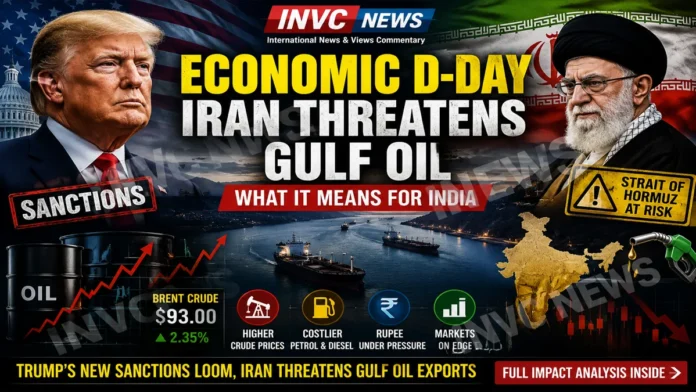
US Iran sanctions 2026 have become the biggest new flashpoint in the Middle East crisis as the Trump administration prepares what Treasury Secretary Scott Bessent has described as an “economic D-Day” against Tehran, while Iran threatens to disrupt Gulf oil exports if Washington’s financial pressure intensifies.
The confrontation has immediate implications far beyond the United States and Iran.
The Strait of Hormuz remains one of the world’s most important energy corridors, and any further disruption could affect crude oil prices, LPG supplies, shipping costs, inflation and financial markets across Asia.
For India, the risks are especially important because the country imports close to nine-tenths of the crude oil it consumes.
Brent crude was trading around $93 a barrel on Monday, while Indian markets opened cautiously and the rupee remained near 95.67 against the U.S. dollar.
However, one distinction is crucial: the full details of Washington’s new sanctions package had not yet been formally unveiled at the time of publication.
Bessent is expected to provide further details later Monday.
What Is Trump’s ‘Economic D-Day’ Against Iran?
The Trump administration is moving from heavy military pressure toward an intensified financial campaign designed to isolate Iran from international trade and finance.
Bessent has described the coming measures as the most extensive financial offensive Washington has mounted against an adversary.
The strategy is expected to target economic networks that continue providing Tehran with revenue or access to global markets.
Potential areas of pressure include:
- Iranian petroleum sales
- International banking transactions
- Shipping and transportation networks
- Oil-smuggling channels
- Financial intermediaries
- Companies facilitating sanctioned trade
- Businesses helping Iran obtain foreign currency
- Countries or entities maintaining prohibited economic links with Tehran
The precise scope of the next measures, however, will depend on the formal sanctions package.
Washington has already been tightening pressure on Iranian financial networks.
Earlier this month, the U.S. Treasury targeted networks that it said were helping Iran move hundreds of millions of dollars through clandestine financial channels.
The latest move appears designed to widen that pressure significantly.
Iran Threatens Gulf Oil Exports in Response
Tehran’s response has dramatically raised the stakes.
Iranian security chief Mohsen Rezaei has warned countries against participating in Washington’s economic pressure campaign and indicated that Iran could retaliate against regional economic interests.
Iranian officials have also threatened that Gulf oil exports could be stopped if what Tehran calls an economic war continues.
That threat matters because the Persian Gulf is home to some of the world’s largest oil and gas producers.
Saudi Arabia, the United Arab Emirates, Kuwait, Qatar, Iraq and other regional producers depend on maritime energy routes connected directly or indirectly to the Strait of Hormuz.
A serious interruption could therefore become a global energy shock rather than merely an Iranian oil problem.
Why the Strait of Hormuz Matters So Much
The Strait of Hormuz is a narrow waterway connecting the Persian Gulf with the Gulf of Oman and the Arabian Sea.
Before the current conflict sharply reduced normal traffic, roughly one-fifth of globally traded crude oil and LNG moved through the route.
That makes Hormuz one of the most strategically important shipping chokepoints in the global economy.
Traffic is already far below normal levels.
Recent vessel-tracking data showed only a limited number of commodity ships crossing the strait over the weekend, with activity dramatically lower than pre-conflict levels.
That means oil markets are not reacting merely to a theoretical threat.
Shipping through Hormuz is already operating under severe geopolitical and security pressure.
INVC has been tracking this escalation for weeks. Earlier, Iran condemned renewed U.S. oil sanctions as tensions around the Strait of Hormuz intensified.
The new financial offensive now risks taking that confrontation to another level.
US-Iran Diplomacy Has Failed to Produce a Breakthrough
The sanctions escalation follows the failure of Washington and Tehran to reach a broader political settlement.
A June framework created a 60-day window for negotiations over sanctions, Iran’s nuclear program, maritime security and other major disputes.
However, that deadline expired without a final agreement.
The United Nations subsequently urged both sides to restart negotiations, warning that diplomacy remained essential to preventing another escalation.
INVC recently explained how the US-Iran talks stalled after the 60-day deal deadline expired.
The failure of that diplomatic window is important because the latest economic confrontation did not emerge in isolation.
It follows months of disputes over sanctions, nuclear restrictions and control of maritime traffic through Hormuz.
Could the New Sanctions Target Iran’s Trading Partners?
That is one of the biggest questions surrounding Monday’s announcement.
The Trump administration has warned countries and businesses against maintaining economic lifelines to Tehran.
Secondary sanctions could potentially penalize foreign companies or financial institutions that conduct prohibited transactions with sanctioned Iranian entities.
China faces particularly intense scrutiny because it has remained the dominant destination for Iranian oil.
India’s exposure is different.
India-Iran bilateral trade has fallen sharply under previous U.S. sanctions and stood at about $1.63 billion in FY2025-26, with Indian exports accounting for most of the trade.
India therefore does not have the same Iranian oil exposure as China.
Nevertheless, New Delhi will closely examine the exact wording of any new secondary sanctions because they could affect banking, shipping, regional trade and companies dealing with Iranian entities.
Why India Has More to Worry About Than Direct Iran Trade
For India, the larger threat is not necessarily direct trade with Iran.
It is energy-market disruption.
India imports roughly 88% of its crude-oil requirements.
Therefore, a prolonged rise in international oil prices can increase the country’s import bill even when the crude itself comes from Russia, Iraq, Saudi Arabia, the United States or another supplier.
Oil is priced internationally in dollars.
That means India can face a double impact when:
crude prices rise + the rupee weakens.
This combination makes each imported barrel more expensive in rupee terms.
Brent Crude Around $93 Keeps India on Alert
Brent crude remained around the $93-per-barrel region Monday as traders awaited further information about U.S. sanctions.
Oil prices had eased modestly during Asian trading, but they remain substantially elevated because of the geopolitical risk surrounding Iran and Hormuz.
This is particularly important for Indian consumers.
INVC recently examined whether the Iran-America conflict could push petrol and diesel prices higher in India as Brent crude moved above $91.
The new sanctions confrontation adds another risk factor.
If Hormuz traffic deteriorates further and Brent moves toward or above $100 for an extended period, pressure on India’s energy system would increase.
Will Petrol and Diesel Prices Rise in India?
Not automatically.
A rise in crude oil does not immediately produce an identical increase in retail petrol and diesel prices.
Indian pump prices depend on several factors, including:
- International crude prices
- Refined fuel prices
- Rupee-dollar exchange rate
- Refining costs
- Freight expenses
- Dealer commissions
- Central taxes
- State VAT
- Oil-marketing company margins
Therefore, one or two volatile trading sessions do not necessarily mean an immediate nationwide fuel-price hike.
The duration of high crude prices matters more.
If Brent stays above $90 or moves toward $100 for a sustained period, pressure on oil-marketing companies and the wider economy could become much harder to absorb.
LPG Could Be an Even Bigger Concern
India’s exposure to Middle Eastern energy is not limited to crude oil.
LPG is another important vulnerability.
India sourced approximately 90% of its LPG imports from the Middle East in 2025, making disruption to Gulf shipping particularly significant for cooking-gas security.
India is already trying to diversify.
State-run refiners are looking at increased LPG supplies from countries including the United States and Algeria to reduce dependence on Middle Eastern routes.
That diversification has become more urgent because of continuing disruption around Hormuz.
Rupee Under Pressure From Expensive Oil
The Indian rupee was trading near 95.67 per dollar Monday, with elevated crude prices remaining an important source of pressure.
The Reserve Bank of India has been active in the foreign-exchange market, limiting excessive volatility.
However, oil prices remain one of the most important external risks for the currency.
Higher crude prices generally mean Indian refiners need more dollars to pay for imports.
That can increase demand for the U.S. currency and put additional pressure on the rupee.
A weaker rupee then makes imported energy even more expensive.
This feedback loop is one reason Indian policymakers monitor Gulf tensions so closely.
Sensex and Nifty Turn Cautious Ahead of Sanctions Details
Indian equities also showed caution Monday morning.
The Nifty 50 was around 24,286, while the Sensex traded near 77,692 in early dealings.
The moves were modest rather than panic-driven.
However, traders were closely watching Iran sanctions, crude prices, bond yields and the rupee.
For Indian markets, sustained high oil prices can create pressure on:
- Airlines
- Paint companies
- Tyre manufacturers
- Chemicals companies
- Logistics businesses
- Consumer companies
- Oil-marketing companies
At the same time, upstream energy producers and some refiners can experience very different effects depending on global prices and refining margins.
Therefore, the oil shock does not affect every stock in the same way.
India’s Trade Deficit Is Already Feeling Middle East Pressure
The geopolitical crisis is already showing up in India’s external trade numbers.
India’s merchandise trade deficit widened to a six-month high of $31.98 billion in July, with elevated crude prices and higher freight costs among the pressures affecting imports.
A fresh surge in oil prices could increase the import bill further.
That could also influence:
- Current-account calculations
- Inflation expectations
- Government subsidy costs
- Corporate transportation expenses
- Airline fares
- Logistics prices
The economic consequences can therefore move well beyond petrol pumps.
Russia Gives India an Important Energy Buffer
India has one major advantage compared with earlier oil shocks: a much more diversified crude-supply basket.
Russia has become one of India’s most important crude suppliers.
That relationship is especially relevant during instability in West Asia.
External Affairs Minister S. Jaishankar’s current Moscow visit has again placed energy security at the center of India-Russia economic ties.
INVC’s report on the Jaishankar Russia visit and India-Russia energy cooperation explains why alternative energy suppliers have become strategically important for New Delhi.
Russian supplies cannot completely insulate India from a global oil-price shock.
Even barrels purchased outside the Gulf are influenced by international benchmark prices.
However, diversification gives refiners greater flexibility when one major shipping corridor becomes unreliable.
What Happens if Iran Actually Disrupts Gulf Oil Exports?
A complete shutdown would represent an extreme scenario.
Iran has made strong threats, but a threat is not the same as a confirmed closure of Gulf oil exports.
Still, if maritime traffic were substantially reduced from already-depressed levels, several consequences could follow quickly.
Crude prices could rise sharply.
LPG and LNG markets could tighten.
Shipping insurance and freight costs could increase.
Asian refiners could compete more aggressively for alternative crude supplies.
Inflation expectations could rise.
Energy-importing currencies could face additional pressure.
Financial markets could become more volatile.
For India, the scale of the impact would depend heavily on how long the disruption lasted.
Could Brent Crude Cross $100 Again?
Yes, but it is not inevitable.
Brent could move toward $100 if:
- Iran significantly restricts Gulf oil movement
- New U.S. sanctions remove additional supply
- Shipping attacks increase
- Insurers withdraw coverage
- Gulf producers struggle to reroute exports
- Diplomatic negotiations collapse further
However, oil prices could also decline rapidly if tensions ease.
A diplomatic breakthrough, clearer shipping arrangements, increased production elsewhere or weaker global demand could remove part of the geopolitical risk premium.
Therefore, $100 oil should be treated as a risk scenario, not a guaranteed outcome.
Trump’s Sanctions Details Are the Next Big Trigger
The next major market-moving event is the formal unveiling of Washington’s measures.
Treasury Secretary Scott Bessent is expected to provide details later Monday.
Investors will watch closely for answers to several questions.
Will the United States impose broader secondary sanctions?
Which countries, banks, shipping companies or trading networks will be targeted?
Will Iranian oil buyers face new penalties?
How aggressively will Washington enforce restrictions against foreign businesses?
And perhaps most importantly, how will Tehran respond?
Those answers could determine the next move in crude oil, the rupee and global financial markets.
What Should Indian Consumers and Investors Watch Now?
Four indicators matter most.
1. Brent Crude Price
A sustained move toward $100 would increase pressure on India’s import bill.
2. Strait of Hormuz Shipping Traffic
Further reductions in tanker traffic would signal a worsening supply problem.
3. Rupee-Dollar Exchange Rate
A weaker rupee magnifies the cost of expensive crude.
4. US Sanctions Details
The actual scope of Washington’s economic measures will matter more than political rhetoric.
US Iran Sanctions 2026: The Bottom Line for India
The US Iran sanctions 2026 confrontation has reached a potentially decisive stage.
Washington is preparing an unusually aggressive financial campaign against Tehran, while Iran is threatening retaliation involving the Gulf’s energy lifeline.
For India, the central danger is not simply whether New Delhi trades directly with Iran.
The larger risks are higher crude prices, disrupted LPG supplies, an expensive import bill, rupee pressure, higher freight costs and renewed inflation concerns.
At the moment, there is no basis to say that petrol and diesel prices will definitely rise or that Gulf oil exports will completely stop.
But the risk level has clearly increased.
The most important development now will come later Monday, when Washington is expected to reveal the full details of its new sanctions offensive.
Until then, oil traders, governments and consumers across Asia will be watching the Strait of Hormuz very closely.