WASHINGTON, D.C., United States | August 24, 2026 —
The US Visa Bulletin September 2026 brings a striking mix of good and bad news for Indians waiting for permanent residence, with several family-sponsored green card categories advancing sharply while the employment-based EB-2 India category remains “Unavailable.”
The U.S. Department of State’s September Visa Bulletin shows major forward movement in India’s F1, F2B and F3 family-sponsored Final Action Dates compared with August.
For employment-based applicants, however, the picture is much tougher.
India’s EB-1 Final Action Date remains October 15, 2022, while EB-3 stays at January 1, 2014.
Most importantly, EB-2 India is marked “U,” or Unavailable, meaning immigrant visa numbers are not authorized for issuance in that category during September under the Final Action Dates chart.
India’s EB-5 Unreserved category is also unavailable.
For the large number of Indian professionals waiting years—or even decades—for employment-based green cards, the September bulletin therefore offers little immediate relief.
US Visa Bulletin September 2026: India at a Glance
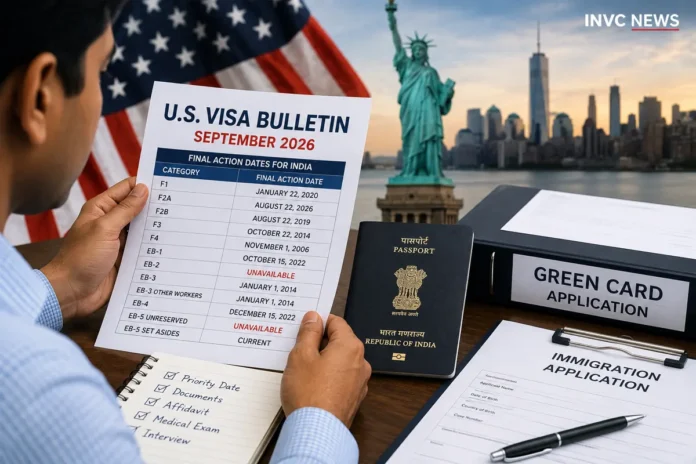
Here are the most important Final Action Dates for India in September:
| Category | September 2026 Final Action Date |
|---|---|
| F1 | January 22, 2020 |
| F2A | August 22, 2026 |
| F2B | August 22, 2019 |
| F3 | October 22, 2014 |
| F4 | November 1, 2006 |
| EB-1 | October 15, 2022 |
| EB-2 | Unavailable |
| EB-3 | January 1, 2014 |
| EB-3 Other Workers | January 1, 2014 |
| EB-4 | December 15, 2022 |
| EB-5 Unreserved | Unavailable |
| EB-5 Rural Set-Aside | Current |
| EB-5 High Unemployment Set-Aside | Current |
| EB-5 Infrastructure Set-Aside | Current |
The most dramatic movement is on the family-sponsored side.
Also Read: H-1B Visa Crackdown Proposed: Trump Allies Push 3-Year Ban Bill—What It Means for Indian Workers
Big Movement for Indian Family Green Card Applicants
Compared with the August bulletin, several family categories have advanced substantially.
F1 India
The F1 category applies to unmarried sons and daughters of U.S. citizens.
The Final Action Date moves from:
August: December 15, 2018
September: January 22, 2020
That is more than a year of forward movement.
For applicants whose priority dates fall within that newly opened window, the change could be highly significant.
F2A Moves Forward by One Month
F2A covers spouses and unmarried children under 21 of U.S. lawful permanent residents.
India’s Final Action Date advances from:
July 22, 2026 → August 22, 2026
The Dates for Filing chart for F2A remains Current, meaning there is no listed priority-date cutoff on that filing chart.
However, applicants seeking adjustment of status inside the United States should always check which chart USCIS authorizes for use in a particular month.
The Department of State bulletin itself notes that USCIS determines whether adjustment-of-status applicants may use the Dates for Filing chart instead of the Final Action Dates chart.
F2B India Makes a Major Jump
F2B applies to unmarried sons and daughters aged 21 or older of lawful permanent residents.
India’s Final Action Date advances from:
January 1, 2018 → August 22, 2019
That represents roughly 20 months of forward movement.
The September Date for Filing for India F2B also advances:
January 1, 2019 → September 1, 2019
That combination makes F2B one of the biggest positive stories in the September bulletin for Indian families.
F3 India Advances by More Than Two Years
F3 covers married sons and daughters of U.S. citizens.
This is arguably the biggest India family-category movement in the bulletin.
The Final Action Date moves from:
May 15, 2012 → October 22, 2014
That is an advance of more than two years and five months in a single bulletin.
The F3 Date for Filing also moves sharply:
March 1, 2013 → November 1, 2014
For families who have spent years tracking the Visa Bulletin month after month, this is substantial movement.
F4 India Does Not Move
The news is less encouraging for Indians waiting in the F4 category, which covers brothers and sisters of adult U.S. citizens.
India’s F4 Final Action Date remains:
November 1, 2006
The F4 Date for Filing also remains unchanged at:
December 15, 2006
The long F4 backlog therefore continues despite the significant movement seen in several other family categories.
What Does ‘EB-2 India Unavailable’ Actually Mean?
This is the most important clarification in the entire bulletin.
When the State Department marks a category “U,” it means Unavailable.
It does not mean:
- Your approved I-140 has been cancelled
- Your green card petition has been rejected
- Your priority date has disappeared
- Your H-1B status automatically changes
- You must restart the entire immigration process
Instead, it means that immigrant visa numbers are not authorized for issuance in that category under the September Final Action Dates chart.
The State Department explains that when an annual limit, category limit or applicable country limit is reached, a preference category may need to be made unavailable.
For Indian EB-2 applicants, that is exactly why September is such an important—and frustrating—bulletin.
Why Is India EB-2 Under So Much Pressure?
India has one of the world’s largest employment-based green card backlogs.
The U.S. immigration system imposes annual numerical limits on employment-based preference visas as well as country-based allocation restrictions.
The State Department says India is one of the oversubscribed chargeability areas.
Earlier in FY 2026, exceptionally strong demand and visa-number usage forced the Department to retrogress India’s employment-based categories.
The situation has now reached the point where EB-2 India is unavailable for September.
This matters particularly to Indian technology, engineering, healthcare, research and other highly skilled professionals who may have spent years working in the United States while waiting for their priority dates to become current.
EB-1 India Stays at October 15, 2022
The EB-1 category includes certain priority workers, including qualifying multinational executives and managers, outstanding professors and researchers, and individuals meeting extraordinary-ability requirements.
For India, the September Final Action Date remains:
October 15, 2022
There is no movement from August.
Interestingly, the EB-1 Date for Filing for India is December 1, 2023, which is considerably later than the Final Action Date.
That distinction matters.
A Date for Filing can determine when eligible applicants may potentially begin submitting documentation, while the Final Action Date determines when a visa number can actually become available for final approval.
EB-3 India Also Stays Frozen
The employment-based third preference category includes skilled workers and professionals.
India’s EB-3 Final Action Date remains:
January 1, 2014
The Date for Filing remains:
January 15, 2015
So there is no September movement for India EB-3 either.
For applicants comparing EB-2 and EB-3, the September bulletin is unusual because EB-3 continues to carry a published Final Action Date while EB-2 is unavailable.
However, immigration decisions such as changing employment-based categories or pursuing interfiling can involve complicated legal and case-specific considerations. Applicants should not make such decisions solely because of one month’s Visa Bulletin.
India EB-5 Unreserved Is Also Unavailable
The September bulletin marks India EB-5 Unreserved as unavailable.
However, all three EB-5 set-aside categories remain Current for India:
- Rural
- High unemployment
- Infrastructure
That distinction may be important for qualifying investors, although EB-5 eligibility and investment structures involve detailed legal and financial requirements.
Employment-Based Dates for Filing: Better Than Final Action Dates
One interesting point is that India’s employment-based Dates for Filing remain much more favorable than Final Action Dates in several categories.
| Category | India Date for Filing — September 2026 |
| EB-1 | December 1, 2023 |
| EB-2 | January 15, 2015 |
| EB-3 | January 15, 2015 |
| EB-3 Other Workers | January 15, 2015 |
| EB-4 | January 1, 2023 |
| EB-5 Unreserved | May 1, 2024 |
| EB-5 Set-Asides | Current |
But this does not automatically mean everyone with a priority date before these dates can file Form I-485.
USCIS separately announces which Visa Bulletin chart employment-based and family-sponsored adjustment applicants must use each month.
Applicants inside the United States should therefore check the official USCIS Visa Bulletin information page before filing.
Final Action Date vs Date for Filing: What Is the Difference?
This causes enormous confusion every month.
Final Action Date
This is generally the date that determines whether an immigrant visa number can be available for final approval.
If your priority date is earlier than the applicable Final Action Date, your case may be eligible for final action, subject to all other requirements.
Date for Filing
This is an earlier stage that can indicate when an applicant may submit documents or potentially file for adjustment of status when the relevant authorities permit use of that chart.
The two charts should never be treated as interchangeable.
What Is a Green Card Priority Date?
Your priority date essentially represents your place in the immigrant visa queue.
For employment-based cases, it is generally connected to the filing of the qualifying labor certification or immigrant petition, depending on category.
For family-sponsored immigration, the priority date is generally tied to when the immigrant petition was properly filed.
Suppose an Indian EB-3 applicant has a priority date of December 1, 2013.
Because the September EB-3 India Final Action Date is January 1, 2014, that priority date is earlier than the listed cutoff and could therefore fall within the Final Action Date window, assuming all other requirements are satisfied.
By contrast, an EB-3 India priority date of February 2014 would remain beyond the September cutoff.
Why Did Family Dates Move So Much in September?
The State Department provides an important clue.
It says immigrant visa issuance rates for applicants from some countries have fallen because of various administration actions relating to national security, public safety and visa processing.
As a result, the government has advanced Final Action Dates and Dates for Filing across several immigrant categories in recent months to make available visa numbers usable elsewhere during FY 2026.
But there is an important warning.
The Department says retrogression could again become necessary as additional demand appears.
That means September’s large family-sponsored movement should not be interpreted as a guarantee that every category will continue advancing at the same pace.
Why October 2026 Will Be Crucial for India EB-2
September is the final month of the U.S. government’s 2026 fiscal year for immigration visa-number allocation.
The new fiscal year begins on October 1, 2026.
That makes the October Visa Bulletin particularly important for Indian employment-based applicants.
A new fiscal year brings a new annual allocation of employment-based immigrant visa numbers.
However, applicants should not assume that EB-2 India will automatically return with a dramatically favorable cutoff date.
The State Department sets dates according to available numbers and expected demand.
October could therefore bring reopening, movement, limited movement or another restrictive cutoff depending on visa-number availability and demand.
Does This Affect H-1B Visa Holders?
The Visa Bulletin primarily concerns the availability of immigrant visas and employment- or family-based green cards.
It does not, by itself, cancel a person’s H-1B visa or other nonimmigrant status.
However, the employment-based backlog is extremely relevant to H-1B professionals because many Indian workers rely on H-1B status while waiting for their employment-based permanent residence process to progress.
That is why changes in EB-1, EB-2 and EB-3 dates attract substantial interest among Indian professionals in the United States.
What Indian Applicants Should Do Now
Applicants should first identify:
- Their correct immigration category
- Their country of chargeability
- Their priority date
- The applicable Final Action Date
- The applicable Date for Filing
- Which chart USCIS authorizes for adjustment-of-status filing that month
They should then monitor both the Department of State Visa Bulletin and USCIS instructions.
Applicants with complicated cases—including job changes, category changes, dependent-age concerns or status issues—may need individualized advice from a qualified U.S. immigration professional.
September 2026 Visa Bulletin: Good News or Bad News for India?
It depends entirely on the category.
For family-sponsored applicants, September is one of the more encouraging bulletins in recent months.
F1, F2B and especially F3 show substantial forward movement.
For employment-based Indian applicants, however, the picture is far more difficult.
EB-1 does not move.
EB-3 does not move.
EB-2 is unavailable.
EB-5 Unreserved is also unavailable.
That makes September a sharply divided bulletin: real progress for many Indian families, but continued frustration for employment-based green card applicants.
The Bottom Line
The US Visa Bulletin September 2026 delivers some of the strongest recent movement for Indian family-sponsored immigration categories.
India’s F1 Final Action Date advances to January 22, 2020, F2B moves to August 22, 2019, and F3 makes an especially large jump to October 22, 2014.
But the employment-based story is dramatically different.
EB-1 India remains at October 15, 2022. EB-3 stays at January 1, 2014. EB-2 India is Unavailable.
For thousands of Indian professionals waiting in the employment-based green card queue, attention will now turn quickly to the October 2026 Visa Bulletin, the first bulletin of the new U.S. fiscal year.
Until then, applicants should rely on official Department of State and USCIS information rather than treating social-media claims about green card dates as confirmed guidance.
Official U.S. Visa Bulletin: https://travel.state.gov/content/travel/en/legal/visa-law0/visa-bulletin/2026/visa-bulletin-for-september-2026.html
This article provides general informational coverage and is not individualized U.S. immigration or legal advice.