NEW DELHI, India | August 24, 2026 —
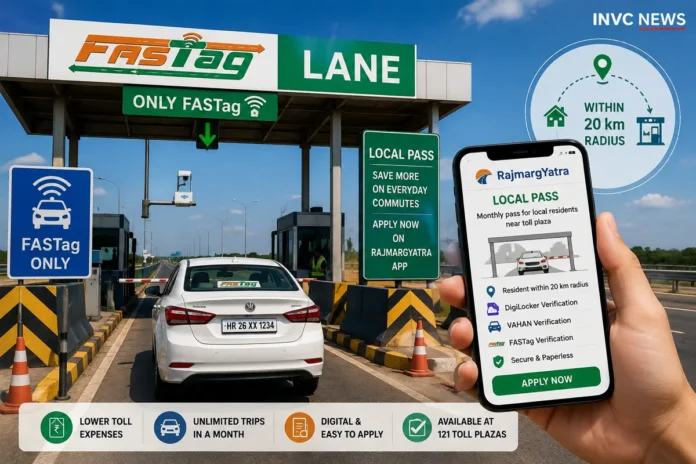
The FASTag Local Pass has been expanded to 121 toll plazas across India, potentially cutting a major recurring travel expense for eligible residents who cross the same National Highway toll plaza repeatedly.
The National Highways Authority of India has digitized the monthly Local Pass process through the RajmargYatra mobile app, eliminating the need for eligible commuters to repeatedly visit a toll plaza with physical documents.
The most important eligibility rule is straightforward:
Residents living within a 20 km radius of an eligible toll plaza may apply for the FASTag Local Pass, subject to applicable conditions.
Once approved, the monthly pass allows eligible commuters to make unlimited trips through that specific toll plaza during the applicable month.
For someone who crosses the same toll booth twice every working day, the potential savings can be substantial.
FASTag Local Pass Expanded to 121 Toll Plazas
NHAI formally announced the nationwide expansion after first introducing its Digital Local Pass facility at the Mundka-Bakkarwala Toll Plaza on Delhi’s Urban Extension Road-II in July 2026.
After the initial rollout, the online facility has now been extended to 121 toll plazas across the country.
NHAI says more toll plazas are expected to be added in the coming months.
The biggest change is not the existence of local toll concessions themselves.
Local passes have existed under applicable toll rules for eligible residents.
What has changed is the way commuters can obtain them.
Instead of visiting the toll plaza office, submitting address documents and waiting for manual verification, eligible users can now complete much of the process digitally.
Also Read: India to Remove Toll Plazas by 2026? What Nitin Gadkari Said About the GPS-Based Toll System
Who Is Eligible for the FASTag Local Pass?
The key eligibility condition is residence.
NHAI says a resident whose registered address falls within a 20 km radius of an eligible toll plaza can apply through the RajmargYatra app.
But simply telling the app that you live nearby is not enough.
The new digital system verifies information electronically.
The process uses consent-based integration with government databases including:
- DigiLocker
- VAHAN
- FASTag-related information
- GIS-based location verification
These systems can be used to check:
- Residential address
- Vehicle details
- FASTag linkage
- Whether the registered address actually falls within the prescribed 20 km radius
This is intended to reduce fake claims and remove much of the manual paperwork that previously made local-pass applications inconvenient.
Does the 20 Km Rule Mean 20 Km by Road?
NHAI says eligibility is established using GIS-based verification to determine whether the registered address falls within the prescribed 20 km radius of the eligible toll plaza.
That means applicants should not assume that a Google Maps driving route of less than 20 km automatically guarantees approval.
The digital system will determine eligibility using the address and geographical verification.
If your home is close to the boundary, the result displayed through the official process should be treated as authoritative.
How to Apply for FASTag Local Pass Online
Eligible commuters can use the RajmargYatra mobile app.
The general process is expected to work like this:
- Open or download the official RajmargYatra app.
- Select the Local Pass facility.
- Choose the relevant eligible toll plaza.
- Provide consent for digital verification.
- Allow required details to be retrieved through DigiLocker and VAHAN where applicable.
- Verify vehicle and FASTag details.
- Allow GIS-based address verification.
- Confirm the applicable local-pass fee.
- Make the required payment.
- Wait for activation/confirmation.
Users can also check whether their toll plaza is covered through the official NHAI Local Pass page:
https://rajmargyatra.nhai.gov.in/buy-fastag-local-pass
Using the official app and website is important because fake FASTag payment and recharge links can be used for phishing.
How Much Does the FASTag Local Pass Cost?
This is where commuters need to be careful.
NHAI’s August 18 announcement confirms the monthly Local Pass facility, but it does not announce one single universal price applicable to every one of the 121 toll plazas.
The applicable amount can depend on the fee rules and notification governing the particular toll plaza.
Current FY 2026-27 toll schedules available for different plazas show local non-commercial vehicle monthly-pass charges in the region of ₹350 to ₹360 at several locations.
However, users should not assume that ₹350 or ₹360 automatically applies to every toll plaza.
The safest approach is to select your eligible plaza in the RajmargYatra system and check the exact amount displayed before payment.
How Much Can a Daily Commuter Save?
This is where the Local Pass can become extremely attractive.
Consider an illustrative example.
Suppose a commuter crosses the same toll plaza going to work and returning home.
If that plaza effectively costs around ₹150 per daily return journey, then over 22 working days:
₹150 × 22 = ₹3,300 per month
If that commuter qualifies for a Local Pass priced around ₹350-₹360, the difference could be approximately:
₹2,940-₹2,950 per month
That would be a very large reduction in toll spending.
But this is only an illustration.
Actual savings depend on:
- The toll rate at your plaza
- How often you cross
- Whether you already use another concession
- The local-pass rate applicable to that plaza
- Your vehicle category and eligibility
A commuter crossing only a few times each month may save much less.
Someone crossing twice every weekday could save considerably more.
Who Could Benefit the Most?
The Digital Local Pass could be especially useful for people who live near National Highways but need to cross a toll plaza regularly for ordinary daily activities.
That could include:
- Office commuters
- Teachers
- Doctors and healthcare workers
- Small business owners
- College staff
- Local professionals
- Residents traveling repeatedly to a nearby city
- Families whose daily route passes through the same toll plaza
For these users, normal per-trip toll payments can become a significant monthly expense.
The local pass converts that unpredictable recurring expense into a monthly concession for eligible users.
Also Read: Toll Tax Hike: How Higher NHAI Toll Rates Can Increase Highway Travel Costs
Is the FASTag Local Pass Valid at Every Toll Plaza?
No.
This is one of the most important distinctions.
The local pass is tied to the respective eligible toll plaza.
It is not a nationwide unlimited toll pass.
If you receive a local pass for the toll plaza near your residence, that does not mean you can travel free through every NHAI toll plaza in India.
This makes it very different from the FASTag Annual Pass.
FASTag Local Pass vs FASTag Annual Pass
The two schemes solve different problems.
FASTag Local Pass
Designed primarily for eligible residents living within approximately 20 km of a specific eligible toll plaza.
Key features:
- Monthly validity
- Linked to a particular toll plaza
- Unlimited journeys through that plaza during the applicable month
- 20 km residential eligibility requirement
- Available digitally at 121 plazas currently
FASTag Annual Pass
Designed for eligible non-commercial cars, jeeps and vans using National Highways and National Expressways more broadly.
For FY 2026-27, the annual pass costs ₹3,075.
It provides:
One year of validity OR 200 toll-plaza crossings, whichever comes first.
The Annual Pass therefore has a completely different use case.
For someone who lives beside one toll plaza and crosses it every day, the Local Pass could be more relevant.
For someone who regularly travels across many National Highway toll plazas, the Annual Pass may deserve consideration.
Could the Local Pass Be Better Than the ₹3,075 Annual Pass?
For some commuters, yes.
Imagine someone living within 20 km of one eligible toll booth and crossing that exact plaza hundreds of times throughout the year.
A monthly Local Pass with unlimited journeys through that plaza could fit that travel pattern much better.
The Annual Pass, by comparison, stops after 200 eligible crossings or one year, whichever occurs first.
But the comparison is not simply about which number is cheaper.
It depends on how you travel.
Local Pass may suit you if:
You repeatedly cross one nearby eligible toll plaza.
Annual Pass may suit you if:
You drive across multiple National Highway or National Expressway fee plazas throughout the year.
Commuters should therefore calculate their own travel pattern rather than automatically choosing the pass with the lower headline price.
Why NHAI Is Digitizing Local Toll Passes
The expansion forms part of a broader shift toward digital highway tolling.
The existing manual process required commuters to establish that they lived within the eligibility radius and submit documents at the toll plaza.
NHAI says the digital system can reduce:
- Physical paperwork
- Manual verification
- Repeated toll-plaza visits
- Processing delays
- Scope for inconsistent eligibility decisions
Government database integration also allows information to be checked more systematically.
The broader goal is to make National Highway travel increasingly automated and less dependent on cash or manual toll-booth processes.
FASTag and India’s Toll System Are Changing Rapidly
India’s tolling system is undergoing several changes at the same time.
FASTag already dominates electronic toll collection.
The government has also introduced the FASTag Annual Pass, while work continues on more advanced tolling systems intended to reduce or eventually eliminate traditional toll-booth stoppages.
That means motorists could increasingly move from:
Cash toll → FASTag → subscription-style passes → barrier-free/distance-linked digital tolling
over time.
The new Local Pass is another part of that transition.
Also Read: Tata Motors Price Hike: Cars and SUVs to Cost Up to ₹25,000 More From September 1
What If Your Toll Plaza Is Not Among the 121?
Do not assume the facility will never reach your area.
NHAI has said the Digital Local Pass will be rolled out to more toll plazas in the coming months.
Users should periodically check the official eligibility list.
A plaza that is not digitally supported today could be added later.
What If the App Says You Are Not Eligible?
Possible reasons could include:
- Registered address is beyond the 20 km radius
- Vehicle information does not match
- FASTag is not properly linked
- Address details need updating
- The toll plaza is not yet covered
- Digital records do not match the applicant information
Do not submit false information simply to obtain the concession.
The entire purpose of DigiLocker, VAHAN and GIS integration is to make eligibility verification more accurate.
If you believe the rejection is incorrect, use official NHAI support channels or the RajmargYatra grievance mechanism.
The National Highway emergency and road-user helpline is 1033.
FASTag Local Pass: What Commuters Should Do Now
Regular commuters should take four simple steps.
First, check whether the toll plaza you cross every day is among the currently eligible plazas.
Second, determine whether your registered residential address falls within the required 20 km radius.
Third, calculate what you currently spend on tolls each month.
Finally, compare that amount with the Local Pass price displayed for your specific plaza.
For someone spending thousands of rupees every month crossing one toll booth, this small check could potentially result in substantial annual savings.
The Bottom Line
The FASTag Local Pass is now available digitally at 121 toll plazas across India, giving eligible nearby residents a much easier way to obtain monthly toll concessions.
Residents living within a 20 km radius of an eligible toll plaza can apply through the RajmargYatra app, with DigiLocker, VAHAN and GIS-based systems helping verify the applicant’s address, vehicle and FASTag information.
The pass offers unlimited journeys through the respective toll plaza during the month, subject to applicable conditions.
For regular commuters, the financial impact could be significant.
A driver spending ₹3,000 or more every month at the same toll booth could potentially save thousands of rupees if eligible for a local monthly pass.
But users should check the exact local-pass fee displayed for their specific plaza, rather than assuming one standard ₹350 or ₹360 rate applies everywhere.
For residents living near National Highways, this is one government digital service worth checking before the next FASTag deduction.