
New Delhi, India | August 22, 2026 —
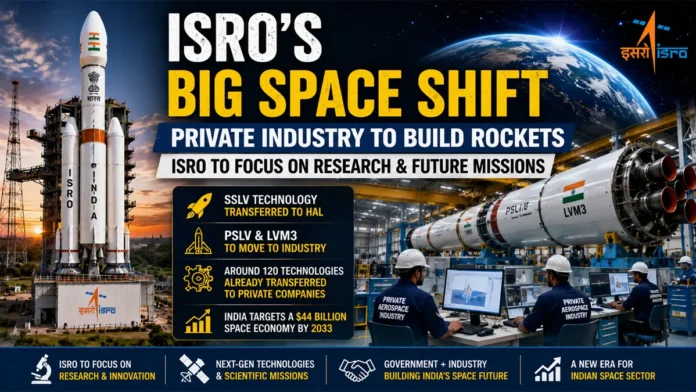
ISRO private sector reforms are entering a transformative phase as India’s national space agency prepares to progressively move routine launch vehicle and satellite production to industry, allowing its scientists and engineers to concentrate more heavily on research, advanced technologies and ambitious scientific missions.
IN-SPACe Chairman Pawan Goenka has outlined the changing model, saying launch vehicle manufacturing will increasingly be handled by private companies or industry while ISRO assumes a more research-and-development-focused role.
The transition is already underway.
Technology and production rights for India’s Small Satellite Launch Vehicle, or SSLV, have been transferred to Hindustan Aeronautics Limited, while plans are progressing to move other established launch vehicles toward industry-led production.
The shift could fundamentally reshape India’s space ecosystem by separating cutting-edge government research from routine commercial manufacturing.
ISRO to Move Away From Routine Launch Vehicle Manufacturing
For decades, ISRO has been at the center of virtually every major component of India’s space program — from developing rockets and satellites to launching spacecraft and conducting scientific missions.
That model is now changing.
Under the emerging structure, mature technologies developed by ISRO can eventually be transferred to industry for production and commercial operation.
ISRO would then devote more resources to developing the next generation of technologies rather than repeatedly manufacturing mature systems.
Goenka said the agency’s future role will increasingly resemble that of a high-end research and development organization.
That represents one of the most consequential structural changes in India’s space program since private participation was substantially opened up in 2020.
SSLV Technology Already Transferred to HAL
The transition is not merely a future proposal.
The Small Satellite Launch Vehicle program has already moved significantly toward industry.
SSLV technology and production rights were transferred to Hindustan Aeronautics Limited following a competitive process.
SSLV was designed to provide relatively low-cost, flexible access to space for smaller payloads and potentially address growing global demand for small-satellite launches.
Moving its production to industry provides a model for how mature ISRO-developed launch technologies could eventually operate commercially outside the agency’s traditional manufacturing structure.
PSLV and LVM3 Could Follow
The next stage could be considerably bigger.
India’s Polar Satellite Launch Vehicle (PSLV) and Launch Vehicle Mark-3 (LVM3) are also expected to move progressively toward industry participation.
PSLV has been one of India’s most successful and internationally recognized launch vehicles.
LVM3, meanwhile, is India’s most powerful operational rocket and plays an important role in heavier satellite launches and India’s human-spaceflight ambitions.
Transferring greater production responsibility for established launch vehicles would allow private industry to build manufacturing capacity while freeing ISRO’s technical resources for future systems.
Around 120 ISRO Technologies Transferred to Industry
Technology transfer is becoming another major pillar of the transformation.
Goenka said approximately 120 technologies developed by ISRO have already been transferred to private industry.
Such transfers can help companies develop indigenous capabilities without recreating decades of government-funded research from scratch.
They can also allow technologies originally developed for India’s national space program to generate commercial opportunities.
This public-private model could eventually create a much broader supply chain involving aerospace manufacturers, electronics companies, materials specialists, software firms and space startups.
Private Space Sector Gains Momentum
India’s private space ecosystem has already moved well beyond its early startup phase.
Private companies are developing rockets, satellites, propulsion systems, Earth-observation platforms and space-based services.
The successful orbital flight of privately developed Vikram-1 in July 2026 represented an important milestone for the sector, demonstrating that an Indian private company could develop and launch an orbital-class rocket.
That achievement also illustrated how the emerging system can work.
Government infrastructure and accumulated ISRO expertise can support private innovation, while commercial companies develop launch capabilities designed for global customers.
ISRO Can Focus on Science and Future Technologies
The biggest potential benefit is specialization.
Manufacturing established rockets repeatedly consumes engineering resources, facilities and organizational attention.
If industry can reliably handle mature production systems, ISRO can redirect greater capacity toward projects where government-backed scientific research remains indispensable.
That could include advanced propulsion, new-generation launch systems, human spaceflight technologies, deep-space exploration, planetary science, sophisticated satellites and large research infrastructure.
ISRO would continue developing technologies.
The difference is that once those technologies mature, industry could increasingly take responsibility for scaling and commercializing them.
New Launch Center Could Also Move to Private Operations
India’s changing space model may extend beyond rockets and satellites.
Goenka has indicated that operations of a new launch center could also eventually be handed to private industry, with an operator potentially selected within the coming months.
That would represent another important step toward creating an end-to-end commercial space ecosystem.
Private companies would then be capable not merely of supplying components but potentially manufacturing rockets, operating launch infrastructure and providing commercial missions.
India Targets a $44 Billion Space Economy
The transformation has a major economic objective.
India wants to expand its space economy substantially by 2033, with a target of approximately $44 billion.
Reaching that scale will require much more than government missions.
Indian companies will need to compete internationally across launch services, satellite manufacturing, space applications, Earth-observation data, communications, ground systems and other commercial services.
A larger private-sector role could also attract investment and create specialized high-technology employment.
Government Could Become an Anchor Customer
One challenge for emerging space companies is demand.
Developing rockets, satellites and advanced space systems requires significant capital, while commercial revenues can take years to materialize.
Government procurement can therefore play an important role in building a sustainable domestic industry.
Goenka has emphasized the importance of government acting as an anchor customer while private companies simultaneously pursue commercial and international markets.
Such a model has parallels in other major space economies where government missions helped private companies establish technological capability before expanding globally.
Why This Is a Major Change for India’s Space Program
The importance of the transition extends beyond privatization.
It represents a fundamental change in how India divides responsibility for its space ambitions.
Instead of ISRO designing, developing, manufacturing and operating virtually everything itself, the emerging model creates distinct roles.
ISRO can concentrate on frontier science and technology.
Private companies can industrialize mature technologies and pursue commercial markets.
IN-SPACe can regulate and facilitate private activity, while NewSpace India Limited can support commercialization of space capabilities.
If implemented successfully, the system could allow India to pursue more ambitious scientific missions while simultaneously building a competitive commercial space industry.
From Government-Led Space Program to National Space Ecosystem
India’s space achievements were historically driven overwhelmingly by ISRO.
That legacy remains central to the country’s future ambitions.
However, the next phase is increasingly about converting decades of ISRO expertise into a broader national ecosystem capable of supporting both science and commercial growth.
The transition will depend heavily on execution.
Private manufacturers will need to demonstrate reliability, cost efficiency and the ability to meet demanding aerospace quality standards.
ISRO, meanwhile, will need to ensure that technology transfers do not compromise mission reliability while continuing to develop systems that push India’s capabilities forward.
If that balance succeeds, ISRO private sector reforms could ultimately produce two parallel engines of growth: a research-focused national space agency pursuing ambitious scientific missions and a commercially competitive Indian space industry serving domestic and global customers.











Comments are closed.